
Exam 8: Applications of Trigonometry

arrow
  • Select Tags
search iconSearch Question
flashcardsStudy Flashcards
  • Select Tags

Find the two square roots of Find the two square roots of

(Multiple Choice)
4.7/5
(91)

A cathedral is located on a hill, as shown in the figure. When the top of the spire is viewed from the base of the hill, the angle of elevation is A cathedral is located on a hill, as shown in the figure. When the top of the spire is viewed from the base of the hill, the angle of elevation is   . When it is viewed at a distance of   feet from the base of the hill, the angle of elevation is   . The hill rises at an angle of   .   Approximate the height of the cathedral. . When it is viewed at a distance of A cathedral is located on a hill, as shown in the figure. When the top of the spire is viewed from the base of the hill, the angle of elevation is   . When it is viewed at a distance of   feet from the base of the hill, the angle of elevation is   . The hill rises at an angle of   .   Approximate the height of the cathedral. feet from the base of the hill, the angle of elevation is A cathedral is located on a hill, as shown in the figure. When the top of the spire is viewed from the base of the hill, the angle of elevation is   . When it is viewed at a distance of   feet from the base of the hill, the angle of elevation is   . The hill rises at an angle of   .   Approximate the height of the cathedral. . The hill rises at an angle of A cathedral is located on a hill, as shown in the figure. When the top of the spire is viewed from the base of the hill, the angle of elevation is   . When it is viewed at a distance of   feet from the base of the hill, the angle of elevation is   . The hill rises at an angle of   .   Approximate the height of the cathedral. . A cathedral is located on a hill, as shown in the figure. When the top of the spire is viewed from the base of the hill, the angle of elevation is   . When it is viewed at a distance of   feet from the base of the hill, the angle of elevation is   . The hill rises at an angle of   .   Approximate the height of the cathedral. Approximate the height of the cathedral.

(Multiple Choice)
4.8/5
(74)

Find (a) the dot product of the two vectors and (b) the angle between the two vectors. Find (a) the dot product of the two vectors and (b) the angle between the two vectors.   and  and Find (a) the dot product of the two vectors and (b) the angle between the two vectors.   and

(Multiple Choice)
4.8/5
(78)

Solve Solve    Solve

(Multiple Choice)
4.9/5
(85)

If c represents a constant force, find the work done if the point of application of c moves along the line segment from P to Q. If c represents a constant force, find the work done if the point of application of c moves along the line segment from P to Q.   and  and If c represents a constant force, find the work done if the point of application of c moves along the line segment from P to Q.   and

(Multiple Choice)
4.8/5
(83)

Find || a ||. a = - < 2, - 5 >

(Multiple Choice)
4.9/5
(79)

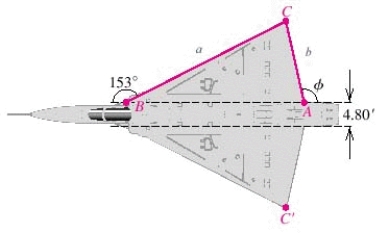
Shown in the figure is a plan for the top of a wing of a jet fighter, where Shown in the figure is a plan for the top of a wing of a jet fighter, where   feet and   feet.   Approximate the area of triangle ABC. feet and Shown in the figure is a plan for the top of a wing of a jet fighter, where   feet and   feet.   Approximate the area of triangle ABC. feet. Shown in the figure is a plan for the top of a wing of a jet fighter, where   feet and   feet.   Approximate the area of triangle ABC. Approximate the area of triangle ABC.
(Multiple Choice)
4.9/5
(92)

Use De Moivre's theorem to change the given complex number to the form Use De Moivre's theorem to change the given complex number to the form   , where   and   are real numbers.  , where Use De Moivre's theorem to change the given complex number to the form   , where   and   are real numbers.  and Use De Moivre's theorem to change the given complex number to the form   , where   and   are real numbers.  are real numbers. Use De Moivre's theorem to change the given complex number to the form   , where   and   are real numbers.

(Multiple Choice)
4.9/5
(70)

Vectors are used in computer graphics to calculate the length of shadows over flat surfaces. An object represented by a vector a is held over a flat surface inclined at an angle Vectors are used in computer graphics to calculate the length of shadows over flat surfaces. An object represented by a vector a is held over a flat surface inclined at an angle   , as shown in the figure.   If a light is shining directly downward, approximate the length of the shadow to two decimal places for the specified values of the vector   . , as shown in the figure. Vectors are used in computer graphics to calculate the length of shadows over flat surfaces. An object represented by a vector a is held over a flat surface inclined at an angle   , as shown in the figure.   If a light is shining directly downward, approximate the length of the shadow to two decimal places for the specified values of the vector   . If a light is shining directly downward, approximate the length of the shadow to two decimal places for the specified values of the vector Vectors are used in computer graphics to calculate the length of shadows over flat surfaces. An object represented by a vector a is held over a flat surface inclined at an angle   , as shown in the figure.   If a light is shining directly downward, approximate the length of the shadow to two decimal places for the specified values of the vector   . .

(Multiple Choice)
4.8/5
(80)

Represent the complex number geometrically. Represent the complex number geometrically.

(Multiple Choice)
4.9/5
(75)

Find (a) the dot product of the two vectors and (b) the angle between the two vectors. Find (a) the dot product of the two vectors and (b) the angle between the two vectors.   and  and Find (a) the dot product of the two vectors and (b) the angle between the two vectors.   and

(Multiple Choice)
4.8/5
(80)

Find the absolute value. Find the absolute value.

(Multiple Choice)
4.8/5
(82)

Find the four fourth roots of Find the four fourth roots of   . .

(Multiple Choice)
4.8/5
(72)

Solve Solve    Solve

(Multiple Choice)
4.8/5
(79)

Find (a) the dot product of the two vectors and (b) the angle between the two vectors. Find (a) the dot product of the two vectors and (b) the angle between the two vectors.   and  and Find (a) the dot product of the two vectors and (b) the angle between the two vectors.   and

(Multiple Choice)
4.8/5
(68)

Find (a) the dot product of the two vectors and (b) the angle between the two vectors. Find (a) the dot product of the two vectors and (b) the angle between the two vectors.   and  and Find (a) the dot product of the two vectors and (b) the angle between the two vectors.   and

(Multiple Choice)
4.9/5
(81)

A cathedral is located on a hill, as shown in the figure. When the top of the spire is viewed from the base of the hill, the angle of elevation is A cathedral is located on a hill, as shown in the figure. When the top of the spire is viewed from the base of the hill, the angle of elevation is   . When it is viewed at a distance of   feet from the base of the hill, the angle of elevation is   . The hill rises at an angle of   .   Approximate the height of the cathedral. . When it is viewed at a distance of A cathedral is located on a hill, as shown in the figure. When the top of the spire is viewed from the base of the hill, the angle of elevation is   . When it is viewed at a distance of   feet from the base of the hill, the angle of elevation is   . The hill rises at an angle of   .   Approximate the height of the cathedral. feet from the base of the hill, the angle of elevation is A cathedral is located on a hill, as shown in the figure. When the top of the spire is viewed from the base of the hill, the angle of elevation is   . When it is viewed at a distance of   feet from the base of the hill, the angle of elevation is   . The hill rises at an angle of   .   Approximate the height of the cathedral. . The hill rises at an angle of A cathedral is located on a hill, as shown in the figure. When the top of the spire is viewed from the base of the hill, the angle of elevation is   . When it is viewed at a distance of   feet from the base of the hill, the angle of elevation is   . The hill rises at an angle of   .   Approximate the height of the cathedral. . A cathedral is located on a hill, as shown in the figure. When the top of the spire is viewed from the base of the hill, the angle of elevation is   . When it is viewed at a distance of   feet from the base of the hill, the angle of elevation is   . The hill rises at an angle of   .   Approximate the height of the cathedral. Approximate the height of the cathedral.

(Multiple Choice)
4.9/5
(78)

Solve Solve    Solve

(Multiple Choice)
4.9/5
(76)

The magnitudes and directions of two forces acting at a point P are given in (a) and (b). Approximate the magnitude and direction of the resultant vector. Round the answer to the nearest integer. The magnitudes and directions of two forces acting at a point P are given in (a) and (b). Approximate the magnitude and direction of the resultant vector. Round the answer to the nearest integer.

(Multiple Choice)
4.8/5
(72)

Use De Moivre's theorem to change the given complex number to the form Use De Moivre's theorem to change the given complex number to the form   , where   and   are real numbers.  , where Use De Moivre's theorem to change the given complex number to the form   , where   and   are real numbers.  and Use De Moivre's theorem to change the given complex number to the form   , where   and   are real numbers.  are real numbers. Use De Moivre's theorem to change the given complex number to the form   , where   and   are real numbers.

(Multiple Choice)
4.9/5
(70)
Showing 41 - 60 of 144
close modal

Filters

  • Essay(0)
  • Multiple Choice(0)
  • Short Answer(0)
  • True False(0)
  • Matching(0)


