



 Chat with AI
Exam 8: Applications of Trigonometry

Exam 1: Fundamental Concepts of Algebra150 Questions
Exam 2: Equations and Inequalities142 Questions
Exam 3: Functions and Graphs147 Questions
Exam 4: Polynomial and Rational Functions147 Questions
Exam 5: Inverse, Exponential, and Logarithmic Functions144 Questions
Exam 6: The Trigonometric Functions150 Questions
Exam 7: Analytic Trigonometry150 Questions
Exam 8: Applications of Trigonometry144 Questions
Exam 9: Systems of Equations and Inequalities147 Questions
Exam 10: Sequences, Series and Probability150 Questions
Exam 11: Topics From Analytic Geometry150 Questions
Select questions type


 , find the number.


The magnitudes and directions of two forces acting at a point P are given in (a) and (b). Approximate the magnitude and direction of the resultant vector. Round the answer to the nearest integer. 
(Multiple Choice)
4.9/5  (86)
(86) Two tugboats are towing a large ship into port, as shown in the figure. The larger tug exerts a force of 4,100 pounds on its cable, and the smaller tug exerts a force of 3,500 pounds on its cable. 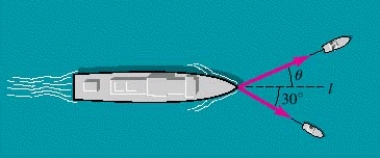 If the ship is to travel on a straight line l, approximate the angle
 that the larger tug must make with l.
If the ship is to travel on a straight line l, approximate the angle that the larger tug must make with l. (Multiple Choice)
4.9/5 (76)
(76) Find (a) the dot product of the two vectors and (b) the angle between the two vectors.  and

and (Multiple Choice)
4.8/5 (71)
(71) A rhombus has sides of length 115 centimeters, and the angle at one of the vertices is 70  . Approximate the lengths of the diagonals to the nearest tenth of a centimeter.
 (Multiple Choice)
4.8/5 (78)
(78) A straight road makes an angle of  with the horizontal. When the angle of elevation of the sun is
 , a vertical pole at the side of the road casts a shadow
 feet long directly down the road, as shown in the figure.
 Approximate the length of the pole.
with the horizontal. When the angle of elevation of the sun is , a vertical pole at the side of the road casts a shadow feet long directly down the road, as shown in the figure. Approximate the length of the pole. (Multiple Choice)
4.8/5 (85)
(85)  and
 .

Vectors are used in computer graphics to calculate the length of shadows over flat surfaces. An object represented by a vector a is held over a flat surface inclined at an angle  , as shown in the figure.
 If a light is shining directly downward, approximate the length of the shadow to two decimal places for the specified values of the vector
 .
, as shown in the figure. If a light is shining directly downward, approximate the length of the shadow to two decimal places for the specified values of the vector . (Multiple Choice)
4.8/5 (78)
(78) A helicopter hovers at an altitude that is  feet above a mountain peak of altitude 5,184 feet, as shown in the figure. A second, taller peak is viewed from both the mountaintop and the helicopter. From the helicopter, the angle of depression is
 , and from the mountaintop, the angle of elevation is
 .
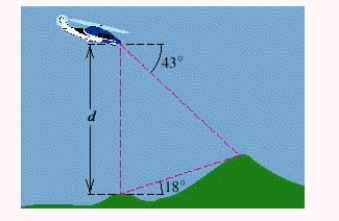 Approximate the altitude of the taller peak.
feet above a mountain peak of altitude 5,184 feet, as shown in the figure. A second, taller peak is viewed from both the mountaintop and the helicopter. From the helicopter, the angle of depression is , and from the mountaintop, the angle of elevation is . Approximate the altitude of the taller peak. (Multiple Choice)
4.8/5 (84)
(84) 

The trigonometric form of complex numbers is often used by electrical engineers to describe the current I, voltage V, and impedance Z in electrical circuits with alternating current. Impedance is the opposition to the flow of current in a circuit. Most common electrical devices operate on 115-volt, alternating current. The relationship among these three quantities is  . The real part of I represents the actual current delivered to an electrical appliance in amps. Approximate this current when
 and
 , and express the answer in rectangular form to two decimal places.
. The real part of I represents the actual current delivered to an electrical appliance in amps. Approximate this current when and , and express the answer in rectangular form to two decimal places. (Multiple Choice)
5.0/5 (81)
(81) Shown in the figure is a plan for the top of a wing of a jet fighter, where  feet and
 feet.
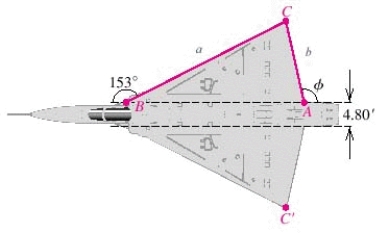 Approximate the area of triangle ABC.
feet and feet. Approximate the area of triangle ABC. (Multiple Choice)
4.7/5 (83)
(83) A rhombus has sides of length 100 centimeters, and the angle at one of the vertices is 70  . Approximate the lengths of the diagonals to the nearest tenth of a centimeter.
 (Multiple Choice)
4.8/5 (96)
(96) Determine whether the given pair of vectors are orthogonal or not.  and

and (Multiple Choice)
4.8/5 (79)
(79)  .
A triangular field has sides of lengths a, b, and c (in yards). Approximate the number of acres in the field (  ).

). (Multiple Choice)
4.8/5 (69)
(69) If forces F 1 , F 2 ,..., F n act at a point P, the net (or resultant) force F is the sum  If
 the forces are said to be in equilibrium. The given forces act at the origin O of an xy-plane. a) Find the net force F.
B ) Find an additional force G such that equilibrium occurs.

If the forces are said to be in equilibrium. The given forces act at the origin O of an xy-plane. a) Find the net force F.
B ) Find an additional force G such that equilibrium occurs. (Multiple Choice)
5.0/5 (78)
(78) A jet airplane approaches a runway at an angle of  with the horizontal, traveling at a speed of 175 mi/hr. Approximate the horizontal and vertical components of the vector that is described. Round the answer to the nearest hundredth.
 (Multiple Choice)
4.8/5 (76)
(76) 
Filters
- Essay(0)
- Multiple Choice(0)
- Short Answer(0)
- True False(0)
- Matching(0)