



 Chat with AI
Exam 11: Cranium, Facial Bones, and Paranasal Sinuses

Exam 1: Terminology, Positioning, and Imaging Principles198 Questions
Exam 2: Chest98 Questions
Exam 3: Abdomen90 Questions
Exam 4: Upper Limb107 Questions
Exam 5: Humerus and Shoulder Girdle75 Questions
Exam 6: Lower Limb110 Questions
Exam 7: Femur and Pelvic Girdle80 Questions
Exam 8: Cervical and Thoracic Spine84 Questions
Exam 9: Lumbar Spine, Sacrum, and Coccyx75 Questions
Exam 10: Bony Thorax-Sternum and Ribs66 Questions
Exam 11: Cranium, Facial Bones, and Paranasal Sinuses181 Questions
Exam 12: Biliary Tract and Upper Gastrointestinal System127 Questions
Exam 13: Lower Gastrointestinal System83 Questions
Exam 14: Urinary System and Venipuncture100 Questions
Exam 15: Trauma, Mobile, and Surgical Radiography108 Questions
Exam 16: Pediatric Radiography72 Questions
Exam 17: Angiography and Interventional Procedures72 Questions
Exam 18: Computed Tomography103 Questions
Exam 19: Special Radiographic Procedures69 Questions
Exam 20: Diagnostic and Therapeutic Modalities208 Questions
Select questions type


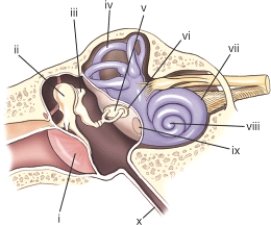
A patient comes to radiology with a clinical history of an acoustic neuroma.Which of the following imaging modalities will provide the best assessment for this tumor?
(Multiple Choice)
4.8/5  (73)
(73) 
Which of the following structures passes through the superior orbital fissure?
(Multiple Choice)
4.9/5 (79)
(79) The pathway of communication between the frontal,maxillary,and ethmoid sinuses that provides drainage between them is termed:
(Multiple Choice)
4.8/5 (81)
(81) The osseous labyrinth includes the cochlea,the vestibule,and the semicircular canals.
(True/False)
4.9/5 (74)
(74) Which one of the following cranial projections will best demonstrate a possible basilar fracture?
(Multiple Choice)
4.8/5 (79)
(79) The CR must be placed parallel to the ____ positioning line for the superoinferior (tangential)projection of nasal bones.
(Multiple Choice)
5.0/5 (75)
(75) Which of the following imaging modalities should NOT be used to rule out a possible metal foreign body in the eye?
(Multiple Choice)
4.8/5 (70)
(70) The cranial bone labeled i is the:
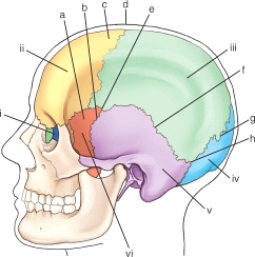 (Anatomic structures are labeled i through vi and sutures a through h.)
 (Multiple Choice)
4.9/5 (79)
(79) Which of the following structures are described as scroll-like projections found in the nasal cavity?
(Multiple Choice)
4.8/5 (80)
(80) Which division of the temporal bone contains the organs of hearing and equilibrium?
(Multiple Choice)
4.9/5 (77)
(77) The sutural point or area labeled e is the:
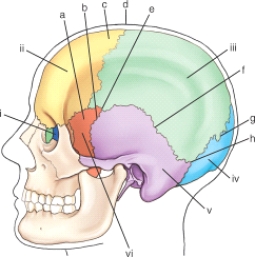 (Anatomic structures are labeled i through vi and sutures a through h.)
 (Multiple Choice)
4.9/5 (73)
(73) What is the name of the joint found between the lateral condylar processes of the skull and the atlas of C1?
(Multiple Choice)
4.9/5 (79)
(79) A radiograph of a lateral projection of the cranium reveals that the orbital roofs (plates)are not superimposed-one is slightly superior to the other.Which of the following positioning errors led to this radiographic outcome?
(Multiple Choice)
4.8/5 (61)
(61) The suture labeled f is termed the:
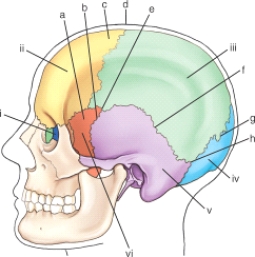 (Anatomic structures are labeled i through vi and sutures a through h.)
 (Multiple Choice)
4.8/5 (77)
(77) Which cranial bone articulates with all the other cranial bones?
(Multiple Choice)
4.8/5 (61)
(61) A PA axial projection with a 25° caudad angle of the cranium reveals that the petrous ridges are at the level of the superior orbital margins.Which of the following modifications are required to correct this error?
(Multiple Choice)
4.8/5 (81)
(81) 
Filters
- Essay(0)
- Multiple Choice(0)
- Short Answer(0)
- True False(0)
- Matching(0)