



 Chat with AI
Exam 11: Cranium, Facial Bones, and Paranasal Sinuses

Exam 1: Terminology, Positioning, and Imaging Principles198 Questions
Exam 2: Chest98 Questions
Exam 3: Abdomen90 Questions
Exam 4: Upper Limb107 Questions
Exam 5: Humerus and Shoulder Girdle75 Questions
Exam 6: Lower Limb110 Questions
Exam 7: Femur and Pelvic Girdle80 Questions
Exam 8: Cervical and Thoracic Spine84 Questions
Exam 9: Lumbar Spine, Sacrum, and Coccyx75 Questions
Exam 10: Bony Thorax-Sternum and Ribs66 Questions
Exam 11: Cranium, Facial Bones, and Paranasal Sinuses181 Questions
Exam 12: Biliary Tract and Upper Gastrointestinal System127 Questions
Exam 13: Lower Gastrointestinal System83 Questions
Exam 14: Urinary System and Venipuncture100 Questions
Exam 15: Trauma, Mobile, and Surgical Radiography108 Questions
Exam 16: Pediatric Radiography72 Questions
Exam 17: Angiography and Interventional Procedures72 Questions
Exam 18: Computed Tomography103 Questions
Exam 19: Special Radiographic Procedures69 Questions
Exam 20: Diagnostic and Therapeutic Modalities208 Questions
Select questions type


Match each of the following radiographic appearances with the corresponding pathologic indication.(Use each selection only once.)
-Enlarged sella turcica
(Multiple Choice)
4.8/5  (79)
(79) A patient comes in with a clinical history of a possible pituitary adenoma.Because this is a rural hospital,CT and MRI are not available.Which radiographic projection or position would best demonstrate signs of bony erosion of the sella turcica because of the tumor?
(Multiple Choice)
4.8/5 (83)
(83) A patient comes to radiology with a possible bone cyst within the squamous portion of the frontal bone.Which of the following projections would best demonstrate this region with a minimal amount of distortion of the frontal bone?
(Multiple Choice)
4.8/5 (76)
(76) Which sinuses are best demonstrated with the PA projection?
(Multiple Choice)
4.9/5 (68)
(68) Which of the following sutures separates the parietal from the occipital bone?
(Multiple Choice)
4.9/5 (75)
(75) The 15° PA axial (Caldwell)projection produces an unobstructed view of the maxilla.
(True/False)
4.9/5 (60)
(60) Which aspect of the mandible is best demonstrated with an AP axial projection?
(Multiple Choice)
4.9/5 (79)
(79) The ____ sinuses develop last and are not fully developed until the teenage years.
(Multiple Choice)
4.7/5 (84)
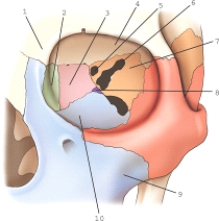
(84) 
MATCHING
Select the imaging modality that would best demonstrate the following pathologies.
-Paget's disease
(Multiple Choice)
4.8/5 (76)
(76) A patient comes to radiology for a routine study of the cranium.He is unable to flex his head and neck sufficiently to place the OML perpendicular to the IR for the AP axial projection.What should the technologist do to compensate for this problem without creating excessive magnification of the occipital bone?
(Multiple Choice)
4.9/5 (70)
(70) A patient enters the emergency department (ED)with a possible basilar skull fracture.Which of the following skull projections would best demonstrate any blood present in the sphenoid sinus?
(Multiple Choice)
5.0/5 (81)
(81) A radiograph of a parietoacanthial transoral (open-mouth Waters)projection reveals that the mouth is open but the sphenoid sinus is superimposed over the maxilla and upper teeth.What positioning error led to this radiographic outcome?
(Multiple Choice)
4.9/5 (70)
(70) The point of union between both halves of the mandible is termed:
(Multiple Choice)
4.8/5 (76)
(76) Infections involving the upper teeth may involve the frontal sinuses.
(True/False)
4.8/5 (94)
(94) What CR angle is required for the AP axial projection for the temporomandibular joints (TMJs)with the IOML perpendicular to the image receptor?
(Multiple Choice)
4.8/5 (66)
(66) Which one of the following structures is part of the middle ear?
(Multiple Choice)
4.9/5 (83)
(83) 
Filters
- Essay(0)
- Multiple Choice(0)
- Short Answer(0)
- True False(0)
- Matching(0)