



 Chat with AI
Exam 11: Cranium, Facial Bones, and Paranasal Sinuses

Exam 1: Terminology, Positioning, and Imaging Principles198 Questions
Exam 2: Chest98 Questions
Exam 3: Abdomen90 Questions
Exam 4: Upper Limb107 Questions
Exam 5: Humerus and Shoulder Girdle75 Questions
Exam 6: Lower Limb110 Questions
Exam 7: Femur and Pelvic Girdle80 Questions
Exam 8: Cervical and Thoracic Spine84 Questions
Exam 9: Lumbar Spine, Sacrum, and Coccyx75 Questions
Exam 10: Bony Thorax-Sternum and Ribs66 Questions
Exam 11: Cranium, Facial Bones, and Paranasal Sinuses181 Questions
Exam 12: Biliary Tract and Upper Gastrointestinal System127 Questions
Exam 13: Lower Gastrointestinal System83 Questions
Exam 14: Urinary System and Venipuncture100 Questions
Exam 15: Trauma, Mobile, and Surgical Radiography108 Questions
Exam 16: Pediatric Radiography72 Questions
Exam 17: Angiography and Interventional Procedures72 Questions
Exam 18: Computed Tomography103 Questions
Exam 19: Special Radiographic Procedures69 Questions
Exam 20: Diagnostic and Therapeutic Modalities208 Questions
Select questions type


A radiograph of a submentovertex projection reveals that the mandible is superimposed over the ethmoid and sphenoid sinuses.Which of the following modifications will eliminate this problem?
(Multiple Choice)
4.9/5  (88)
(88) A patient comes to radiology with a history of a possible erosion of the superior orbital fissures.Which of the following projections would best demonstrate this structure?
(Multiple Choice)
4.9/5 (65)
(65) A patient enters the ED with facial bone injuries.The physician is concerned about a possible blow-out fracture of the left orbit.Which of the following three-projection routines would best diagnose this injury?
(Multiple Choice)
4.8/5 (73)
(73) Where should the optic foramen be located with a well-positioned parieto-orbital oblique projection of the optic foramina?
(Multiple Choice)
4.8/5 (83)
(83) The widest portion of the cranium is found at the level of the:
(Multiple Choice)
4.9/5 (70)
(70) 
MATCHING
Select the imaging modality that would best demonstrate the following pathologies.
-Craniosynostosis (premature suture closing in neonate skull)
(Multiple Choice)
4.9/5 (87)
(87) Which of the following bones is part of the floor of the cranium?
(Multiple Choice)
4.9/5 (76)
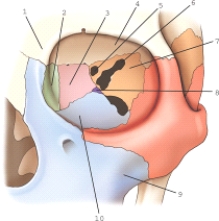
(76) 
The modified Law method for TMJs requires a ____ rotation of the skull and a ____ angle of the CR.
(Multiple Choice)
4.9/5 (84)
(84) Which of the following projections will best demonstrate the bony nasal septum?
(Multiple Choice)
4.7/5 (82)
(82) A radiograph of a posteroanterior (PA)axial projection (Caldwell method)of the cranium reveals that the petrous ridges are located at the level of the lower one third of the orbits.The technologist performed this projection with the CR angled 15° caudal to the orbitomeatal line (OML).How must positioning be altered if a repeat exposure is performed?
(Multiple Choice)
5.0/5 (73)
(73) The lateral projection for the nasal bones is generally a unilateral projection.(Both right and left lateral projections are usually not required.)
(True/False)
4.8/5 (70)
(70) A radiograph of a submentovertex projection of the cranium reveals that the mandibular condyles are projected into the petrous pyramids.What must be altered during the repeat exposure to produce a more diagnostic radiograph?
(Multiple Choice)
4.9/5 (79)
(79) Which projection will best demonstrate the entire mandible with one exposure?
(Multiple Choice)
4.8/5 (73)
(73) Which sinus often produces an air/fluid level indicating a basilar skull fracture?
(Multiple Choice)
5.0/5 (80)
(80) What can the technologist do if the patient cannot extend the head and neck adequately for the routine submentovertex projection of the zygomatic arches?
(Multiple Choice)
4.9/5 (84)
(84) The modified parietoacanthial (modified Waters)projection requires more extension of the head and neck as compared with the parietoacanthial (Waters)projection.
(True/False)
4.8/5 (88)
(88) 
Filters
- Essay(0)
- Multiple Choice(0)
- Short Answer(0)
- True False(0)
- Matching(0)