



 Chat with AI
Exam 17: Externalities

Exam 1: What Is Economics483 Questions
Exam 2: The Economic Problem440 Questions
Exam 3: Demand and Supply515 Questions
Exam 4: Elasticity530 Questions
Exam 5: Efficiency and Equity450 Questions
Exam 6: Government Actions in Markets412 Questions
Exam 7: Global Markets in Action205 Questions
Exam 8: Utility and Demand366 Questions
Exam 10: Organizing Production385 Questions
Exam 11: Output and Costs493 Questions
Exam 12: Perfect Competition487 Questions
Exam 13: Monopoly599 Questions
Exam 14: Monopolistic Competition318 Questions
Exam 15: Oligopoly276 Questions
Exam 16: Public Choices, Public Goods, and Healthcare205 Questions
Exam 17: Externalities437 Questions
Exam 18: Markets for Factors of Production382 Questions
Exam 19: Economic Inequality351 Questions
Exam 20: Uncertainty and Information233 Questions
Select questions type


If property rights for air and water exist, then polluters bear the costs of pollution.
(True/False)
4.8/5  (82)
(82) 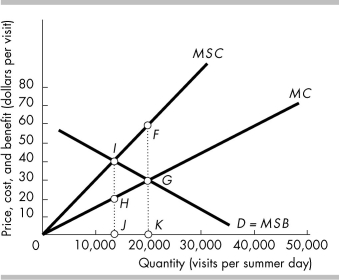 -The figure above illustrates the problem of overcrowding and external costs experienced during the summer months in the state park. The competitive equilibrium is at
 (Multiple Choice)
4.9/5 (86)
(86) If production of a good creates an external cost, the amount of output where the marginal social benefit equals the marginal private cost is
(Multiple Choice)
4.8/5 (91)
(91) Why should people without children pay some tax to support local schools?
(Essay)
4.9/5 (74)
(74) In the absence of property rights, factories will dump waste into a waterway up to the point where ________ equals ________.
(Multiple Choice)
4.9/5 (88)
(88) 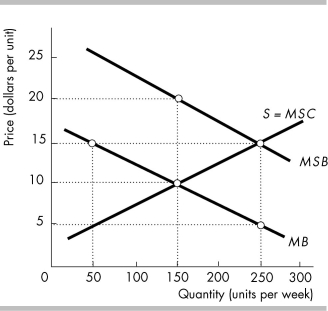 -In the above figure, if a subsidy is granted to producers that generates an efficient level of production, then the deadweight loss will be
 (Multiple Choice)
4.8/5 (91)
(91) Suppose that recycling rubber for sneakers creates an external benefit of $2.00 per ton of rubber. There are no external costs. The efficient amount of rubber will be recycled when the government creates a
(Multiple Choice)
4.8/5 (79)
(79) 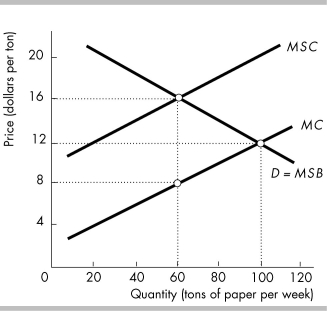 -Using the above figure, in the absence of any government intervention, the number of tons of paper produced will be
 (Multiple Choice)
4.9/5 (100)
(100) Consider an industry that produces an output Q with marginal private cost (MC) and marginal social cost (MSC) as given in the table: 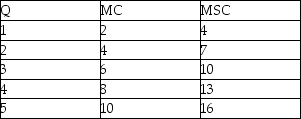 Which of the following is TRUE?
 (Multiple Choice)
4.8/5 (82)
(82) The tragedy of the commons is the absence of incentives to
(Multiple Choice)
4.7/5 (77)
(77) If the production of a good creates an external cost, is the supply curve the same as the marginal social cost or the same as the marginal private cost curve or both?
(Essay)
4.9/5 (84)
(84) 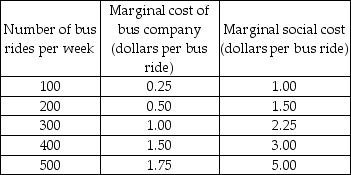 -The demand for bus service is perfectly elastic at a price of $1.00 a ride. The table above shows the bus company's marginal cost and the marginal social cost of the bus service. The competitive quantity of bus rides per week is
 (Multiple Choice)
4.9/5 (75)
(75) Explain why a producer who is causing external costs does not have the incentive to reduce these costs.
(Essay)
4.7/5 (85)
(85) With the debris of more than 50 years of climbing on the beautiful high slopes - oxygen canisters, tents, backpacks and even some bodies - Mount Everest has been called the world's highest garbage dump. If Everest is a common resource, currently there is an ________ of the mountain.
(Multiple Choice)
4.7/5 (80)
(80) According to the Coase theorem, part of what is needed for private transactions to be efficient is that property rights
(Multiple Choice)
4.8/5 (78)
(78) Burning coal to generate electricity can create pollution. If the market for generating electricity is competitive and is allowed to operate without any government intervention, is the equilibrium quantity of coal burned equal to, more than, or less than the efficient quantity?
(Essay)
4.9/5 (101)
(101) In an unregulated, competitive market, less than the efficient quantity of education is produced and consumed because
(Multiple Choice)
4.9/5 (98)
(98) If the government assigns private property rights to a common resource, then the
(Multiple Choice)
4.7/5 (79)
(79) 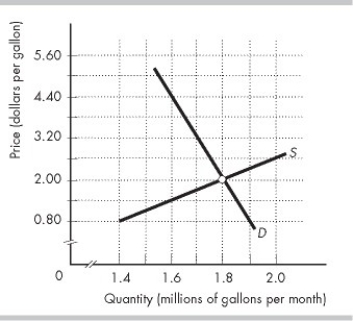 -In the figure above, S is the supply curve and D is the demand curve in the unregulated, competitive market for gasoline in Motorland. The external cost of gasoline is constant at $1.50 per gallon. Suppose Motorland's government imposes a tax of $1.50 per gallon of gasoline sold. With the tax, when the market is in equilibrium, the deadweight loss is
 (Multiple Choice)
4.9/5 (81)
(81) 
Filters
- Essay(0)
- Multiple Choice(0)
- Short Answer(0)
- True False(0)
- Matching(0)