



 Chat with AI
Exam 17: Externalities

Exam 1: What Is Economics483 Questions
Exam 2: The Economic Problem440 Questions
Exam 3: Demand and Supply515 Questions
Exam 4: Elasticity530 Questions
Exam 5: Efficiency and Equity450 Questions
Exam 6: Government Actions in Markets412 Questions
Exam 7: Global Markets in Action205 Questions
Exam 8: Utility and Demand366 Questions
Exam 10: Organizing Production385 Questions
Exam 11: Output and Costs493 Questions
Exam 12: Perfect Competition487 Questions
Exam 13: Monopoly599 Questions
Exam 14: Monopolistic Competition318 Questions
Exam 15: Oligopoly276 Questions
Exam 16: Public Choices, Public Goods, and Healthcare205 Questions
Exam 17: Externalities437 Questions
Exam 18: Markets for Factors of Production382 Questions
Exam 19: Economic Inequality351 Questions
Exam 20: Uncertainty and Information233 Questions
Select questions type


When a production quota is used to remedy the problem of the commons, then
(Multiple Choice)
4.7/5  (71)
(71) Why does the existence of an external benefit lead to the production of less than the efficient quantity?
(Essay)
4.8/5 (88)
(88) If the government creates a system of pollution permits, firms with low marginal costs of reducing pollution will
(Multiple Choice)
4.8/5 (78)
(78) 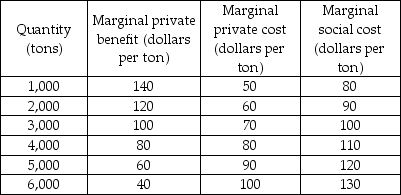 -The above table shows the marginal benefits and costs from production of fertilizer. There are no external benefits. If the market is perfectly competitive and unregulated, the efficient level of output could be achieved by setting a per ton tax of
 (Multiple Choice)
4.8/5 (79)
(79) In the case of an external benefit generated by an activity, such as education, a private subsidy for that activity can achieve an efficient outcome.
(True/False)
4.8/5 (75)
(75) 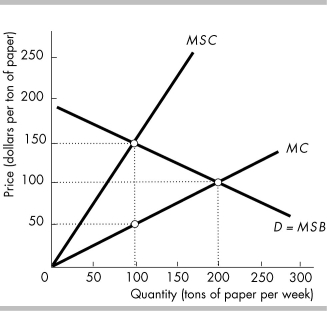 -In the above figure, the competitive unregulated equilibrium is producing and consuming ________ tons of paper at a price of ________ per ton.
 (Multiple Choice)
4.8/5 (85)
(85) When people make decisions about the quantity of education to undertake, they balance the marginal social benefit against the marginal private cost.
(True/False)
4.8/5 (77)
(77) Both firm A and firm B emit 300 tons of pollution. Suppose both firm A and firm B have permits that allow each to emit 100 tons of pollution. If it costs $5,000 for firm A to eliminate 100 tons of pollution and it costs firm B $6,000 to eliminate 100 tons of pollution, then
(Multiple Choice)
4.9/5 (71)
(71) 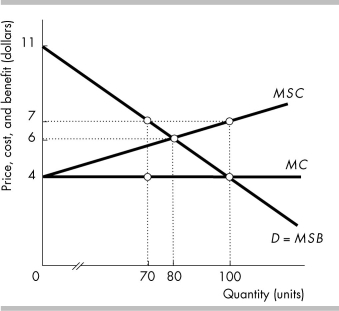 -In the above figure, the efficient quantity is
Food stamps provided by the U.S. Department of Agriculture are an example of
(Multiple Choice)
4.8/5 (70)
(70) 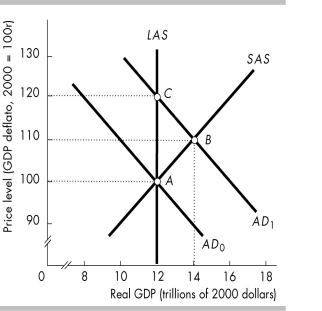 -In the figure above, if the market is unregulated, then at the equilibrium output level, the marginal social cost of production
 (Multiple Choice)
4.9/5 (72)
(72) 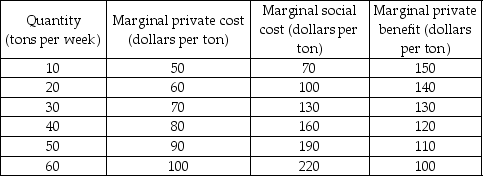 -The table above describes the market for paper. The production of paper produces pollution. There are no external benefits. Now suppose a Pigovian tax is successfully implemented and the efficient quantity of paper is produced. What is the total tax revenue collected by the government per week?
 (Multiple Choice)
4.8/5 (85)
(85)
-The above table shows the marginal benefits and costs from production of fertilizer. There are no external benefits. If the market is perfectly competitive and unregulated, at the equilibrium output, the
-The above table shows the marginal benefits and costs from production of fertilizer. There are no external benefits. If the market is perfectly competitive and unregulated, at the equilibrium output, the (Multiple Choice)
4.9/5 (75)
(75) Why are fish in the ocean an example of a resource that suffers from the tragedy of the commons but cattle grazing in a farmer's pasture do not suffer from the tragedy of the commons?
(Essay)
4.9/5 (82)
(82) A chemical factory and a fishing club share a lake. Producing chemicals creates water pollution that harms the fish. Initially the lake is owned by no one. Keeping in mind the Coase theorem, suppose transactions costs are low and the fishing club is given ownership of the lake. Compared to the situation with no property rights, the quantity of chemicals produced
(Multiple Choice)
4.8/5 (82)
(82) The marginal social benefit is the sum of the benefit enjoyed by the consumer of an additional unit of a good or service plus the marginal benefit enjoyed by others.
(True/False)
4.8/5 (87)
(87) In 2008, a man was charged with one count of illegally stocking wild animals, a civil offense. State investigators had accused him of bringing 31 wild hogs from Texas to Wisconsin to hunt on his private land, spawning a feral hog population that has caused thousands of dollars in crop damage to hundreds of farms in the region. Can the Coase theorem apply in this example? Why or why not?
(Multiple Choice)
4.8/5 (67)
(67) 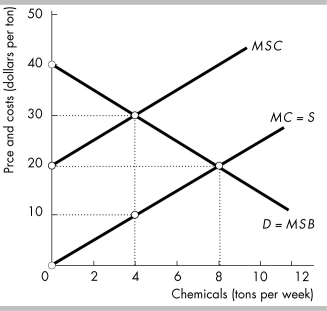 -In the above figure, the efficient level of chemicals produced per week is
 (Multiple Choice)
4.8/5 (69)
(69) 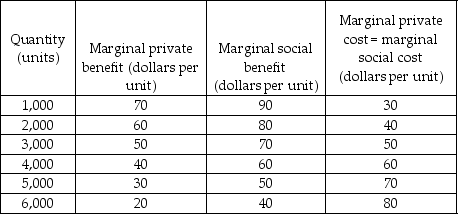 -Based on the data in the above table, the product exhibits
 (Multiple Choice)
4.9/5 (98)
(98) 
Filters
- Essay(0)
- Multiple Choice(0)
- Short Answer(0)
- True False(0)
- Matching(0)