



 Chat with AI
Exam 17: Externalities

Exam 1: What Is Economics483 Questions
Exam 2: The Economic Problem440 Questions
Exam 3: Demand and Supply515 Questions
Exam 4: Elasticity530 Questions
Exam 5: Efficiency and Equity450 Questions
Exam 6: Government Actions in Markets412 Questions
Exam 7: Global Markets in Action205 Questions
Exam 8: Utility and Demand366 Questions
Exam 10: Organizing Production385 Questions
Exam 11: Output and Costs493 Questions
Exam 12: Perfect Competition487 Questions
Exam 13: Monopoly599 Questions
Exam 14: Monopolistic Competition318 Questions
Exam 15: Oligopoly276 Questions
Exam 16: Public Choices, Public Goods, and Healthcare205 Questions
Exam 17: Externalities437 Questions
Exam 18: Markets for Factors of Production382 Questions
Exam 19: Economic Inequality351 Questions
Exam 20: Uncertainty and Information233 Questions
Select questions type


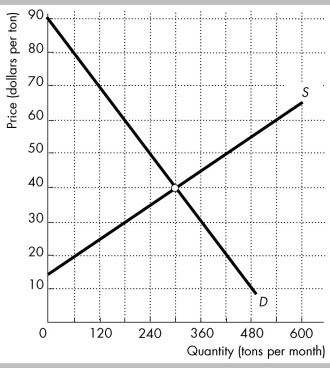 The figure shows the unregulated market for a pesticide, where S is the supply curve and D is the demand curve. The demand curve is the same as the MSB curve. When factories produce the pesticide, they also create waste, which they dump into a lake on the outskirts of the town. The marginal external cost of the dumped waste is equal to the marginal private cost of producing the pesticide.
-In the figure above, if no one owns the lake, what is the deadweight loss in the market?
The figure shows the unregulated market for a pesticide, where S is the supply curve and D is the demand curve. The demand curve is the same as the MSB curve. When factories produce the pesticide, they also create waste, which they dump into a lake on the outskirts of the town. The marginal external cost of the dumped waste is equal to the marginal private cost of producing the pesticide.
-In the figure above, if no one owns the lake, what is the deadweight loss in the market? (Multiple Choice)
4.9/5  (84)
(84) 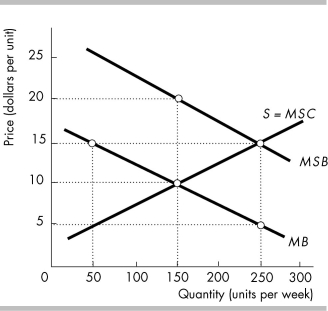 -In the above figure, if the market is competitive and unregulated
 (Multiple Choice)
4.9/5 (75)
(75) 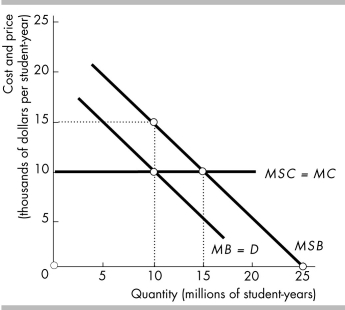 -The above figure shows the marginal benefits and marginal costs of a college education. If colleges receive a $5,000 subsidy, then enrollment equals
 (Multiple Choice)
4.9/5 (78)
(78) When the production of a good creates an external cost, to achieve the efficient quantity governments can set taxes (T) such that
(Multiple Choice)
4.8/5 (85)
(85) 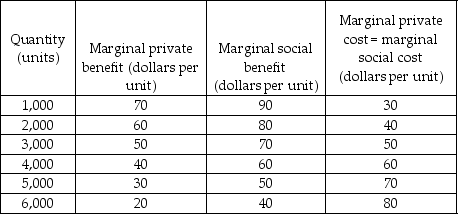 -In the above table, the efficient level of output is
If production of a good produces an external benefit, in order for the marginal social cost to equal the marginal social benefit
(Multiple Choice)
5.0/5 (79)
(79) 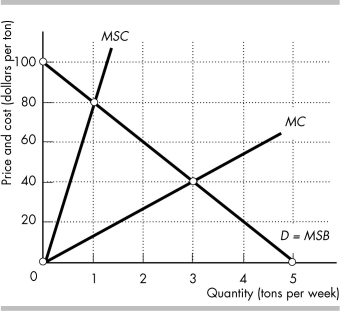 -The figure above provides information for a factory that produces chemicals that pollute a waterway. The waterway is used by water skiers. If the waterway is owned by a water ski club and the Coase theorem applies, then the factory will produce ________ tons of chemicals a week.
 (Multiple Choice)
4.8/5 (92)
(92) 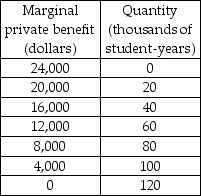 -The table above provides information about the marginal private benefit of education. The marginal private cost, which also equals the marginal social cost, of educating a student is $16,000 per year and does not change as more students are educated. There is an external benefit from education that is equal to $12,000 per student year and does not change as more students are educated. If the market for education is competitive and unregulated, the equilibrium quantity of education will be ________ and the tuition will be ________.
 (Multiple Choice)
4.7/5 (80)
(80) 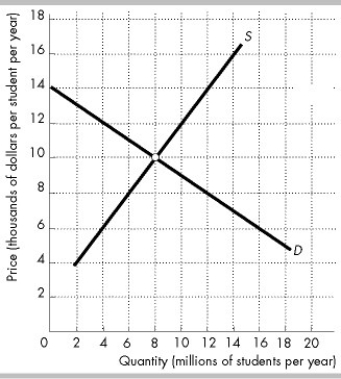 The figure shows the supply curve (S) and the demand curve (D) for college education. The external benefit from college education is $6,000 per student per year and is constant.
-In the figure above, with no government involvement and if the colleges are competitive, how many students are enrolled?
The figure shows the supply curve (S) and the demand curve (D) for college education. The external benefit from college education is $6,000 per student per year and is constant.
-In the figure above, with no government involvement and if the colleges are competitive, how many students are enrolled? (Multiple Choice)
4.7/5 (80)
(80)
-The above figure shows the marginal benefits and marginal costs of a college education. If no subsidies are paid, enrollment equals
-The above figure shows the marginal benefits and marginal costs of a college education. If no subsidies are paid, enrollment equals (Multiple Choice)
4.7/5 (82)
(82) 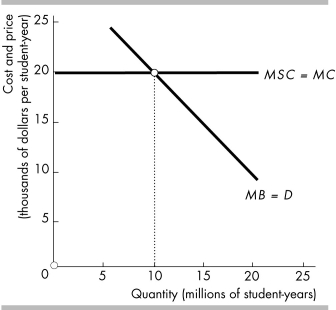 -The above figure shows the marginal private benefit and marginal social cost of a college education. A $10,000 subsidy to colleges results in a college charging tuition of
 (Multiple Choice)
4.7/5 (77)
(77) 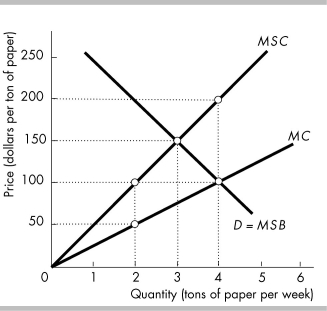 -The figure above shows the costs associated with producing paper. When paper is produced, there is some pollution runoff into a lake. According to the Coase Theorem, if the transactions costs are low and there are only a few people involved, the output will equal ________ tons of paper if ________ own the lake.
 (Multiple Choice)
4.9/5 (82)
(82)
-In the above figure, if the market is competitive and unregulated, then at the equilibrium amount of output the marginal social benefit is
-In the above figure, if the market is competitive and unregulated, then at the equilibrium amount of output the marginal social benefit is (Multiple Choice)
4.8/5 (75)
(75) Consider a market in which there is an external cost. A tax can be used to arrive at the efficient market equilibrium because the tax will
(Multiple Choice)
4.8/5 (59)
(59) The marginal social cost is the cost of producing an additional unit of a good or service that falls on people other than the producer of the good or service.
(True/False)
4.9/5 (72)
(72) If the government assigns private property rights to a common resource, then the
(Multiple Choice)
4.8/5 (88)
(88) The HPV vaccine protects against human papillomavirus (HPV) that causes cancer. It protects both the person getting the vaccine and the sexual partners of that person. In a private market with no government intervention, the equilibrium will be
(Multiple Choice)
4.9/5 (91)
(91) The benefit from an additional unit of a good or service that the consumer of that good or service receives is the
(Multiple Choice)
4.8/5 (83)
(83) 
Filters
- Essay(0)
- Multiple Choice(0)
- Short Answer(0)
- True False(0)
- Matching(0)