



 Chat with AI
Exam 17: Externalities

Exam 1: What Is Economics483 Questions
Exam 2: The Economic Problem440 Questions
Exam 3: Demand and Supply515 Questions
Exam 4: Elasticity530 Questions
Exam 5: Efficiency and Equity450 Questions
Exam 6: Government Actions in Markets412 Questions
Exam 7: Global Markets in Action205 Questions
Exam 8: Utility and Demand366 Questions
Exam 10: Organizing Production385 Questions
Exam 11: Output and Costs493 Questions
Exam 12: Perfect Competition487 Questions
Exam 13: Monopoly599 Questions
Exam 14: Monopolistic Competition318 Questions
Exam 15: Oligopoly276 Questions
Exam 16: Public Choices, Public Goods, and Healthcare205 Questions
Exam 17: Externalities437 Questions
Exam 18: Markets for Factors of Production382 Questions
Exam 19: Economic Inequality351 Questions
Exam 20: Uncertainty and Information233 Questions
Select questions type


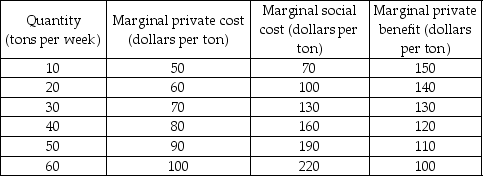 -The table above describes the market for paper. The production of paper produces pollution. There are no external benefits. What amount of tax per ton of paper is necessary to produce the efficient quantity of paper?
 (Multiple Choice)
4.7/5  (80)
(80) Pollution occurs when lumber is produced. If the lumber market is unregulated, there would be
(Multiple Choice)
4.9/5 (85)
(85) The Atlantic City Expressway is a highway that runs from outside Philadelphia to Atlantic City, New Jersey. It is notoriously congested during the summer weekends when many people are driving to the beach about the same time. The marginal private cost for a driver of driving on the Expressway includes I. the cost of gasoline.
II) the cost of increasing congestion for everyone else.
(Multiple Choice)
4.8/5 (70)
(70) 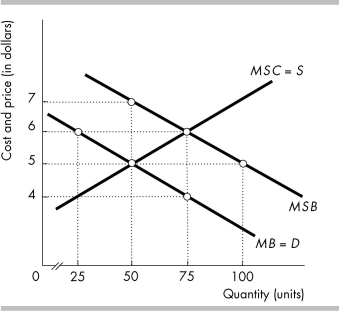 -In the above figure, if no government intervention occurs, at the unregulated competitive market equilibrium, there is an
 (Multiple Choice)
4.8/5 (80)
(80) 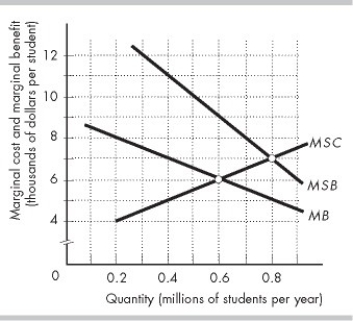 -The figure above shows the marginal social costs (MSC), marginal private benefits (MB), and marginal social benefits (MSB) of college education in Inland. If Inland's government provides a voucher per student equal to the marginal external benefit of college education, then ________ million students will attend college, and colleges will collect ________ per student from the voucher.
 (Multiple Choice)
4.8/5 (76)
(76) 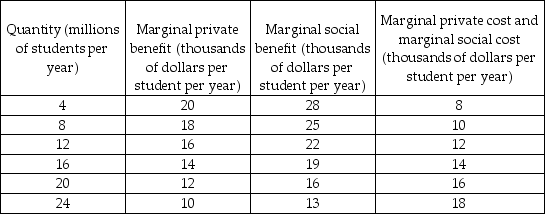 -The table above shows the marginal costs and marginal benefits of college education. If the market for college education is perfectly competitive and unregulated, the amount of enrollment is
 (Multiple Choice)
4.9/5 (73)
(73) Consider a market in which there is an external benefit. A private subsidy paid to producers can be used to arrive at the efficient market equilibrium because the subsidy will
(Multiple Choice)
4.8/5 (98)
(98) Most economist would consider the marginal private benefit of education is
(Multiple Choice)
4.9/5 (74)
(74) When producers are hard to monitor and marginal costs differ across producers, ________ are an effective method to achieve efficient use of a ________.
(Multiple Choice)
4.8/5 (80)
(80) Those opposed to fracking, a method of extracting natural gas through breaking up underground rocks with chemicals and water, warn that this method might pollute nearby sources of drinking water.
-Any such pollution is
(Multiple Choice)
4.9/5 (75)
(75) 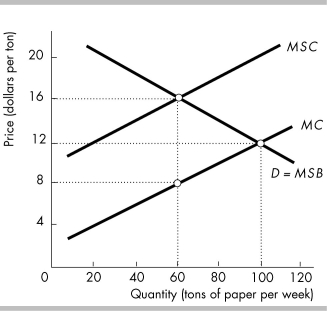 -In the above figure, to achieve the efficient amount of paper production, the government could impose a tax of
 (Multiple Choice)
4.9/5 (79)
(79) 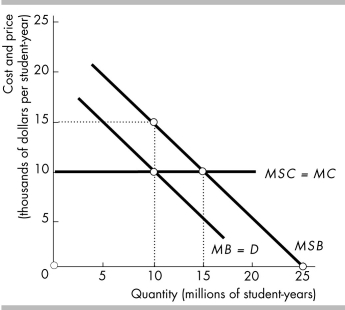 -The above figure shows the marginal benefits and marginal costs of a college education. If no subsidies are paid, colleges charge tuition of
 (Multiple Choice)
4.7/5 (83)
(83) 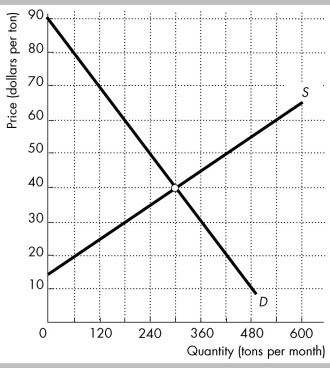 The figure shows the unregulated market for a pesticide, where S is the supply curve and D is the demand curve. The demand curve is the same as the MSB curve. When factories produce the pesticide, they also create waste, which they dump into a lake on the outskirts of the town. The marginal external cost of the dumped waste is equal to the marginal private cost of producing the pesticide.
-In the figure above, if no one owns the lake, what is the quantity of pesticide produced?
The figure shows the unregulated market for a pesticide, where S is the supply curve and D is the demand curve. The demand curve is the same as the MSB curve. When factories produce the pesticide, they also create waste, which they dump into a lake on the outskirts of the town. The marginal external cost of the dumped waste is equal to the marginal private cost of producing the pesticide.
-In the figure above, if no one owns the lake, what is the quantity of pesticide produced? (Multiple Choice)
4.9/5 (79)
(79) 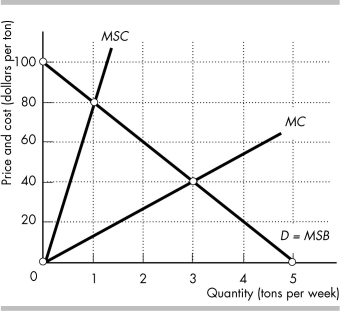 -The figure above provides information for a factory that produces chemicals that pollute a waterway. The waterway is used by water skiers. The efficient quantity of chemicals to produce is ________ tons of chemicals a week.
 (Multiple Choice)
4.8/5 (74)
(74) 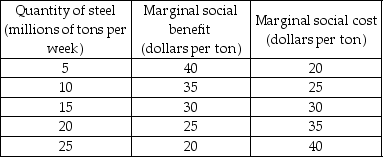 -The table above shows information about the costs and benefits of a steel smelter that pollutes the air of a city. The market is efficient when the quantity of steel produced is ________ tons per week.
 (Multiple Choice)
4.8/5 (75)
(75) A tax equal to the external marginal cost of an activity yields the efficient level of production because the tax
(Multiple Choice)
4.7/5 (64)
(64) 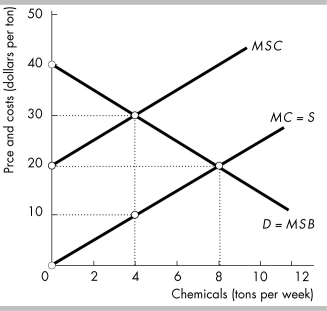 -A chemical factory and a fishing club share a lake. Producing chemicals creates water pollution that harms the fish. The marginal social cost, private marginal cost, and marginal social benefit from producing chemicals are in the figure above. If polluting is legal and no one owns the lake into which waste is dumped, then the amount of chemicals produced each week will be
 (Multiple Choice)
4.7/5 (75)
(75) A chemical factory and a fishing club share a lake. Producing chemicals creates water pollution that harms the fish. Initially the lake is owned by no one. Keeping in mind the Coase theorem, suppose transactions costs are low and the chemical factory is given ownership of the lake. Compared to the situation with no property rights, the quantity of chemicals produced
(Multiple Choice)
4.9/5 (82)
(82) 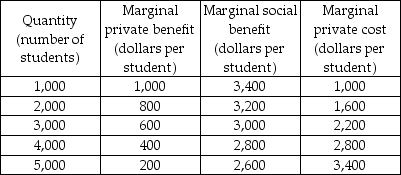 -The table above shows the marginal private benefit, marginal social benefit, and marginal cost of education at the College of Epsilon. What is the equilibrium number of students at the college if the market is unregulated?
 (Multiple Choice)
4.8/5 (84)
(84) 
Filters
- Essay(0)
- Multiple Choice(0)
- Short Answer(0)
- True False(0)
- Matching(0)