



 Chat with AI
Exam 17: Externalities

Exam 1: What Is Economics483 Questions
Exam 2: The Economic Problem440 Questions
Exam 3: Demand and Supply515 Questions
Exam 4: Elasticity530 Questions
Exam 5: Efficiency and Equity450 Questions
Exam 6: Government Actions in Markets412 Questions
Exam 7: Global Markets in Action205 Questions
Exam 8: Utility and Demand366 Questions
Exam 10: Organizing Production385 Questions
Exam 11: Output and Costs493 Questions
Exam 12: Perfect Competition487 Questions
Exam 13: Monopoly599 Questions
Exam 14: Monopolistic Competition318 Questions
Exam 15: Oligopoly276 Questions
Exam 16: Public Choices, Public Goods, and Healthcare205 Questions
Exam 17: Externalities437 Questions
Exam 18: Markets for Factors of Production382 Questions
Exam 19: Economic Inequality351 Questions
Exam 20: Uncertainty and Information233 Questions
Select questions type


The Coase theorem is the proposition that if property rights exist, the number of parties is small, and transactions costs are low
(Multiple Choice)
4.8/5  (69)
(69) Why does government provide educational opportunities in the form of vouchers, subsidies, and public provision?
(Essay)
4.9/5 (75)
(75) If an external cost exists, then who bears the external cost in an unregulated competitive market transaction?
(Multiple Choice)
5.0/5 (93)
(93) The HPV vaccine protects against human papillomavirus (HPV) that causes cancer. It protects both the person getting the vaccine and the sexual partners of that person. When calculating the marginal social benefit of the vaccine, it is necessary to include
(Multiple Choice)
4.9/5 (87)
(87) 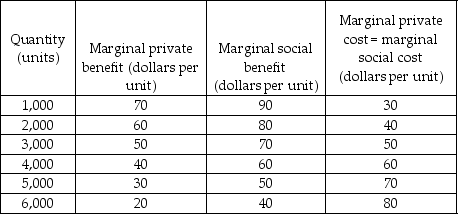 -In the above table, if the market is perfectly competitive and unregulated, the equilibrium output will be
 (Multiple Choice)
4.9/5 (89)
(89) The government can aid in reducing pollution by using a policy of cap-and-trade, which means that
(Multiple Choice)
4.8/5 (79)
(79) The marginal social cost of a chemical is $100 per ton and its marginal private cost is $85 per ton. What is the marginal external cost of the chemical?
(Essay)
4.8/5 (88)
(88) 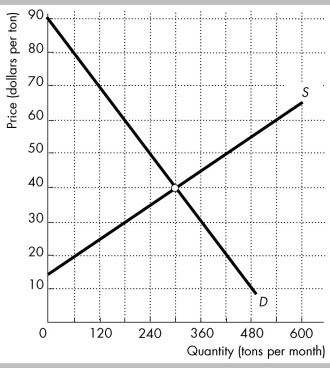 The figure shows the unregulated market for a pesticide, where S is the supply curve and D is the demand curve. The demand curve is the same as the MSB curve. When factories produce the pesticide, they also create waste, which they dump into a lake on the outskirts of the town. The marginal external cost of the dumped waste is equal to the marginal private cost of producing the pesticide.
-In the figure above, if no one owns the lake, what is the equilibrium price of the pesticide?
The figure shows the unregulated market for a pesticide, where S is the supply curve and D is the demand curve. The demand curve is the same as the MSB curve. When factories produce the pesticide, they also create waste, which they dump into a lake on the outskirts of the town. The marginal external cost of the dumped waste is equal to the marginal private cost of producing the pesticide.
-In the figure above, if no one owns the lake, what is the equilibrium price of the pesticide? (Multiple Choice)
4.7/5 (71)
(71) 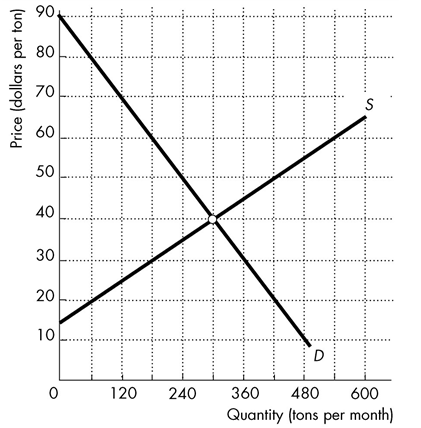 -Keeping in mind the Coase theorem, in the figure above, if the pesticide factories own the lake, the market does what?
 (Multiple Choice)
4.9/5 (83)
(83) When property rights are assigned and transactions costs are low
(Multiple Choice)
4.7/5 (72)
(72) When the marginal social cost of the production of Good A is greater than the marginal private cost of the production of Good A, then
(Multiple Choice)
4.9/5 (81)
(81) 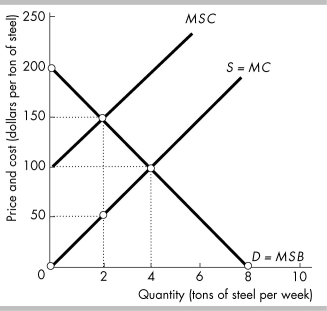 -The above figure shows the marginal social benefit, marginal private cost and marginal social cost of producing steel. There is a marginal external ________ of ________ per ton.
 (Multiple Choice)
4.9/5 (84)
(84) If there are externalities present in a market, resources are allocated efficiently when marginal social cost equals marginal social benefit.
(True/False)
4.9/5 (73)
(73) The marginal social cost, MSC, of producing a good or service equals
(Multiple Choice)
4.8/5 (79)
(79) 
Filters
- Essay(0)
- Multiple Choice(0)
- Short Answer(0)
- True False(0)
- Matching(0)