



 Chat with AI
Exam 23: The Evolution of Populations

Exam 1: Evolution, the Themes of Biology, and Scientific Inquiry51 Questions
Exam 2: The Chemical Context of Life61 Questions
Exam 3: Water and Life55 Questions
Exam 4: Carbon and the Molecular Diversity of Life58 Questions
Exam 5: The Structure and Function of Large Biological Molecules70 Questions
Exam 6: A Tour of the Cell66 Questions
Exam 7: Membrane Structure and Function68 Questions
Exam 8: An Introduction to Metabolism67 Questions
Exam 9: Cellular Respiration and Fermentation68 Questions
Exam 10: Photosynthesis65 Questions
Exam 11: Cell Communication65 Questions
Exam 12: The Cell Cycle66 Questions
Exam 13: Meiosis and Sexual Life Cycles64 Questions
Exam 14: Mendel and the Gene Idea62 Questions
Exam 15: The Chromosomal Basis of Inheritance58 Questions
Exam 16: The Molecular Basis of Inheritance65 Questions
Exam 17: Gene Expression: From Gene to Protein67 Questions
Exam 18: Regulation of Gene Expression66 Questions
Exam 19: Viruses54 Questions
Exam 20: DNA Tools and Biotechnology57 Questions
Exam 21: Genomes and Their Evolution44 Questions
Exam 22: Descent with Modification: A Darwinian View of Life60 Questions
Exam 23: The Evolution of Populations64 Questions
Exam 24: The Origin of Species67 Questions
Exam 25: The History of Life on Earth59 Questions
Exam 26: Phylogeny and the Tree of Life75 Questions
Exam 27: Bacteria and Archaea75 Questions
Exam 28: Protists79 Questions
Exam 29: Plant Diversity I: How Plants Colonized Land82 Questions
Exam 30: Plant Diversity II: The Evolution of Seed Plants80 Questions
Exam 31: Fungi75 Questions
Exam 32: An Overview of Animal Diversity67 Questions
Exam 33: An Introduction to Invertebrates83 Questions
Exam 34: The Origin and Evolution of Vertebrates82 Questions
Exam 35: Vascular Plant Structure, Growth, and Development65 Questions
Exam 36: Resource Acquisition and Transport in Vascular Plants74 Questions
Exam 37: Soil and Plant Nutrition52 Questions
Exam 38: Angiosperm Reproduction and Biotechnology60 Questions
Exam 39: Plant Responses to Internal and External Signals61 Questions
Exam 40: Basic Principles of Animal Form and Function68 Questions
Exam 41: Animal Nutrition64 Questions
Exam 42: Circulation and Gas Exchange67 Questions
Exam 43: The Immune System69 Questions
Exam 44: Osmoregulation and Excretion64 Questions
Exam 45: Hormones and the Endocrine System66 Questions
Exam 46: Animal Reproduction68 Questions
Exam 47: Animal Development70 Questions
Exam 48: Neurons, Synapses, and Signaling68 Questions
Exam 49: Nervous Systems65 Questions
Exam 50: Sensory and Motor Mechanisms67 Questions
Exam 51: Animal Behavior69 Questions
Exam 52: An Introduction to Ecology and the Biosphere68 Questions
Exam 53: Population Ecology69 Questions
Exam 54: Community Ecology71 Questions
Exam 55: Ecosystems and Restoration Ecology68 Questions
Exam 56: Conservation Biology and Global Change69 Questions
Select questions type


In the formula for determining a population's genotype frequencies, the "pq" in the term 2pq is necessary because ________.
(Multiple Choice)
4.8/5  (81)
(81) No two people are genetically identical, except for identical twins. The main source of genetic variation among humans is
(Multiple Choice)
4.8/5 (77)
(77) Use the following information to answer the question below.
Martin Wikelski and L. Michael Romero (Body size, performance and fitness in Galápagos marine iguanas, Integrative and Comparative Biology 43 [2003]:376-86)measured the snout-to-vent (anus)length of Galápagos marine iguanas and observed the percent survival of different-sized animals, all of the same age. The graph shows the log snout-vent length (SVL, a measure of overall body size)plotted against the percent survival of these different size classes for males and females.
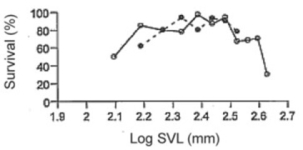 Examine the figure. What type of selection for body size appears to be occurring in these marine iguanas?
 (Multiple Choice)
4.9/5 (78)
(78) Suppose 64% of a remote mountain village can taste phenylthiocarbamide (PTC)and must, therefore, have at least one copy of the dominant PTC taster allele. If this population conforms to Hardy-Weinberg equilibrium for this gene, what percentage of the population must be heterozygous for this trait?
(Multiple Choice)
4.8/5 (82)
(82) If the nucleotide variability of a locus equals 0%, what is the gene variability and number of alleles at that locus?
(Multiple Choice)
4.9/5 (62)
(62) In a Hardy-Weinberg population with two alleles, A and a, that are in equilibrium, the frequency of allele a is 0.1. What is the frequency of individuals with AA genotype?
(Multiple Choice)
4.7/5 (64)
(64) Natural selection changes allele frequencies because some ________ survive and reproduce better than others.
(Multiple Choice)
4.8/5 (79)
(79) A large population of laboratory animals has been allowed to breed randomly for a number of generations. After several generations, 25% of the animals display a recessive trait (aa), the same percentage as at the beginning of the breeding program. The rest of the animals show the dominant phenotype, with heterozygotes indistinguishable from the homozygous dominants.
What is the most reasonable conclusion that can be drawn from the fact that the frequency of the recessive trait (aa)has not changed over time?
(Multiple Choice)
4.9/5 (81)
(81) Which of the following is the best modern definition of evolution?
(Multiple Choice)
4.8/5 (82)
(82) A proficient engineer can easily design skeletal structures that are more functional than those currently found in the forelimbs of such diverse mammals as horses, whales, and bats. The actual forelimbs of these mammals do not seem to be optimally arranged because ________.
(Multiple Choice)
4.7/5 (76)
(76) In the formula for determining a population's genotype frequencies, the "2" in the term 2pq is necessary because ________.
(Multiple Choice)
4.8/5 (86)
(86) Why does the fitness of a phenotype depend on frequency-dependent selection?
(Multiple Choice)
4.9/5 (94)
(94) On the Bahamian island of Andros, mosquitofish populations live in various, now-isolated, freshwater ponds that were once united. Currently, some predator-rich ponds have mosquitofish that can swim in short, fast bursts; other predator-poor ponds have mosquitofish that can swim continuously for a long time. When placed together in the same body of water, the two kinds of female mosquitofish exhibit exclusive breeding preferences.
If one builds a canal linking a predator-rich pond to a predator-poor pond, then what type of selection should subsequently be most expected among the mosquitofish in the original predator-rich pond, and what type should be most expected among the mosquitofish in the formerly predator-poor pond?
(Multiple Choice)
4.9/5 (70)
(70) Use the following information to answer the question below.
Martin Wikelski and L. Michael Romero (Body size, performance and fitness in Galápagos marine iguanas, Integrative and Comparative Biology 43 [2003]:376-86)measured the snout-to-vent (anus)length of Galápagos marine iguanas and observed the percent survival of different-sized animals, all of the same age. The graph shows the log snout-vent length (SVL, a measure of overall body size)plotted against the percent survival of these different size classes for males and females.
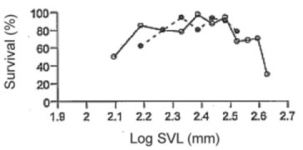 Currently the only predators of Galápagos marine iguanas are Galápagos hawks. Iguana body size is not correlated with risk of hawk predation, although small iguanas can sprint faster than large iguanas. If predators (for example, cats)that preferably catch and eat slower iguanas are introduced to the island, iguana body size is likely to ________ in the absence of other factors; the iguanas would then be under ________ selection.
 (Multiple Choice)
4.9/5 (86)
(86) There are 25 individuals in population 1, all with genotype AA, and there are 40 individuals in population 2, all with genotype aa. Assume that these populations are located far from each other and that their environmental conditions are very similar. Based on the information given here, the observed genetic variation most likely resulted from
(Multiple Choice)
4.9/5 (82)
(82) Over time, the movement of people on Earth has steadily increased. This has altered the course of human evolution by increasing ________.
(Multiple Choice)
4.9/5 (81)
(81) Arrange the following in order from most general to most specific.
1natural selection
2)microevolution
3)intrasexual selection
4)evolution
5)sexual selection
(Multiple Choice)
4.8/5 (71)
(71) Which of the following is the most predictable outcome of increased gene flow between two populations?
(Multiple Choice)
4.9/5 (72)
(72) You are maintaining a small population of fruit flies in the laboratory by transferring the flies to a new culture bottle after each generation. After several generations, you notice that the viability of the flies has decreased greatly. Recognizing that small population size is likely to be linked to decreased viability, the best way to reverse this trend is to ________.
(Multiple Choice)
4.8/5 (90)
(90) You sample a population of butterflies and find that 56% are heterozygous at a particular locus. What should be the frequency of the homozygous individuals in this population?
(Multiple Choice)
4.9/5 (85)
(85) 
Filters
- Essay(0)
- Multiple Choice(0)
- Short Answer(0)
- True False(0)
- Matching(0)