



 Chat with AI
Exam 23: The Evolution of Populations

Exam 1: Evolution, the Themes of Biology, and Scientific Inquiry51 Questions
Exam 2: The Chemical Context of Life61 Questions
Exam 3: Water and Life55 Questions
Exam 4: Carbon and the Molecular Diversity of Life58 Questions
Exam 5: The Structure and Function of Large Biological Molecules70 Questions
Exam 6: A Tour of the Cell66 Questions
Exam 7: Membrane Structure and Function68 Questions
Exam 8: An Introduction to Metabolism67 Questions
Exam 9: Cellular Respiration and Fermentation68 Questions
Exam 10: Photosynthesis65 Questions
Exam 11: Cell Communication65 Questions
Exam 12: The Cell Cycle66 Questions
Exam 13: Meiosis and Sexual Life Cycles64 Questions
Exam 14: Mendel and the Gene Idea62 Questions
Exam 15: The Chromosomal Basis of Inheritance58 Questions
Exam 16: The Molecular Basis of Inheritance65 Questions
Exam 17: Gene Expression: From Gene to Protein67 Questions
Exam 18: Regulation of Gene Expression66 Questions
Exam 19: Viruses54 Questions
Exam 20: DNA Tools and Biotechnology57 Questions
Exam 21: Genomes and Their Evolution44 Questions
Exam 22: Descent with Modification: A Darwinian View of Life60 Questions
Exam 23: The Evolution of Populations64 Questions
Exam 24: The Origin of Species67 Questions
Exam 25: The History of Life on Earth59 Questions
Exam 26: Phylogeny and the Tree of Life75 Questions
Exam 27: Bacteria and Archaea75 Questions
Exam 28: Protists79 Questions
Exam 29: Plant Diversity I: How Plants Colonized Land82 Questions
Exam 30: Plant Diversity II: The Evolution of Seed Plants80 Questions
Exam 31: Fungi75 Questions
Exam 32: An Overview of Animal Diversity67 Questions
Exam 33: An Introduction to Invertebrates83 Questions
Exam 34: The Origin and Evolution of Vertebrates82 Questions
Exam 35: Vascular Plant Structure, Growth, and Development65 Questions
Exam 36: Resource Acquisition and Transport in Vascular Plants74 Questions
Exam 37: Soil and Plant Nutrition52 Questions
Exam 38: Angiosperm Reproduction and Biotechnology60 Questions
Exam 39: Plant Responses to Internal and External Signals61 Questions
Exam 40: Basic Principles of Animal Form and Function68 Questions
Exam 41: Animal Nutrition64 Questions
Exam 42: Circulation and Gas Exchange67 Questions
Exam 43: The Immune System69 Questions
Exam 44: Osmoregulation and Excretion64 Questions
Exam 45: Hormones and the Endocrine System66 Questions
Exam 46: Animal Reproduction68 Questions
Exam 47: Animal Development70 Questions
Exam 48: Neurons, Synapses, and Signaling68 Questions
Exam 49: Nervous Systems65 Questions
Exam 50: Sensory and Motor Mechanisms67 Questions
Exam 51: Animal Behavior69 Questions
Exam 52: An Introduction to Ecology and the Biosphere68 Questions
Exam 53: Population Ecology69 Questions
Exam 54: Community Ecology71 Questions
Exam 55: Ecosystems and Restoration Ecology68 Questions
Exam 56: Conservation Biology and Global Change69 Questions
Select questions type


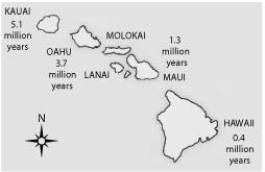 Soon after the island of Hawaii rose above the sea surface (somewhat less than one million years ago), the evolution of life on this new island should have been most strongly influenced by ________.
 (Multiple Choice)
4.9/5  (84)
(84) Which of the following descriptions illustrates phenotype variation caused by environment?
(Multiple Choice)
4.8/5 (69)
(69) Homozygotes with two sickle-cell alleles are selected against because of mortality. However, heterozygotes for sickle-cell allele experience little effects of sickle allele and are more likely to survive malaria. The net effect of this exposure produced evolutionary change in areas where malaria is endemic by ________.
(Multiple Choice)
4.8/5 (75)
(75) The following experiment is used for the corresponding question.
A researcher discovered a species of moth that lays its eggs on oak trees. Eggs are laid at two distinct times of the year: early in spring when the oak trees are flowering and in midsummer when flowering is past. Caterpillars from eggs that hatch in spring feed on oak flowers and look like oak flowers. But caterpillars that hatch in summer feed on oak leaves and look like oak twigs.
How does the same population of moths produce such different-looking caterpillars on the same trees? To answer this question, the biologist caught many female moths from the same population and collected their eggs. He put at least one egg from each female into eight identical cups. The eggs hatched, and at least two larvae from each female were maintained in one of the four temperature and light conditions listed below.
Temperature Day Length Springlike Springlike Springlike Summerlike Summerlike Springlike Summerlike Summerlike
In each of the four environments, one of the caterpillars was fed oak flowers, the other oak leaves. Thus, there were a total of eight treatment groups (4 environments × 2 diets).
Which of the following is a testable hypothesis that would explain the differences in caterpillar appearance observed in this population?
(Multiple Choice)
4.8/5 (80)
(80) Genetic drift produces variation for evolution when ________.
(Multiple Choice)
5.0/5 (81)
(81) Which statement about the beak size of finches on the island of Daphne Major during prolonged drought is true?
(Multiple Choice)
4.8/5 (79)
(79) Whenever diploid populations are in Hardy-Weinberg equilibrium at a particular locus, ________.
(Multiple Choice)
4.9/5 (69)
(69) Comparisons of Neanderthal DNA revealed that there are more similarities to non-African DNA than reference sequences from West Africans. Additionally, scientists found that Neanderthal DNA is as closely related to East Asians as to Europeans. This indicates that interbreeding occurred before human migration further east. What process of population genetics generated these results?
(Multiple Choice)
4.9/5 (83)
(83) Which one of the following conditions would allow gene frequencies to change by chance?
(Multiple Choice)
4.9/5 (70)
(70) The inability of organisms to evolve anything that could be an advantage reflects ________.
(Multiple Choice)
5.0/5 (83)
(83) Use the following information to answer the question below.
Researchers studying a small milkweed population note that some plants produce a toxin and other plants do not. They identify the gene responsible for toxin production. The dominant allele (T)codes for an enzyme that makes the toxin, and the recessive allele (t)codes for a nonfunctional enzyme that cannot produce the toxin. Heterozygotes produce an intermediate amount of toxin. The genotypes of all individuals in the population are determined (see chart)and used to determine the actual allele frequencies in the population.
 Is this population in Hardy-Weinberg equilibrium?
 (Multiple Choice)
4.9/5 (72)
(72) Swine are vulnerable to infection by bird flu virus and human flu virus, which can both be present in an individual pig at the same time. When this occurs, it is possible for genes from bird flu virus and human flu virus to be combined. If the human flu virus contributes a gene for Tamiflu resistance (Tamiflu is an antiviral drug)to the new virus, and if the new virus is introduced to an environment lacking Tamiflu, then what is most likely to occur?
(Multiple Choice)
4.8/5 (90)
(90) Adult male humans generally have deeper voices than do adult female humans, which is the direct result of higher levels of testosterone causing growth of the larynx. If the fossil records of apes and humans alike show a trend toward decreasing larynx size in adult females and increasing larynx size in adult males, then ________.
(Multiple Choice)
4.9/5 (88)
(88) Use the following information to answer the question below.
In those parts of equatorial Africa where the malaria parasite is most common, the sickle-cell allele constitutes 20% of the β hemoglobin alleles in the human gene pool.
In the United States, the parasite that causes malaria is not present, but it is present in African-Americans whose ancestors were from equatorial Africa. What should be happening to the sickle-cell allele in the United States, and what should be happening to it in equatorial Africa?
(Multiple Choice)
4.9/5 (79)
(79) A large population of laboratory animals has been allowed to breed randomly for a number of generations. After several generations, 25% of the animals display a recessive trait (aa), the same percentage as at the beginning of the breeding program. The rest of the animals show the dominant phenotype, with heterozygotes indistinguishable from the homozygous dominants.
What proportion of the population is probably heterozygous (Aa)for this trait?
(Multiple Choice)
4.9/5 (81)
(81) Which Hardy-Weinberg condition is affected by population size?
(Multiple Choice)
4.8/5 (77)
(77) A biologist doing a long-term study on a wild spider population observes increased variation in silk thickness. Which of the following could the spider population be experiencing?
(Multiple Choice)
4.8/5 (82)
(82) Anopheles mosquitoes, which carry the malaria parasite, cannot live above elevations of 5,900 feet. In addition, oxygen availability decreases with higher altitude. Consider a hypothetical human population that is adapted to life on the slopes of Mt. Kilimanjaro in Tanzania, a country in equatorial Africa. Mt. Kilimanjaro's base is about 2,600 feet above sea level and its peak is 19,341 feet above sea level. If the incidence of the sickle-cell allele in the population is plotted against altitude (feet above sea level), which of the following distributions is most likely, assuming little migration of people up or down the mountain?
(Multiple Choice)
4.8/5 (79)
(79) 
Filters
- Essay(0)
- Multiple Choice(0)
- Short Answer(0)
- True False(0)
- Matching(0)