



 Chat with AI
Exam 3: Water and Life

Exam 1: Evolution, the Themes of Biology, and Scientific Inquiry51 Questions
Exam 2: The Chemical Context of Life61 Questions
Exam 3: Water and Life55 Questions
Exam 4: Carbon and the Molecular Diversity of Life58 Questions
Exam 5: The Structure and Function of Large Biological Molecules70 Questions
Exam 6: A Tour of the Cell66 Questions
Exam 7: Membrane Structure and Function68 Questions
Exam 8: An Introduction to Metabolism67 Questions
Exam 9: Cellular Respiration and Fermentation68 Questions
Exam 10: Photosynthesis65 Questions
Exam 11: Cell Communication65 Questions
Exam 12: The Cell Cycle66 Questions
Exam 13: Meiosis and Sexual Life Cycles64 Questions
Exam 14: Mendel and the Gene Idea62 Questions
Exam 15: The Chromosomal Basis of Inheritance58 Questions
Exam 16: The Molecular Basis of Inheritance65 Questions
Exam 17: Gene Expression: From Gene to Protein67 Questions
Exam 18: Regulation of Gene Expression66 Questions
Exam 19: Viruses54 Questions
Exam 20: DNA Tools and Biotechnology57 Questions
Exam 21: Genomes and Their Evolution44 Questions
Exam 22: Descent with Modification: A Darwinian View of Life60 Questions
Exam 23: The Evolution of Populations64 Questions
Exam 24: The Origin of Species67 Questions
Exam 25: The History of Life on Earth59 Questions
Exam 26: Phylogeny and the Tree of Life75 Questions
Exam 27: Bacteria and Archaea75 Questions
Exam 28: Protists79 Questions
Exam 29: Plant Diversity I: How Plants Colonized Land82 Questions
Exam 30: Plant Diversity II: The Evolution of Seed Plants80 Questions
Exam 31: Fungi75 Questions
Exam 32: An Overview of Animal Diversity67 Questions
Exam 33: An Introduction to Invertebrates83 Questions
Exam 34: The Origin and Evolution of Vertebrates82 Questions
Exam 35: Vascular Plant Structure, Growth, and Development65 Questions
Exam 36: Resource Acquisition and Transport in Vascular Plants74 Questions
Exam 37: Soil and Plant Nutrition52 Questions
Exam 38: Angiosperm Reproduction and Biotechnology60 Questions
Exam 39: Plant Responses to Internal and External Signals61 Questions
Exam 40: Basic Principles of Animal Form and Function68 Questions
Exam 41: Animal Nutrition64 Questions
Exam 42: Circulation and Gas Exchange67 Questions
Exam 43: The Immune System69 Questions
Exam 44: Osmoregulation and Excretion64 Questions
Exam 45: Hormones and the Endocrine System66 Questions
Exam 46: Animal Reproduction68 Questions
Exam 47: Animal Development70 Questions
Exam 48: Neurons, Synapses, and Signaling68 Questions
Exam 49: Nervous Systems65 Questions
Exam 50: Sensory and Motor Mechanisms67 Questions
Exam 51: Animal Behavior69 Questions
Exam 52: An Introduction to Ecology and the Biosphere68 Questions
Exam 53: Population Ecology69 Questions
Exam 54: Community Ecology71 Questions
Exam 55: Ecosystems and Restoration Ecology68 Questions
Exam 56: Conservation Biology and Global Change69 Questions
Select questions type


How does 0.5 M sucrose (molecular mass 342)solution compare to 0.5 M glucose (molecular mass 180)solution?

Free
(Multiple Choice)
4.8/5  (82)
(82) Correct Answer: Verified
C
Carbon dioxide in the atmosphere dissolves with the raindrops. The pH of raindrops is ________.
Free
(Multiple Choice)
4.9/5 (87)
(87) Correct Answer:Verified
VerifiedA
Measurements show that the pH of a particular lake is 4.0. What is the hydroxide ion concentration of the lake?
Free
(Multiple Choice)
4.8/5 (77)
(77) Correct Answer:Verified
VerifiedA
What is the hydroxyl ion (OH⁻)concentration of a solution of pH 8?
(Multiple Choice)
4.8/5 (79)
(79) A solution with a pH of 2 has how many more protons in it than a solution with a pH of 4?
(Multiple Choice)
5.0/5 (80)
(80) The partial negative charge in a molecule of water occurs because ________.
(Multiple Choice)
4.9/5 (88)
(88) Which of the following graphs describes the relationship between [H₃O⁺] and pH?
(Multiple Choice)
4.9/5 (78)
(78) Consider two solutions: solution X has a pH of 4; solution Y has a pH of 7. From this information, we can reasonably conclude that ________.
(Multiple Choice)
4.9/5 (65)
(65) What is the pH of a solution with a hydroxyl ion (OH⁻)concentration of 10⁻¹⁰ M?
(Multiple Choice)
4.9/5 (86)
(86) The cities of Portland, Oregon, and Minneapolis, Minnesota, are at about the same latitude, but Minneapolis has much hotter summers and much colder winters than Portland. Why?
(Multiple Choice)
4.7/5 (91)
(91) How much of 0.5 M glucose (molecular mass 180)is needed to provide 100 mg of glucose?
(Multiple Choice)
4.8/5 (70)
(70) In a single molecule of water, two hydrogen atoms are bonded to a single oxygen atom by ________.
(Multiple Choice)
4.7/5 (77)
(77) If the cytoplasm of a cell is at pH 7, and the mitochondrial matrix is at pH 8, then the concentration of H⁺ ions ________.
(Multiple Choice)
4.8/5 (79)
(79) You have a freshly prepared 0.1 M sucrose (molecular mass 342)solution, which means ________.
(Multiple Choice)
4.9/5 (83)
(83) How many grams of the compound in the figure are required to make 1 liter of a 0.5 M solution? (Note: The atomic masses, in daltons, are approximately 12 for carbon, 1 for hydrogen, and 16 for oxygen.)
(Multiple Choice)
4.8/5 (79)
(79) Rank, from low to high, the pH of blood, stomach acid, and urine.
(Multiple Choice)
5.0/5 (77)
(77) Use the following figure to answer the question.
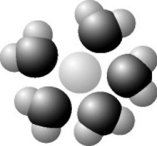 Based on your knowledge of the polarity of water molecules, the solute molecule depicted is most likely ________.
 (Multiple Choice)
4.8/5 (96)
(96) 
Filters
- Essay(0)
- Multiple Choice(0)
- Short Answer(0)
- True False(0)
- Matching(0)