



 Chat with AI
Exam 52: An Introduction to Ecology and the Biosphere

Exam 1: Evolution, the Themes of Biology, and Scientific Inquiry51 Questions
Exam 2: The Chemical Context of Life61 Questions
Exam 3: Water and Life55 Questions
Exam 4: Carbon and the Molecular Diversity of Life58 Questions
Exam 5: The Structure and Function of Large Biological Molecules70 Questions
Exam 6: A Tour of the Cell66 Questions
Exam 7: Membrane Structure and Function68 Questions
Exam 8: An Introduction to Metabolism67 Questions
Exam 9: Cellular Respiration and Fermentation68 Questions
Exam 10: Photosynthesis65 Questions
Exam 11: Cell Communication65 Questions
Exam 12: The Cell Cycle66 Questions
Exam 13: Meiosis and Sexual Life Cycles64 Questions
Exam 14: Mendel and the Gene Idea62 Questions
Exam 15: The Chromosomal Basis of Inheritance58 Questions
Exam 16: The Molecular Basis of Inheritance65 Questions
Exam 17: Gene Expression: From Gene to Protein67 Questions
Exam 18: Regulation of Gene Expression66 Questions
Exam 19: Viruses54 Questions
Exam 20: DNA Tools and Biotechnology57 Questions
Exam 21: Genomes and Their Evolution44 Questions
Exam 22: Descent with Modification: A Darwinian View of Life60 Questions
Exam 23: The Evolution of Populations64 Questions
Exam 24: The Origin of Species67 Questions
Exam 25: The History of Life on Earth59 Questions
Exam 26: Phylogeny and the Tree of Life75 Questions
Exam 27: Bacteria and Archaea75 Questions
Exam 28: Protists79 Questions
Exam 29: Plant Diversity I: How Plants Colonized Land82 Questions
Exam 30: Plant Diversity II: The Evolution of Seed Plants80 Questions
Exam 31: Fungi75 Questions
Exam 32: An Overview of Animal Diversity67 Questions
Exam 33: An Introduction to Invertebrates83 Questions
Exam 34: The Origin and Evolution of Vertebrates82 Questions
Exam 35: Vascular Plant Structure, Growth, and Development65 Questions
Exam 36: Resource Acquisition and Transport in Vascular Plants74 Questions
Exam 37: Soil and Plant Nutrition52 Questions
Exam 38: Angiosperm Reproduction and Biotechnology60 Questions
Exam 39: Plant Responses to Internal and External Signals61 Questions
Exam 40: Basic Principles of Animal Form and Function68 Questions
Exam 41: Animal Nutrition64 Questions
Exam 42: Circulation and Gas Exchange67 Questions
Exam 43: The Immune System69 Questions
Exam 44: Osmoregulation and Excretion64 Questions
Exam 45: Hormones and the Endocrine System66 Questions
Exam 46: Animal Reproduction68 Questions
Exam 47: Animal Development70 Questions
Exam 48: Neurons, Synapses, and Signaling68 Questions
Exam 49: Nervous Systems65 Questions
Exam 50: Sensory and Motor Mechanisms67 Questions
Exam 51: Animal Behavior69 Questions
Exam 52: An Introduction to Ecology and the Biosphere68 Questions
Exam 53: Population Ecology69 Questions
Exam 54: Community Ecology71 Questions
Exam 55: Ecosystems and Restoration Ecology68 Questions
Exam 56: Conservation Biology and Global Change69 Questions
Select questions type


Imagine some cosmic catastrophe jolts Earth so that its axis is perpendicular to the orbital plane between Earth and the sun. The most obvious effect of this change would be ________.

Free
(Multiple Choice)
4.9/5  (73)
(73) Correct Answer: Verified
D
Use the following figures to answer the question below.
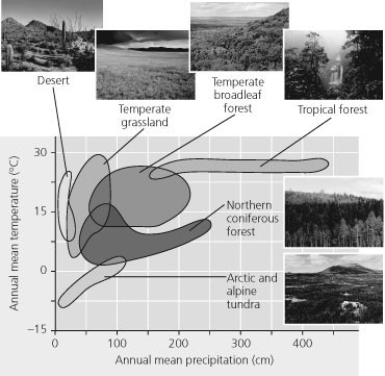 East of the Mississippi River, in Hopkinsville Kentucky, the mean annual precipitation is 130 cm. The mean annual temperature is 14.3°C. In the winter, the mean temperature is 7.3°C, while in summer it is 20.6°C. Using the climograph shown here, how would we classify the biome found in Hopkinsville?
Free
(Multiple Choice)
4.8/5 (79)
(79) Correct Answer:Verified
VerifiedB
If the direction of Earth's rotation reversed, the most predictable effect would be ________.
Free
(Multiple Choice)
4.8/5 (96)
(96) Correct Answer:Verified
VerifiedB
Use the following figure to answer the question below.
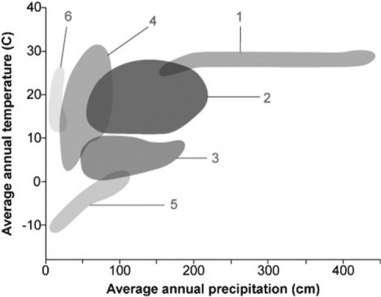 In the figure, which number would designate the biome with the highest variation in both annual precipitation and temperature?
 (Multiple Choice)
4.9/5 (94)
(94) Which of the following investigations would shed the most light on the future distribution of organisms in temperate regions that are faced with climate change?
(Multiple Choice)
4.7/5 (81)
(81) A certain species of pine tree survives only in scattered locations at elevations above 2,800 meters in the western United States. To understand why this tree grows only in these specific places, an ecologist should ________.
(Multiple Choice)
4.8/5 (90)
(90) Coral reefs occur on the southeast coast of the United States but not at similar latitudes on the southwest coast. Differences in which of the following most likely account for this?
(Multiple Choice)
5.0/5 (68)
(68) The success of plants extending their range northward following glacial retreat is primarily determined by ________.
(Multiple Choice)
4.9/5 (71)
(71) If an ecologist were studying the regional interactions among multiple populations of different species and how they influence the exchange of materials between their various environments, then this would be an example of which kind of research?
(Multiple Choice)
4.8/5 (73)
(73) Which of the following is responsible for the differences in summer and winter temperature stratification of deep temperate zone lakes?
(Multiple Choice)
4.8/5 (79)
(79) Which of the following areas of study focuses on the exchange of energy, organisms, and materials between ecosystems?
(Multiple Choice)
4.9/5 (73)
(73) In deep water, which of the following abiotic factors would most limit primary productivity?
(Multiple Choice)
4.8/5 (88)
(88) Which of the following is an important feature of most terrestrial biomes?
(Multiple Choice)
4.9/5 (70)
(70) If you conclude that vegetation at every point on Earth exactly resembles the predicted biome distribution in a climograph, then ________.
(Multiple Choice)
4.8/5 (78)
(78) What would be the effect on climate in the temperate latitudes if Earth were to slow its rate of rotation from a 24-hour period of rotation to a 48-hour period of rotation?
(Multiple Choice)
4.9/5 (76)
(76) Turnover of water in temperate lakes during the spring and fall is caused by which of the following?
(Multiple Choice)
4.9/5 (85)
(85) In mountainous areas of western North America, north-facing slopes would be expected to ________.
(Multiple Choice)
4.8/5 (66)
(66) The oceans affect the biosphere in all of the following ways except
(Multiple Choice)
4.7/5 (74)
(74) Which of the following might be an investigation of microclimate?
(Multiple Choice)
4.9/5 (73)
(73) 
Filters
- Essay(0)
- Multiple Choice(0)
- Short Answer(0)
- True False(0)
- Matching(0)