



 Chat with AI
Exam 52: An Introduction to Ecology and the Biosphere

Exam 1: Evolution, the Themes of Biology, and Scientific Inquiry51 Questions
Exam 2: The Chemical Context of Life61 Questions
Exam 3: Water and Life55 Questions
Exam 4: Carbon and the Molecular Diversity of Life58 Questions
Exam 5: The Structure and Function of Large Biological Molecules70 Questions
Exam 6: A Tour of the Cell66 Questions
Exam 7: Membrane Structure and Function68 Questions
Exam 8: An Introduction to Metabolism67 Questions
Exam 9: Cellular Respiration and Fermentation68 Questions
Exam 10: Photosynthesis65 Questions
Exam 11: Cell Communication65 Questions
Exam 12: The Cell Cycle66 Questions
Exam 13: Meiosis and Sexual Life Cycles64 Questions
Exam 14: Mendel and the Gene Idea62 Questions
Exam 15: The Chromosomal Basis of Inheritance58 Questions
Exam 16: The Molecular Basis of Inheritance65 Questions
Exam 17: Gene Expression: From Gene to Protein67 Questions
Exam 18: Regulation of Gene Expression66 Questions
Exam 19: Viruses54 Questions
Exam 20: DNA Tools and Biotechnology57 Questions
Exam 21: Genomes and Their Evolution44 Questions
Exam 22: Descent with Modification: A Darwinian View of Life60 Questions
Exam 23: The Evolution of Populations64 Questions
Exam 24: The Origin of Species67 Questions
Exam 25: The History of Life on Earth59 Questions
Exam 26: Phylogeny and the Tree of Life75 Questions
Exam 27: Bacteria and Archaea75 Questions
Exam 28: Protists79 Questions
Exam 29: Plant Diversity I: How Plants Colonized Land82 Questions
Exam 30: Plant Diversity II: The Evolution of Seed Plants80 Questions
Exam 31: Fungi75 Questions
Exam 32: An Overview of Animal Diversity67 Questions
Exam 33: An Introduction to Invertebrates83 Questions
Exam 34: The Origin and Evolution of Vertebrates82 Questions
Exam 35: Vascular Plant Structure, Growth, and Development65 Questions
Exam 36: Resource Acquisition and Transport in Vascular Plants74 Questions
Exam 37: Soil and Plant Nutrition52 Questions
Exam 38: Angiosperm Reproduction and Biotechnology60 Questions
Exam 39: Plant Responses to Internal and External Signals61 Questions
Exam 40: Basic Principles of Animal Form and Function68 Questions
Exam 41: Animal Nutrition64 Questions
Exam 42: Circulation and Gas Exchange67 Questions
Exam 43: The Immune System69 Questions
Exam 44: Osmoregulation and Excretion64 Questions
Exam 45: Hormones and the Endocrine System66 Questions
Exam 46: Animal Reproduction68 Questions
Exam 47: Animal Development70 Questions
Exam 48: Neurons, Synapses, and Signaling68 Questions
Exam 49: Nervous Systems65 Questions
Exam 50: Sensory and Motor Mechanisms67 Questions
Exam 51: Animal Behavior69 Questions
Exam 52: An Introduction to Ecology and the Biosphere68 Questions
Exam 53: Population Ecology69 Questions
Exam 54: Community Ecology71 Questions
Exam 55: Ecosystems and Restoration Ecology68 Questions
Exam 56: Conservation Biology and Global Change69 Questions
Select questions type


Suppose that the number of bird species is determined mainly by the number of vertical strata found in the environment. If so, in which of the following biomes would you find the greatest number of bird species?
(Multiple Choice)
4.8/5  (73)
(73) What would happen to the seasons if Earth were tilted 35 degrees off its orbital plane instead of the usual 23.5 degrees?
(Multiple Choice)
4.7/5 (81)
(81) Generally speaking, deserts are located in places where air masses are usually ________.
(Multiple Choice)
4.9/5 (84)
(84) The eight climographs show yearly temperature (line graph and left vertical axis)and precipitation (bar graph and right vertical axis)averages for each month for some locations on Earth.
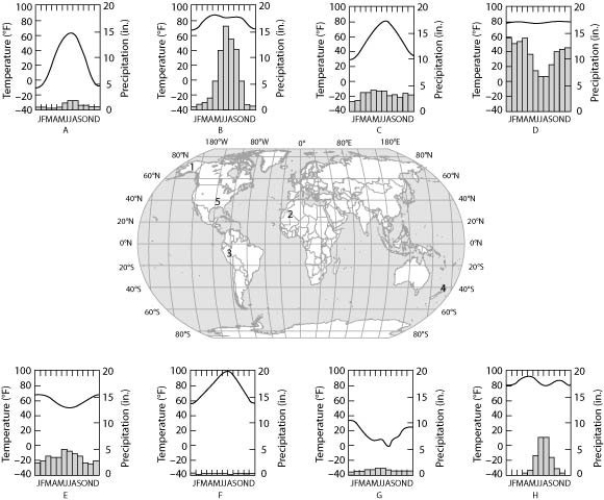 Which climograph shows the climate for location 5?
 (Multiple Choice)
4.9/5 (88)
(88) Suppose that the number of bird species is determined mainly by the number of vertical strata found in the environment. If so, in which of the following biomes would you find the greatest number of bird species?
(Multiple Choice)
4.8/5 (70)
(70) Subtropical plants are commonplace in Land's End, England, whose latitude is the equivalent of Labrador in coastal Canada, where the local flora is instead subarctic. Which statement best explains why this apparent anomaly exists between North America and Europe?
(Multiple Choice)
4.8/5 (76)
(76) The eight climographs show yearly temperature (line graph and left vertical axis)and precipitation (bar graph and right vertical axis)averages for each month for some locations on Earth.
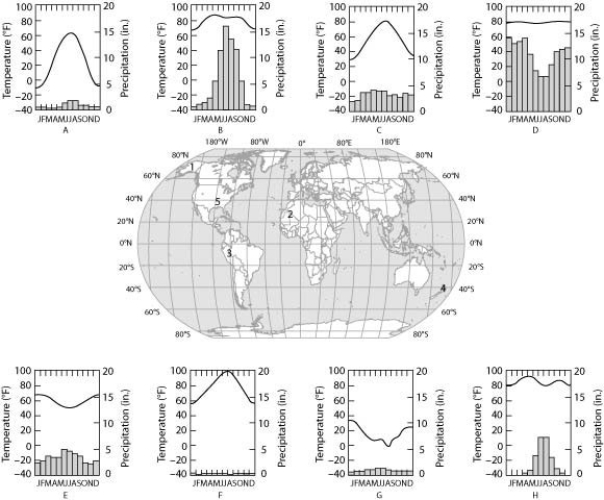 Which climograph shows the climate for location 2?
 (Multiple Choice)
4.7/5 (89)
(89) Which statements about dispersal are accurate?
I.Dispersal is a common component of the life cycles of plants and animals.
II.Colonization of devastated areas after floods or volcanic eruptions primarily depends upon climate.
III.Seeds are important dispersal stages in the life cycles of most flowering plants.
IV.Dispersal occurs only on an evolutionary time scale.
(Multiple Choice)
5.0/5 (82)
(82) In the region of the Rocky Mountains, imagine that one local variety of Ponderosa pine (Pinus ponderosa)predominantly occurs between 5,000-8,500 feet in elevation, where it can best tolerate temperatures and precipitation. If future climate change in this region causes the temperature to increase and rainfall to decrease, then which of the following changes might an ecologist predict about the variety's range?
(Multiple Choice)
4.7/5 (85)
(85) Use the following figure to answer the question below.
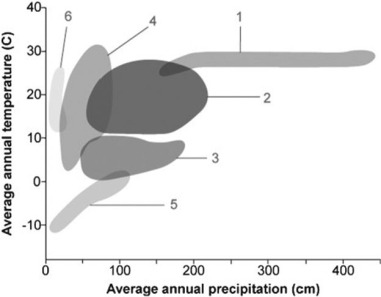 In the figure, which number would designate the arctic tundra biome?
 (Multiple Choice)
4.8/5 (74)
(74) Which of the following biomes spans the largest annual mean temperature range, but the narrowest mean precipitation range?
(Multiple Choice)
4.9/5 (73)
(73) Which aquatic biome listed here is one of the most productive on Earth, and why?
(Multiple Choice)
4.8/5 (73)
(73) Which of the following statements regarding turnover in a lake is correct?
(Multiple Choice)
4.8/5 (89)
(89) In creating global climate patterns, which of the following factors is the primary cause of all of the other factors that are listed?
(Multiple Choice)
4.9/5 (70)
(70) Generalized global air circulation and precipitation patterns are caused by ________.
(Multiple Choice)
4.8/5 (94)
(94) The eight climographs show yearly temperature (line graph and left vertical axis)and precipitation (bar graph and right vertical axis)averages for each month for some locations on Earth.
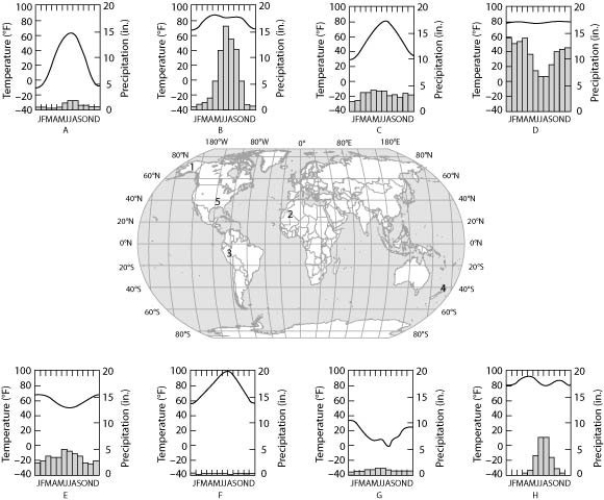 What would be the primary factor, other than precipitation or temperature, that could change the description of a site near location 3 from an equatorial (tropical)climate to alpine tundra?
 (Multiple Choice)
4.9/5 (63)
(63) The eight climographs show yearly temperature (line graph and left vertical axis)and precipitation (bar graph and right vertical axis)averages for each month for some locations on Earth.
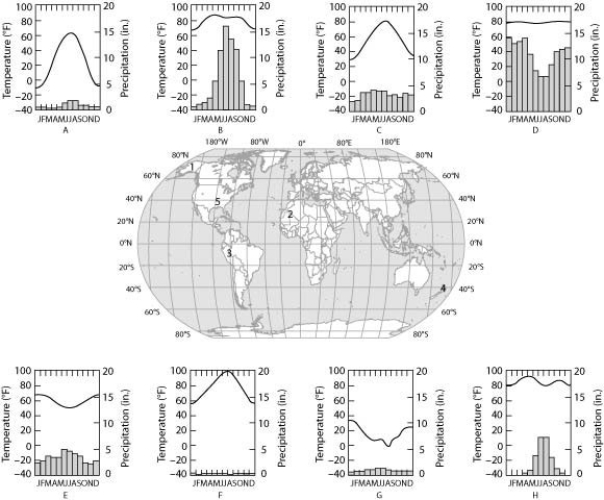 Which climograph shows the climate for location 4?
 (Multiple Choice)
4.8/5 (83)
(83) Which of the following statements best describes the interaction between fire and ecosystems?
(Multiple Choice)
4.8/5 (84)
(84) A fish swimming into an estuary from a river would have which of the following as its greatest physiological challenge?
(Multiple Choice)
4.9/5 (75)
(75) The ocean ecosystems affect the biosphere by ________.
I.producing a substantial amount of the biosphere's oxygen
II.adding carbon dioxide to the atmosphere
III.being the source of most of Earth's rainfall
IV.regulating the pH of freshwater biomes and terrestrial groundwater
(Multiple Choice)
4.9/5 (79)
(79) 
Filters
- Essay(0)
- Multiple Choice(0)
- Short Answer(0)
- True False(0)
- Matching(0)