Multiple Choice
Use the following information to answer the question below.
Martin Wikelski and L. Michael Romero (Body size, performance and fitness in Galápagos marine iguanas, Integrative and Comparative Biology 43 [2003]:376-86) measured the snout-to-vent (anus) length of Galápagos marine iguanas and observed the percent survival of different-sized animals, all of the same age. The graph shows the log snout-vent length (SVL, a measure of overall body size) plotted against the percent survival of these different size classes for males and females.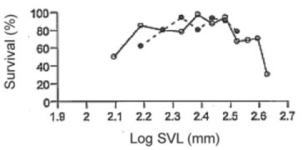
Examine the figure. What type of selection for body size appears to be occurring in these marine iguanas?
A) directional selection
B) stabilizing selection
C) disruptive selection
D) You cannot determine the type of selection from the above information.
Correct Answer:

Verified
Correct Answer:
Verified
Q2: The restriction enzymes of bacteria protect the
Q4: Natural selection changes allele frequencies because some
Q13: Suppose 64% of a remote mountain village
Q16: No two people are genetically identical, except
Q37: In the formula for determining a population's
Q37: If the nucleotide variability of a locus
Q41: In some jacana species, males take care
Q50: A large population of laboratory animals has
Q54: In 1983, a population of dark-eyed junco
Q64: In a Hardy-Weinberg population with two alleles,