



 Chat with AI
Exam 4: Consumer and Producer Surplus

Exam 1: First Principles233 Questions
Exam 2: Economic Models: Trade-Offs and Trade 25382 Questions
Exam 3: Supply and Demand290 Questions
Exam 4: Consumer and Producer Surplus224 Questions
Exam 5: Price Controls and Quotas: Meddling With Markets227 Questions
Exam 6: Elasticity300 Questions
Exam 7: Taxes298 Questions
Exam 8: International Trade272 Questions
Exam 9: Decision Making by Individuals Firms201 Questions
Exam 10: The Rational Consumer372 Questions
Exam 11: Behind the Supply Curve: Inputs and Costs362 Questions
Exam 12: Perfect Competition and the Supply Curve355 Questions
Exam 13: Monopoly350 Questions
Exam 14: Oligopoly294 Questions
Exam 15: Monopolistic Competition and Product Differentiation262 Questions
Exam 16: Externalities199 Questions
Exam 17: Public Goods Common Resources224 Questions
Exam 18: The Economics of the Welfare140 Questions
Exam 19: Factor Markets and the Distribution of Income369 Questions
Exam 20: Uncertainty, Risk, and Private Information202 Questions
Select questions type


If the cost of soybeans (the major ingredient in tofu) decreases, consumer surplus in the market for tofu will decrease.
(True/False)
4.9/5  (79)
(79) Use the following to answer questions:  -(Table: Producer Surplus and Phantom Tickets) The table Producer Surplus and Phantom Tickets shows the minimum price at which each of the students is willing to sell a ticket to Phantom of the Opera. Assume that each student has only one ticket to sell. Given the information in the table, if these students can sell their Phantom tickets for only $5, then:
 (Multiple Choice)
4.9/5 (72)
(72) Use the following to answer questions: 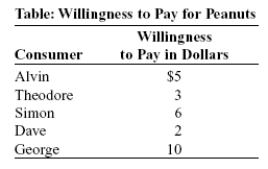 -(Table: Willingness to Pay for Peanuts) Using the table Willingness to Pay for Peanuts, if the price of a bag of peanuts is $2:
 (Multiple Choice)
4.9/5 (91)
(91) Markets work because they allocate sales to the potential sellers who most value the right to sell a good, as indicated by their ability to produce the good at the lowest cost. This statement illustrates:
(Multiple Choice)
4.8/5 (86)
(86) Peanut butter and jelly are complements in consumption. Assuming that the supply curve of peanut butter is upward-sloping, if there is a decrease in the price of jelly, producer surplus in the peanut butter market:
(Multiple Choice)
4.8/5 (85)
(85) Which of the following is TRUE concerning the relationship between efficiency and equity?
(Multiple Choice)
4.8/5 (66)
(66) Alex is willing to buy the last ticket to the Billy Bragg concert for $15, while Jake is willing to pay $25. Alex is first in line and buys a ticket for $15. He then resells his ticket to Jake for $20. By reselling the ticket instead of going to the concert himself, Alex caused:
(Multiple Choice)
5.0/5 (85)
(85) Use the following to answer questions:  -(Table: Consumer Surplus and Phantom Tickets) The table Consumer Surplus and Phantom Tickets shows each student's willingness to pay for a Phantom of the Opera ticket. Assume that each student wants to buy one ticket. If the box office price of a ticket to see Phantom of the Opera is $130 and there is no other market for tickets, the total consumer surplus for the five students is:
 (Multiple Choice)
4.7/5 (72)
(72) Use the following to answer questions:
Figure: Producer Surplus III  -(Figure: Producer Surplus III) Look at the figure Producer Surplus III. If the price of the good decreases from $2 to $1, producer surplus will decrease by:
 (Multiple Choice)
4.8/5 (79)
(79) Use the following to answer questions:
Figure: The Market for Books 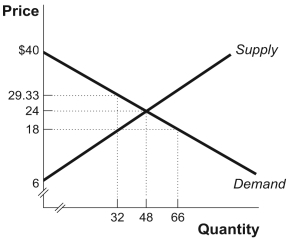 -(Figure: Market for Books) Look at the figure The Market for Books. Suppose the price is temporarily $18. Do consumers gain or lose from this price, and by how much? Do producers gain or lose from this price control, and by how much? How is total surplus affected?
 (Essay)
4.9/5 (87)
(87) Equilibrium in the market for peanut butter is disturbed by an increase in the price of peanuts. Assuming that the supply curve of peanut butter is upward-sloping, producer surplus in the peanut butter market:
(Multiple Choice)
4.7/5 (72)
(72) Use the following to answer question:
Figure: Monthly Supply of Bread  -(Figure: Monthly Supply of Bread) The figure Monthly Supply of Bread represents the monthly supply of bread at a local bakery. At $3 per loaf, the bakery produces 120 loaves per month. The producer surplus received by this bakery is equal to:
 (Multiple Choice)
4.8/5 (78)
(78) Producer surplus is represented by the area _____ the supply curve and _____ the price.
(Multiple Choice)
4.9/5 (66)
(66) If property rights are restricted by government regulation, many more mutually beneficial transactions will occur.
(True/False)
4.9/5 (82)
(82) Use the following to answer questions:
Figure: Change in the Total Surplus  -(Figure: Change in Total Surplus) Look at the figure Change in Total Surplus. Which of the following areas represent the change in total surplus when the price falls from P1 to P2?
 (Multiple Choice)
4.8/5 (89)
(89) If the price is above the equilibrium price in the market for grapefruit, assuming a positively sloped supply curve and a negatively sloped demand curve, total surplus:
(Multiple Choice)
4.8/5 (78)
(78) Coffee and tea are substitutes in consumption. If there is an increase in the price of coffee, assuming a positively sloped supply curve and a negatively sloped demand curve, total surplus in the tea market:
(Multiple Choice)
4.8/5 (83)
(83) The total producer surplus in the Wisconsin milk market is:
(Multiple Choice)
4.8/5 (65)
(65) Use the following to answer questions:  -(Table: Consumer Surplus) Look at the table Consumer Surplus. Assume that each student wants to buy one ticket. If the price of a ticket to see The Nutty Nutcracker is $75, Lois's consumer surplus is:
 (Multiple Choice)
4.9/5 (89)
(89) Vonda and Aleiyah are shopping together at the mall for new jeans. Vonda is willing to pay $90 and Aleiyah is willing to pay $50 for a pair of jeans. What is the gain in total consumer surplus when the price decreases from $59 to $40?
(Multiple Choice)
4.9/5 (94)
(94) 
Filters
- Essay(0)
- Multiple Choice(0)
- Short Answer(0)
- True False(0)
- Matching(0)