



 Chat with AI
Exam 4: Consumer and Producer Surplus

Exam 1: First Principles233 Questions
Exam 2: Economic Models: Trade-Offs and Trade 25382 Questions
Exam 3: Supply and Demand290 Questions
Exam 4: Consumer and Producer Surplus224 Questions
Exam 5: Price Controls and Quotas: Meddling With Markets227 Questions
Exam 6: Elasticity300 Questions
Exam 7: Taxes298 Questions
Exam 8: International Trade272 Questions
Exam 9: Decision Making by Individuals Firms201 Questions
Exam 10: The Rational Consumer372 Questions
Exam 11: Behind the Supply Curve: Inputs and Costs362 Questions
Exam 12: Perfect Competition and the Supply Curve355 Questions
Exam 13: Monopoly350 Questions
Exam 14: Oligopoly294 Questions
Exam 15: Monopolistic Competition and Product Differentiation262 Questions
Exam 16: Externalities199 Questions
Exam 17: Public Goods Common Resources224 Questions
Exam 18: The Economics of the Welfare140 Questions
Exam 19: Factor Markets and the Distribution of Income369 Questions
Exam 20: Uncertainty, Risk, and Private Information202 Questions
Select questions type


One way to measure the gain to consumers from a drug that has the potential to reduce obesity is to measure what people are willing to pay for the good and subtract the amount they have to pay.
(True/False)
4.8/5  (63)
(63) Along a given downward-sloping demand curve, an increase in the price of a good will _____ consumer surplus.
(Multiple Choice)
5.0/5 (66)
(66) Use the following to answer questions:
Figure: The Gains from Trade 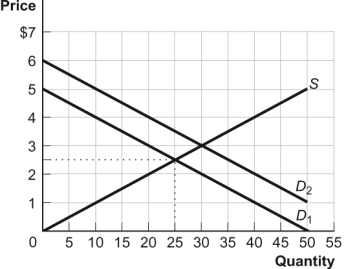 -(Figure: The Gains from Trade) Look at the figure The Gains from Trade. When demand increases from D1 to D2, equilibrium total surplus:
 (Multiple Choice)
4.8/5 (76)
(76) Use the following to answer questions:  -(Table: Willingness to Pay for Basketball Sneakers) The table Willingness to Pay for Basketball Sneakers shows each player's willingness to pay for basketball sneakers. Assume that each player wants to buy at most, one pair of sneakers. If the price of basketball sneakers is $100, how many pairs will be purchased?
 (Multiple Choice)
4.7/5 (82)
(82) Use the following to answer questions:
Figure: The Gains from Trade
-(Figure: The Gains from Trade) Look at the figure The Gains from Trade. What is the total surplus in this market when the demand curve is D2 and the market is in equilibrium?
-(Figure: The Gains from Trade) Look at the figure The Gains from Trade. What is the total surplus in this market when the demand curve is D2 and the market is in equilibrium? (Multiple Choice)
4.8/5 (79)
(79) Total surplus in a market is the excess of the number of consumers above the optimum number.
(True/False)
4.9/5 (84)
(84) Suppose the equilibrium rent for apartments in Boston is $1,600. If the city of Boston imposes a price ceiling of $1,200, there will be:
(Multiple Choice)
4.9/5 (79)
(79) If there is an increase in demand, assuming a positively sloped supply curve and a negatively sloped demand curve, total surplus:
(Multiple Choice)
4.9/5 (85)
(85) Use the following to answer questions:
Figure: Consumer and Producer Surplus  -(Figure: Consumer and Producer Surplus) Look at the figure Consumer and Producer Surplus. If the price is held below equilibrium, producer surplus _____ and total surplus _____.
 (Multiple Choice)
4.8/5 (61)
(61) When a market is in equilibrium and there is no outside intervention to change the equilibrium price:
(Multiple Choice)
4.9/5 (81)
(81) Along a given upward-sloping supply curve, a decrease in the price of a good will _____ producer surplus.
(Multiple Choice)
4.9/5 (83)
(83) Total surplus is the excess of consumer surplus over producer surplus.
(True/False)
4.7/5 (77)
(77) Use the following to answer questions:
Figure: The Market for Hamburgers 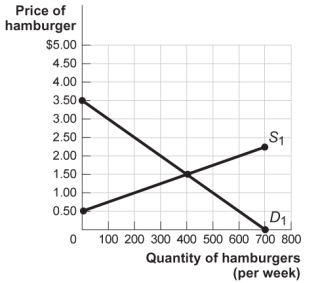 -(Figure: The Market for Hamburgers) The figure The Market for Hamburgers shows the weekly market for hamburgers in Tuscaloosa. If the price of a hamburger falls from $2.00 to $1.50, the gain in consumer surplus to consumers who are persuaded to buy at the lower price (and who were not buying when the price was $2.00) is equal to:
 (Multiple Choice)
4.8/5 (74)
(74) A price below the equilibrium price will cause a reduction in consumer surplus.
(True/False)
4.9/5 (66)
(66) If the government intervened in the market by lowering the price of a good below the equilibrium price, which of the following would NOT occur?
(Multiple Choice)
4.8/5 (87)
(87) Use the following to answer questions:
Figure: A Market in Equilibrium 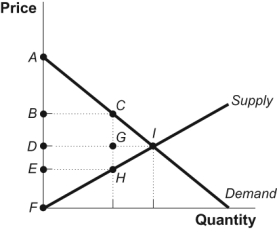 -(Figure: A Market in Equilibrium) Look at the figure A Market in Equilibrium. At the equilibrium price, this market's total producer and consumer surplus equals the area:
 (Multiple Choice)
4.9/5 (72)
(72) Along a given upward-sloping supply curve, a decrease in price will cause producer surplus to:
(Multiple Choice)
4.9/5 (80)
(80) Use the following to answer question:
Figure: Market Demand  -(Figure: Market Demand) Look at the figure Market Demand. The amount by which the total benefits to consumers exceed their total expenditure is called _____, and if the price is B, is depicted by the area _____.
 (Multiple Choice)
4.8/5 (76)
(76) Use the following to answer question:
Figure: Gain in Producer Surplus 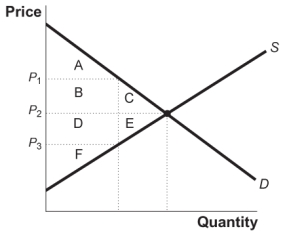 -(Figure: Gain in Producer Surplus) Look at the figure Gain in Producer Surplus. Which of the following areas represent producer surplus when the price is equal to P2?
 (Multiple Choice)
4.8/5 (88)
(88) If the market for grapefruit is in equilibrium without any outside intervention to change the equilibrium price:
(Multiple Choice)
4.9/5 (77)
(77) 
Filters
- Essay(0)
- Multiple Choice(0)
- Short Answer(0)
- True False(0)
- Matching(0)