



 Chat with AI
Exam 4: Consumer and Producer Surplus

Exam 1: First Principles233 Questions
Exam 2: Economic Models: Trade-Offs and Trade 25382 Questions
Exam 3: Supply and Demand290 Questions
Exam 4: Consumer and Producer Surplus224 Questions
Exam 5: Price Controls and Quotas: Meddling With Markets227 Questions
Exam 6: Elasticity300 Questions
Exam 7: Taxes298 Questions
Exam 8: International Trade272 Questions
Exam 9: Decision Making by Individuals Firms201 Questions
Exam 10: The Rational Consumer372 Questions
Exam 11: Behind the Supply Curve: Inputs and Costs362 Questions
Exam 12: Perfect Competition and the Supply Curve355 Questions
Exam 13: Monopoly350 Questions
Exam 14: Oligopoly294 Questions
Exam 15: Monopolistic Competition and Product Differentiation262 Questions
Exam 16: Externalities199 Questions
Exam 17: Public Goods Common Resources224 Questions
Exam 18: The Economics of the Welfare140 Questions
Exam 19: Factor Markets and the Distribution of Income369 Questions
Exam 20: Uncertainty, Risk, and Private Information202 Questions
Select questions type


Use the following to answer questions:
Figure: Demand for Cincinnati Reds Games Tickets 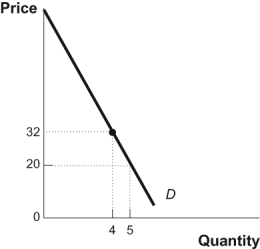 -(Figure: Demand for Cincinnati Reds Games Tickets) The figure Demand for Cincinnati Red Games Tickets represents Jeff's annual demand for tickets to Cincinnati Reds baseball games. At $20, Jeff will purchase five tickets. How much consumer surplus does Jeff receive?
 (Essay)
4.8/5  (86)
(86) Use the following to answer questions:
Figure: A Market in Equilibrium 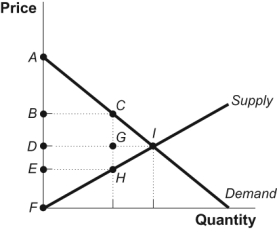 -(Figure: A Market in Equilibrium) Look at the figure A Market in Equilibrium. At the equilibrium price, this market's producer surplus is equal to the area:
 (Multiple Choice)
4.9/5 (78)
(78) Consumer surplus is the amount buyers actually pay for a good minus the maximum amount they are willing to pay for it.
(True/False)
4.9/5 (81)
(81) Use the following to answer questions:
Figure: Gain in Consumer Surplus 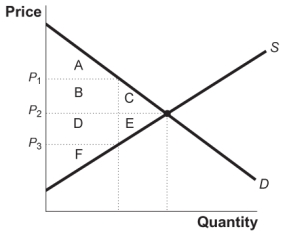 -(Figure: Gain in Consumer Surplus) Look at the figure Gain in Consumer Surplus. Identify the area or areas that represent the gain in consumer surplus to consumers already participating in the market when the price falls from P1 to P2.
 (Multiple Choice)
4.7/5 (75)
(75) All else equal, when the supply curve shifts left, the producer surplus increases.
(True/False)
4.8/5 (74)
(74) Use the following to answer question:
Figure: The Market for Hamburgers 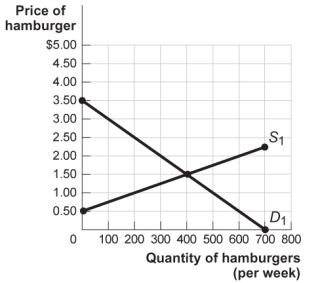 -(Figure: The Market for Hamburgers) Look at the figure The Market for Hamburgers. The maximum total surplus for the market is _____, and it occurs at a price equal to _____.
 (Multiple Choice)
4.8/5 (90)
(90) The gains from trade are the reason that consumers and producers are better off participating in a market economy than they would be if each tried to be self-sufficient.
(True/False)
4.8/5 (73)
(73) If there is a decrease in demand, assuming a positively sloped supply curve and a negatively sloped demand curve, total surplus:
(Multiple Choice)
4.7/5 (70)
(70) Use the following to answer questions:
Figure: Consumer Surplus I 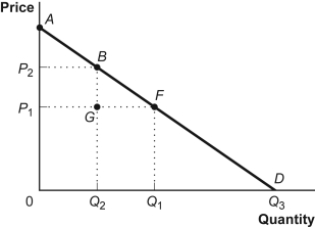 -(Figure: Consumer Surplus I) Look at the figure Consumer Surplus I. At a price of P2, consumer surplus equals the area:
 (Multiple Choice)
4.8/5 (81)
(81) Prices above equilibrium on agricultural products like milk exist to maximize the consumer surplus.
(True/False)
4.9/5 (74)
(74) A competitive market for cell phone chargers is in equilibrium. If the price temporarily falls below the equilibrium price:
(Multiple Choice)
4.8/5 (74)
(74) Along a given downward-sloping demand curve, a decrease in the price of a good will _____ consumer surplus.
(Multiple Choice)
4.9/5 (76)
(76) Anna is willing to sell her 20-year-old boat, but not for less than $2,300. For Anna, the cost of selling this boat is _____ $2,300.
(Multiple Choice)
4.9/5 (81)
(81) Use the following to answer questions:  -(Table: Consumer Surplus) Look at the table Consumer Surplus. Assume that each student wants to buy one ticket. If the price of a ticket to see The Nutty Nutcracker is $50, Lois's consumer surplus is:
 (Multiple Choice)
4.9/5 (68)
(68) If the supply curve of ice cream is upward-sloping and demand for it decreases, there will be _____ in producer surplus.
(Multiple Choice)
4.9/5 (92)
(92) Use the following to answer questions:
Figure: Consumer Surplus II  -(Figure: Consumer Surplus II) Look at the figure Consumer Surplus II. If the price of the good is $4, consumer surplus will equal:
 (Multiple Choice)
4.8/5 (89)
(89) Use the following to answer questions: 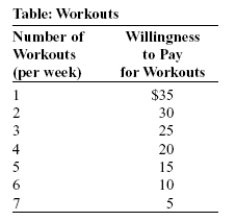 -(Table: Workouts) Look at the table Workouts. Suppose that Eli receives an offer from the club for a weekly membership fee of $50 that allows him to use the club as much as he wants. Assuming Eli joins the club, how many times will Eli use the club per week, and how much consumer surplus will he receive?
 (Essay)
4.8/5 (85)
(85) Which of the following is most likely to INCREASE consumer surplus in the market for cotton T-shirts?
(Multiple Choice)
4.9/5 (73)
(73) 
Filters
- Essay(0)
- Multiple Choice(0)
- Short Answer(0)
- True False(0)
- Matching(0)