



 Chat with AI
Exam 4: Consumer and Producer Surplus

Exam 1: First Principles233 Questions
Exam 2: Economic Models: Trade-Offs and Trade 25382 Questions
Exam 3: Supply and Demand290 Questions
Exam 4: Consumer and Producer Surplus224 Questions
Exam 5: Price Controls and Quotas: Meddling With Markets227 Questions
Exam 6: Elasticity300 Questions
Exam 7: Taxes298 Questions
Exam 8: International Trade272 Questions
Exam 9: Decision Making by Individuals Firms201 Questions
Exam 10: The Rational Consumer372 Questions
Exam 11: Behind the Supply Curve: Inputs and Costs362 Questions
Exam 12: Perfect Competition and the Supply Curve355 Questions
Exam 13: Monopoly350 Questions
Exam 14: Oligopoly294 Questions
Exam 15: Monopolistic Competition and Product Differentiation262 Questions
Exam 16: Externalities199 Questions
Exam 17: Public Goods Common Resources224 Questions
Exam 18: The Economics of the Welfare140 Questions
Exam 19: Factor Markets and the Distribution of Income369 Questions
Exam 20: Uncertainty, Risk, and Private Information202 Questions
Select questions type


Use the following to answer questions:
Figure: Demand for Cincinnati Reds Games Tickets 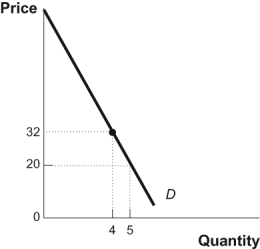 -(Figure: Demand for Cincinnati Reds Games Tickets) The figure Demand for Cincinnati Red Games Tickets represents Jeff's annual demand for tickets to Cincinnati Reds baseball games. Suppose the Reds required all fans to purchase a $12 parking pass for each game. This effectively raises the price of a ticket to $32, and Jeff will decrease his quantity demanded for Reds baseball by one ticket this year. How much consumer surplus has Jeff lost?
 (Essay)
4.8/5  (84)
(84) If total surplus rises, there may have been a(n) _____ in demand or a(n) _____ in supply.
(Multiple Choice)
4.7/5 (75)
(75) If the market for tickets to the World Series is in equilibrium but owners of tickets who would have sold their tickets are not allowed to sell, while fans who would not sell their tickets are required to sell, total surplus would decrease.
(True/False)
4.8/5 (83)
(83) Use the following to answer questions:
Figure: Producer Surplus  -(Figure: Producer Surplus) Look at the figure Producer Surplus. When the price falls from $45 to $35, producer surplus _____ for a total producer surplus of _____.
 (Multiple Choice)
4.9/5 (70)
(70) Suppose a competitive market has a downward-sloping demand curve and a horizontal supply curve. If the supply curve shifts downward, equilibrium price will _____, equilibrium quantity will _____, consumer surplus will _____, and producer surplus will _____.
(Multiple Choice)
4.8/5 (74)
(74) Use the following to answer questions:
Figure: The Wireless Mouse Market 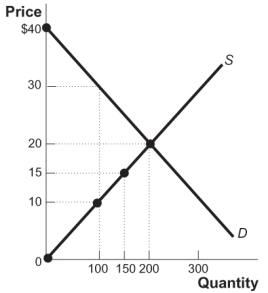 -(Figure: Wireless Mouse Market) Look at the figure Wireless Mouse Market. Calculate producer surplus when the market is in equilibrium.
 (Multiple Choice)
4.7/5 (76)
(76) Gehrig is willing to pay $90 for a cap made of raccoon skin. Suppose he finds such a cap for $71 on eBay. If Gehrig buys the cap for $71, he will have an individual consumer surplus of $71.
(True/False)
4.9/5 (73)
(73) Use the following to answer questions: 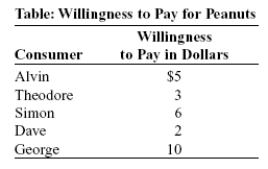 -(Table: Willingness to Pay for Peanuts) Using the table Willingness to Pay for Peanuts, if the price of a bag of peanuts is $3, the total value of consumer surplus is equal to:
 (Multiple Choice)
4.8/5 (79)
(79) Use the following to answer questions:
Figure: Consumer and Producer Surplus  -(Figure: Consumer and Producer Surplus) Look at the figure Consumer and Producer Surplus. If the price is held above equilibrium, consumer surplus _____ and total surplus _____.
 (Multiple Choice)
4.8/5 (86)
(86) Use the following to answer questions:
Figure: Gain in Consumer Surplus 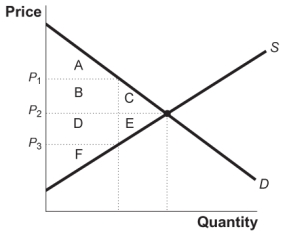 -(Figure: Gain in Consumer Surplus) Look at the figure Gain in Consumer Surplus. Identify the area or areas that represent the total change in consumer surplus when the price falls from P1 to P2.
 (Multiple Choice)
4.8/5 (82)
(82) Suppose the market demand curve for TV remotes is given by the equation Qd = 100 - 2P, where P is the price and Qd is the number of TV remotes demanded. If the market price of TV remotes is $10, then the quantity demanded equals _____ and the value of consumer surplus is _____.
(Multiple Choice)
4.9/5 (79)
(79) Use the following to answer questions:  -(Table: Producer Surplus and Phantom Tickets) The table Producer Surplus and Phantom Tickets shows the minimum price at which each of the students is willing to sell a ticket to Phantom of the Opera. Assume that each student has only one ticket to sell. Given the information in the table, if the price for Phantom tickets is $55, total producer surplus for the five students is:
 (Multiple Choice)
4.8/5 (81)
(81) Use the following to answer questions:  -(Table: Consumer Surplus) Look at the table Consumer Surplus. Assume that each student wants to buy one ticket. If the price of a ticket to see The Nutty Nutcracker is $50 and there is no other market for tickets, total consumer surplus for the five students is:
 (Multiple Choice)
5.0/5 (86)
(86) Use the following to answer questions:  -(Table: Producer Surplus) Look at the table Producer Surplus. If the price of a ticket to see The Nutty Nutcracker is $75, then Dudley's producer surplus is:
 (Multiple Choice)
4.8/5 (88)
(88) Use the following to answer question:
Figure: Producer Surplus and Supply 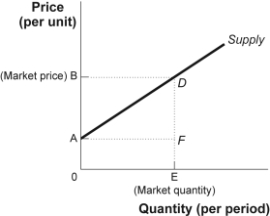 -(Figure: Producer Surplus and Supply) Look at the figure Producer Surplus and Supply. The difference between the total revenue received by sellers and their total cost is called _____ surplus, which is depicted by area _____ if the amount sold is E.
 (Multiple Choice)
4.8/5 (101)
(101) Use the following to answer questions:  -(Table: Willingness to Pay for Basketball Sneakers) The table Willingness to Pay for Basketball Sneakers shows each player's willingness to pay for basketball sneakers. Assume that each player wants to buy at most, one pair of sneakers. If the price of basketball sneakers is $60, how many pairs will be purchased?
 (Multiple Choice)
4.8/5 (71)
(71) Use the following to answer questions:
-(Table: Willingness to Pay for Peanuts) Using the table Willingness to Pay for Peanuts, if the price of a bag of peanuts is $4, what is the value of George's consumer surplus?
-(Table: Willingness to Pay for Peanuts) Using the table Willingness to Pay for Peanuts, if the price of a bag of peanuts is $4, what is the value of George's consumer surplus? (Multiple Choice)
4.8/5 (84)
(84) Along a straight-line downward-sloping demand curve, a decrease in the market price of a good:
(Multiple Choice)
4.7/5 (78)
(78) If the market for smartphones is initially in equilibrium at a price of $250 and consumption is reallocated so that Amanda, who values a phone at $300, is required to give it to Brent, who values a phone at $225, total surplus in the smartphone market will increase.
(True/False)
4.8/5 (80)
(80) 
Filters
- Essay(0)
- Multiple Choice(0)
- Short Answer(0)
- True False(0)
- Matching(0)