



 Chat with AI
Exam 7: Taxes

Exam 1: First Principles233 Questions
Exam 2: Economic Models: Trade-Offs and Trade 25382 Questions
Exam 3: Supply and Demand290 Questions
Exam 4: Consumer and Producer Surplus224 Questions
Exam 5: Price Controls and Quotas: Meddling With Markets227 Questions
Exam 6: Elasticity300 Questions
Exam 7: Taxes298 Questions
Exam 8: International Trade272 Questions
Exam 9: Decision Making by Individuals Firms201 Questions
Exam 10: The Rational Consumer372 Questions
Exam 11: Behind the Supply Curve: Inputs and Costs362 Questions
Exam 12: Perfect Competition and the Supply Curve355 Questions
Exam 13: Monopoly350 Questions
Exam 14: Oligopoly294 Questions
Exam 15: Monopolistic Competition and Product Differentiation262 Questions
Exam 16: Externalities199 Questions
Exam 17: Public Goods Common Resources224 Questions
Exam 18: The Economics of the Welfare140 Questions
Exam 19: Factor Markets and the Distribution of Income369 Questions
Exam 20: Uncertainty, Risk, and Private Information202 Questions
Select questions type


Suppose Governor Meridias initiates a payroll tax of 10% on all income up to $50,000. Any income above $50,000 is not taxed. This payroll tax will be:
(Multiple Choice)
4.9/5  (86)
(86) Use the following to answer questions:
Figure: The Market for Blue Jeans 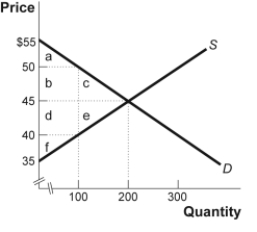 -(Figure: The Market for Blue Jeans) Look at the figure The Market for Blue Jeans. The government recently levied a $10 tax on the producers of blue jeans. What area or areas in the graph identify the loss of consumer surplus due to the tax?
 (Multiple Choice)
4.9/5 (64)
(64) Use the following to answer questions:
Figure: The Market for Blue Jeans
-(Figure: The Market for Blue Jeans) Look at the figure The Market for Blue Jeans. The government recently levied a $10 tax on the producers of blue jeans. What is the deadweight loss?
-(Figure: The Market for Blue Jeans) Look at the figure The Market for Blue Jeans. The government recently levied a $10 tax on the producers of blue jeans. What is the deadweight loss? (Multiple Choice)
4.9/5 (78)
(78) The demand for food is very inelastic compared to the supply of food, so if a tax is imposed on the consumers of food, the tax incidence:
(Multiple Choice)
4.9/5 (72)
(72) Assume the same upward supply curve for each of the following goods. Considering demand only, a tax on _____ would result in the largest deadweight loss.
(Multiple Choice)
4.7/5 (75)
(75) A tax that takes a _____ percentage of income as income rises is _____.
(Multiple Choice)
4.9/5 (72)
(72) If the marginal tax rate is higher than the average rate, the tax system is:
(Multiple Choice)
4.7/5 (74)
(74) Use the following to answer questions:
Figure: The Market for Hamburgers 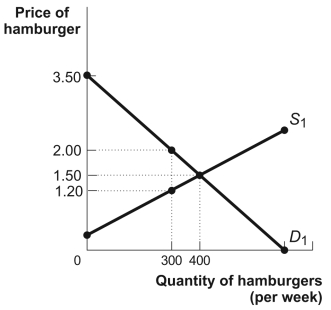 -(Figure: The Market for Hamburgers) Look at the figure The Market for Hamburgers. If the market is originally in equilibrium and the government imposes an excise tax of $0.80 per hamburger, producer surplus will be reduced by:
 (Multiple Choice)
4.8/5 (83)
(83) If personal income up to and including $30,000 is not taxed, income of $30,001 to $60,000 is taxed at 10%, and income over $60,000 is taxed at 25%, then a family earning an income of $100,000 will pay _____ in personal taxes.
(Multiple Choice)
5.0/5 (79)
(79) If the demand curve is downward-sloping and supply is perfectly elastic, then the burden of an excise tax is:
(Multiple Choice)
4.9/5 (91)
(91) Given any downward-sloping demand curve for a good, the more price-elastic the supply curve, the _____ equilibrium output will fall and the _____ will be the deadweight loss when the government imposes an excise tax.
(Multiple Choice)
4.8/5 (77)
(77) Use the following to answer questions:
Scenario: The Market for Good X:
The market for good X can be depicted with the following demand and supply equations:
Demand: P = 50 - 0.5Q
Supply: P = 0.33Q
where P is price per unit and Q represents quantity in units. Policy makers plan on imposing a $1 per unit tax on this good.
-(Scenario: The Market for Good X) Look at the scenario The Market for Good X. If a $1 per unit tax is imposed, the deadweight loss associated with the tax will be equal to:
(Multiple Choice)
4.7/5 (92)
(92) Use the following to answer questions:
Figure: The Market for Blue Jeans
-(Figure: The Market for Blue Jeans) Look at the figure The Market for Blue Jeans. The government recently levied a $10 tax on the producers of blue jeans. What area or areas in the graph identify deadweight loss?
-(Figure: The Market for Blue Jeans) Look at the figure The Market for Blue Jeans. The government recently levied a $10 tax on the producers of blue jeans. What area or areas in the graph identify deadweight loss? (Multiple Choice)
4.8/5 (72)
(72) The ability-to-pay principle regarding taxes suggests that:
(Multiple Choice)
4.9/5 (87)
(87) Use the following to answer questions: 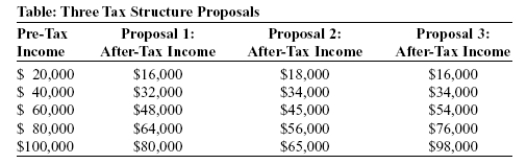 -(Table: Three Tax Structure Proposals) Look at the table Three Tax Structure Proposals. Policy makers interested in implementing a progressive tax structure would suggest using:
 (Multiple Choice)
4.7/5 (81)
(81) The deadweight loss from an excise tax comes about because:
(Multiple Choice)
4.7/5 (68)
(68) Use the following to answer questions: 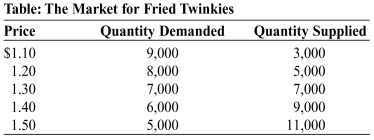 -(Table: The Market for Fried Twinkies) Look at the table The Market for Fried Twinkies. The government decides to tax fried Twinkies at a rate of $0.30 per Twinkie and collect that tax from the producers. After paying the tax, producers will receive _____ per Twinkie, and they will sell _____ Twinkies after the tax.
 (Multiple Choice)
4.7/5 (84)
(84) 
Filters
- Essay(0)
- Multiple Choice(0)
- Short Answer(0)
- True False(0)
- Matching(0)