



 Chat with AI
Exam 7: Taxes

Exam 1: First Principles233 Questions
Exam 2: Economic Models: Trade-Offs and Trade 25382 Questions
Exam 3: Supply and Demand290 Questions
Exam 4: Consumer and Producer Surplus224 Questions
Exam 5: Price Controls and Quotas: Meddling With Markets227 Questions
Exam 6: Elasticity300 Questions
Exam 7: Taxes298 Questions
Exam 8: International Trade272 Questions
Exam 9: Decision Making by Individuals Firms201 Questions
Exam 10: The Rational Consumer372 Questions
Exam 11: Behind the Supply Curve: Inputs and Costs362 Questions
Exam 12: Perfect Competition and the Supply Curve355 Questions
Exam 13: Monopoly350 Questions
Exam 14: Oligopoly294 Questions
Exam 15: Monopolistic Competition and Product Differentiation262 Questions
Exam 16: Externalities199 Questions
Exam 17: Public Goods Common Resources224 Questions
Exam 18: The Economics of the Welfare140 Questions
Exam 19: Factor Markets and the Distribution of Income369 Questions
Exam 20: Uncertainty, Risk, and Private Information202 Questions
Select questions type


The _____ tax rate on income represents the additional tax an individual pays if his or her income goes up by $1. This rate has _____ since 2000.
(Multiple Choice)
4.8/5  (89)
(89) To minimize deadweight loss, excise taxes should be levied on goods with inelastic demand and inelastic supply rather than goods with elastic demand and elastic supply.
(True/False)
4.9/5 (71)
(71) Taxation according to the ability-to-pay principle is best illustrated in the United States by:
(Multiple Choice)
4.8/5 (86)
(86) The evidence suggests that taken collectively, taxes in the U.S. economy are:
(Multiple Choice)
4.7/5 (94)
(94) If the main purpose of a tax is to decrease the amount of a harmful activity, such as underage drinking, the government should impose it on harmful activities whose supply is _____ and demand is _____.
(Multiple Choice)
4.8/5 (86)
(86) According to the _____ principle, those who use public services should bear the burden of the tax that pays for them.
(Multiple Choice)
5.0/5 (73)
(73) A tax of $10 on an income of $100, $25 on an income of $200, and $60 on an income of $300 is:
(Multiple Choice)
4.8/5 (74)
(74) A tax leads to a(n) _____ in consumer surplus and a(n) _____ in producer surplus.
(Multiple Choice)
4.8/5 (69)
(69) The price elasticity of demand for a particular cancer drug is zero and the price elasticity of supply is 0.50. If a $1 excise tax is levied on producers, how much of this tax will eventually be paid by consumers?
(Multiple Choice)
4.8/5 (88)
(88) If demand and supply are both very elastic, a decrease in the rate of an excise tax will likely:
(Multiple Choice)
4.9/5 (76)
(76) _____ and _____ taxes are the largest sources of state and local government revenue.
(Multiple Choice)
4.8/5 (84)
(84) Suppose an income tax is levied on none of the first $1,000, 10% of the next $9,000, and 20% of the remainder of earnings. How much tax would Miranda have to pay if she earned $20,000?
(Multiple Choice)
4.8/5 (76)
(76) The 1990 "yacht tax" caused a large deadweight loss because demand for luxury yachts made in the United States is:
(Multiple Choice)
4.9/5 (83)
(83) Use the following to answer questions:
Figure: The Market for Blue Jeans 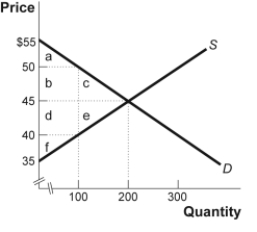 -(Figure: The Market for Blue Jeans) Look at the figure The Market for Blue Jeans. The government recently levied a $10 tax on the producers of blue jeans. What area or areas in the graph identify consumer and producer surplus after the tax was levied?
 (Multiple Choice)
4.9/5 (73)
(73) Use the following to answer question:
Figure: Market for Hotel Rooms 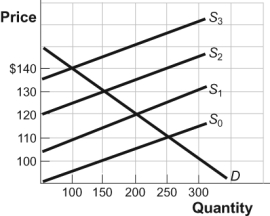 -(Figure: The Market for Hotel Rooms) Look at the figure The Market for Hotel Rooms. Suppose with no tax the equilibrium price is $110 and the equilibrium quantity is 250. If the local government levies a tax of $30 per night on each hotel room rented, the new equilibrium price will equal _____ and the new equilibrium quantity will equal _____.
 (Multiple Choice)
4.9/5 (78)
(78) If an excise tax is imposed on automobiles and collected from consumers:
(Multiple Choice)
4.7/5 (78)
(78) The deadweight loss of an excise tax arises because the tax prevents some mutually beneficial transactions.
(True/False)
4.8/5 (88)
(88) Use the following to answer questions:
Figure: The Market for Lattes 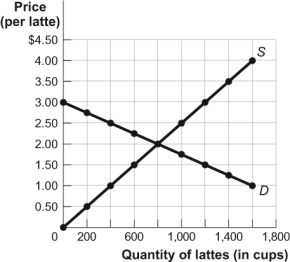 -(Figure: The Market for Lattes) If an excise tax of $1.50 is assessed on each latte, government revenue will be:
 (Multiple Choice)
4.8/5 (75)
(75) 
Filters
- Essay(0)
- Multiple Choice(0)
- Short Answer(0)
- True False(0)
- Matching(0)