



 Chat with AI
Exam 7: Taxes

Exam 1: First Principles233 Questions
Exam 2: Economic Models: Trade-Offs and Trade 25382 Questions
Exam 3: Supply and Demand290 Questions
Exam 4: Consumer and Producer Surplus224 Questions
Exam 5: Price Controls and Quotas: Meddling With Markets227 Questions
Exam 6: Elasticity300 Questions
Exam 7: Taxes298 Questions
Exam 8: International Trade272 Questions
Exam 9: Decision Making by Individuals Firms201 Questions
Exam 10: The Rational Consumer372 Questions
Exam 11: Behind the Supply Curve: Inputs and Costs362 Questions
Exam 12: Perfect Competition and the Supply Curve355 Questions
Exam 13: Monopoly350 Questions
Exam 14: Oligopoly294 Questions
Exam 15: Monopolistic Competition and Product Differentiation262 Questions
Exam 16: Externalities199 Questions
Exam 17: Public Goods Common Resources224 Questions
Exam 18: The Economics of the Welfare140 Questions
Exam 19: Factor Markets and the Distribution of Income369 Questions
Exam 20: Uncertainty, Risk, and Private Information202 Questions
Select questions type


Use the following to answer questions:
Figure and Table: The Market for Taxi Rides 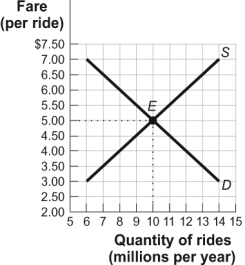
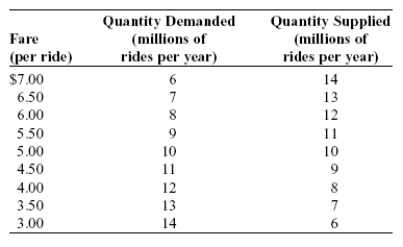 -(Figure and Table: The Market for Taxi Rides) Look at the figure and table The Market for Taxi Rides. If the government imposes an excise tax of $1 per ride (causing the supply curve to shift upward by that amount), then the government will collect tax revenues of _____. However, the tax will cause a _____ deadweight loss to society.
 (Multiple Choice)
4.9/5  (68)
(68) Excise taxes that raise the most revenue and cause the least deadweight loss are likely to be levied on goods for which demand is _____ and supply is _____.
(Multiple Choice)
5.0/5 (86)
(86) Use the following to answer questions:
Figure: The Market for Hamburgers 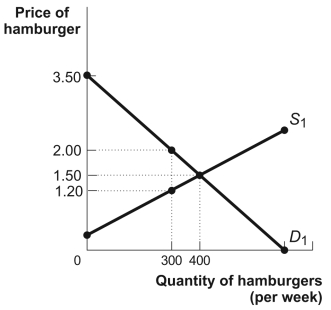 -When the government imposes an excise tax, the deadweight loss is caused by:
 (Multiple Choice)
5.0/5 (90)
(90) Use the following to answer questions:
Figure: The Gasoline Market 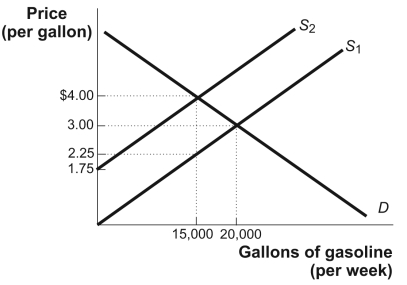 -(Figure: The Gasoline Market) Look at the figure The Gasoline Market. The pretax equilibrium price is $3, and the equilibrium quantity before tax is 20,000 gallons. An excise tax has been levied on each gallon of gasoline supplied by producers. Based on the graph, the incidence of the tax on suppliers is:
 (Multiple Choice)
4.8/5 (68)
(68) The governor wants to levy a $1 excise tax on some good-he doesn't care which-but he does want to minimize the deadweight loss. The deadweight loss will be least when the demand curve is _____ and the supply curve is _____.
(Multiple Choice)
4.8/5 (79)
(79) Consumers in a particular market will bear the greater burden of an excise tax:
(Multiple Choice)
5.0/5 (85)
(85) If personal income up to and including $25,000 is not taxed, income of $25,001 to $50,000 is taxed at 10%, and income over $50,000 is taxed at 20%, then a family earning an income of $75,000 will pay an AVERAGE tax rate of:
(Multiple Choice)
4.9/5 (84)
(84) Taxation according to the benefits-received principle is best illustrated by the _____ tax.
(Multiple Choice)
4.8/5 (74)
(74) The number of seats in a football stadium is fixed at 70,000. The city decides to impose a tax of $10 per ticket. In response, the team management raises the ticket price from $30 to $40 and still sells all 70,000 tickets. The tax caused a change in the consumer surplus of _____, a change in the producer surplus of _____, and a deadweight loss of _____.
(Multiple Choice)
4.9/5 (74)
(74) Use the following to answer questions:
Figure: The Market for Yachts 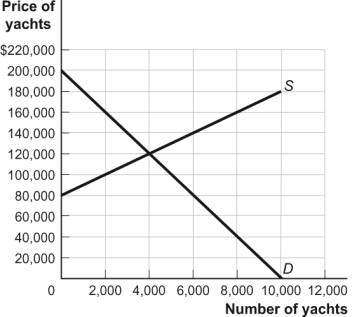 -(Figure: The Market for Yachts) Look at the figure The Market for Yachts. A price _____ of _____ will bring about the same price and output in the market for yachts as would an excise tax of $30,000.
 (Multiple Choice)
4.9/5 (70)
(70) Use the following to answer questions:
Figure: The Gasoline Market
-(Figure: The Gasoline Market) Look at the figure The Gasoline Market. The pretax equilibrium price is $3, and the equilibrium quantity before tax is 20,000 gallons. An excise tax has been levied on each gallon of gasoline supplied by producers, shifting the supply curve upward. The total tax revenue collected by the government is equal to:
-(Figure: The Gasoline Market) Look at the figure The Gasoline Market. The pretax equilibrium price is $3, and the equilibrium quantity before tax is 20,000 gallons. An excise tax has been levied on each gallon of gasoline supplied by producers, shifting the supply curve upward. The total tax revenue collected by the government is equal to: (Multiple Choice)
5.0/5 (60)
(60) Use the following to answer questions:
Figure: The Market for Lattes 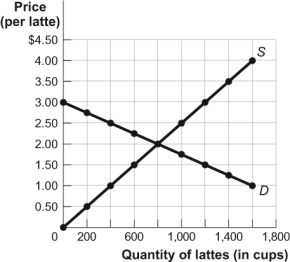 -(Figure: The Market for Lattes) Look at the figure The Market for Lattes. If the government assesses a tax of $0.75 on sellers of lattes, the price producers will receive for a latte after the tax will:
 (Multiple Choice)
4.8/5 (83)
(83) Use the following to answer questions:
Figure: Income Tax Payments 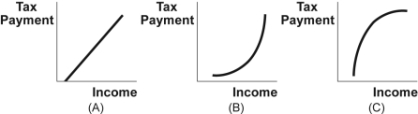 -(Figure: Income Tax Payments) Look at the figure Income Tax Payments. Which panel or panels best represent the effects of a regressive income tax?
 (Multiple Choice)
4.9/5 (77)
(77) When the imposition of an excise tax causes the quantity demanded and quantity supplied to decrease relative to the no-tax equilibrium, this will result in:
(Multiple Choice)
4.8/5 (87)
(87) If a tax system is poorly designed, it may be possible to increase:
(Multiple Choice)
4.8/5 (86)
(86) If an excise tax is imposed on beer and collected from the producers, the _____ curve will shift _____ by the amount of the tax.
(Multiple Choice)
4.7/5 (95)
(95) Use the following to answer questions:
Figure and Table: The Market for Taxi Rides
-(Figure and Table: The Market for Taxi Rides) Look at the figure and table The Market for Taxi Rides. The figure represents a competitive market for taxi rides. If the government imposes an excise tax of $2 per ride (causing the supply curve to shift upward by that amount), then the government will collect tax revenues of _____, BUT the tax will cause a _____ deadweight loss to society.
-(Figure and Table: The Market for Taxi Rides) Look at the figure and table The Market for Taxi Rides. The figure represents a competitive market for taxi rides. If the government imposes an excise tax of $2 per ride (causing the supply curve to shift upward by that amount), then the government will collect tax revenues of _____, BUT the tax will cause a _____ deadweight loss to society. (Multiple Choice)
4.8/5 (71)
(71) All of the following are costs associated with the imposition of a tax EXCEPT:
(Multiple Choice)
4.8/5 (91)
(91) The two most important sources of federal revenue are the _____ taxes.
(Multiple Choice)
4.8/5 (70)
(70) 
Filters
- Essay(0)
- Multiple Choice(0)
- Short Answer(0)
- True False(0)
- Matching(0)