



 Chat with AI
Exam 10: Launching the New Ship of State, 1789-1800

Exam 1: New World Beginnings, 33,000 Bce-1769 Ce125 Questions
Exam 2: The Planting of English America, 1500-1733146 Questions
Exam 3: Settling the Northern Colonies, 1619-1700150 Questions
Exam 4: American Life in the Seventeenth Century, 1607-169286 Questions
Exam 5: Colonial Society on the Eve of Revolution, 1700-1775123 Questions
Exam 6: The Duel for North America, 1608-176394 Questions
Exam 7: The Road to Revolution, 1763-1775119 Questions
Exam 8: America Secedes From the Empire, 1775-1783112 Questions
Exam 9: The Confederation and the Constitution, 1776-1790118 Questions
Exam 10: Launching the New Ship of State, 1789-1800135 Questions
Exam 11: The Triumphs and Travails of the Jeffersonian Republic, 1800-1812103 Questions
Exam 12: The Second War for Independence and the Upsurge of Nationalism, 1812-1824149 Questions
Exam 13: The Rise of a Mass Democracy, 1824-1840145 Questions
Exam 14: Forging the National Economy, 1790-1860137 Questions
Exam 15: The Ferment of Reform and Culture, 1790-1860139 Questions
Exam 16: The South and the Slavery Controversy, 1793-1860103 Questions
Exam 17: Manifest Destiny and Its Legacy, 1841-184888 Questions
Exam 18: Renewing the Sectional Struggle, 1848-1854107 Questions
Exam 19: Drifting Toward Disunion, 1854-186193 Questions
Exam 20: Girding for War: the North and the South, 1861-186589 Questions
Exam 21: The Furnace of Civil War, 1861-186599 Questions
Exam 22: The Ordeal of Reconstruction, 1865-1877105 Questions
Exam 23: Political Paralysis in the Gilded Age, 1869-1896146 Questions
Exam 24: Industry Comes of Age, 1865-1900153 Questions
Exam 25: America Moves to the City, 1865-1900153 Questions
Exam 26: The Great West and the Agricultural Revolution, 1865-1896160 Questions
Exam 27: Empire and Expansion, 1890-1909161 Questions
Exam 28: Progressivism and the Republican Roosevelt, 1901-1912140 Questions
Exam 29: Wilsonian Progressivism in Peace and War, 1913-1920144 Questions
Exam 30: American Life in the Roaring Twenties 1920-1929144 Questions
Exam 31: The Politics of Boom and Bust 1920-1932104 Questions
Exam 32: The Great Depression and the New Deal 1933-1939115 Questions
Exam 33: Franklin D Roosevelt and the Shadow of War 1933-1941104 Questions
Exam 34: America in World War Ii 1941-1945105 Questions
Exam 35: The Cold War Begins 1945-1952153 Questions
Exam 36: American Zenith 1952-1963182 Questions
Exam 37: The Stormy Sixties 1963-1973168 Questions
Exam 38: Challenges to the Postwar Order 1973-198083 Questions
Exam 39: The Resurgence of Conservatism 1980-1992121 Questions
Exam 40: America Confronts the Post-Cold War Era, 1992-200087 Questions
Exam 41: The American People Face a New Century, 2001-201490 Questions
Select questions type


Which sectional and economic groups generally supported the Federalists and which the Democratic-Republicans? Why?
(Essay)
4.9/5  (70)
(70) Compare and contrast loose (broad) constructionism and strict constructionism in analyzing the scope of the constitutional powers to tax, to regulate trade, and to create the Bank of the United States. What is the textual basis of support in the Constitution for each legal viewpoint?
(Essay)
4.7/5 (78)
(78) The Federalist Witch Hunt
Locate the following places by reference number on the map:
The United States, Spanish Louisiana, and the Old Northwest Around 1789 and Before the Louisiana Purchase
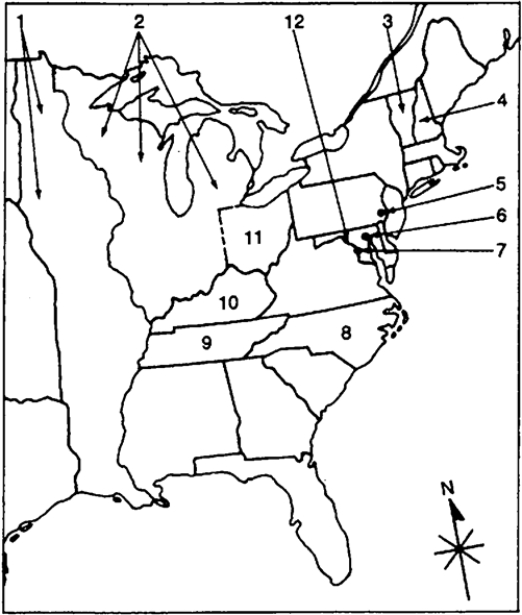 -____ Vermont
 (Short Answer)
4.7/5 (82)
(82) Identify and state the historical significance of the following:
-Little Turtle
(Short Answer)
4.8/5 (90)
(90) Which amendment guards against the danger that enumerating rights might lead to the conclusion that they were the only ones protected?
(Multiple Choice)
4.8/5 (81)
(81) All of the following were true of Alexander Hamilton except
(Multiple Choice)
4.8/5 (73)
(73) The Federalist Witch Hunt
Locate the following places by reference number on the map:
The United States, Spanish Louisiana, and the Old Northwest Around 1789 and Before the Louisiana Purchase
-____ District of Columbia
-____ District of Columbia (Short Answer)
4.8/5 (82)
(82) Before 1790, American political leaders denounced political parties. Explain why these early American political leaders denounced political parties as harmful to the political health of the early Republic and why, nonetheless, political parties came into existence in the 1790s and acquired legitimacy in the early Republic.
(Essay)
4.9/5 (69)
(69) Identify and state the historical significance of the following:
-Bill of Rights
(Short Answer)
5.0/5 (88)
(88) Which of the following do you think made the most important contribution to American national interests: Neutrality Proclamation, Washington's Farewell Address, or Convention of 1800? Justify your answer.
(Essay)
4.8/5 (59)
(59) Identify and state the historical significance of the following:
-French Revolution
(Essay)
4.8/5 (79)
(79) Washington's decision to retire from the presidency in 1797
(Multiple Choice)
4.8/5 (64)
(64) What were the pros and cons of the creation of a National Bank? What political and constitutional issues were involved in this piece of legislation?
(Essay)
4.9/5 (86)
(86) Identify and state the historical significance of the following:
-Washington's Farewell Address
(Short Answer)
4.7/5 (76)
(76) For its continued success, Hamilton's financial program relied heavily on
(Multiple Choice)
4.9/5 (77)
(77) President Adams sought a peaceful solution to the undeclared war with France in order to
(Multiple Choice)
4.9/5 (80)
(80) Jefferson asserted landlessness threatened democracy as much as illiteracy because
(Multiple Choice)
4.9/5 (83)
(83) 
Filters
- Essay(0)
- Multiple Choice(0)
- Short Answer(0)
- True False(0)
- Matching(0)