



 Chat with AI
Exam 1: New World Beginnings, 33,000 Bce-1769 Ce


All of the following set into motion the chain of events that led to a drive of Europeans toward Asia, the penetration of Africa, and the discovery of the New World except

 (88)
 Verified
A
The Great Ice Age accounted for the origins of North America's human history because
(66) VerifiedA
Identify and state the historical significance of the following:
-Ferdinand of Aragon
(90)  Answered by Examlex AI Copilot
Ferdinand of Aragon, also known as Ferdinand II of Aragon, was born on March 10, 1452, and died on January 23, 1516. He played a crucial role in the history of Spain and the world during the late 15th and early 16th centuries. His historical significance can be attributed to several key aspects of his life and reign:
1. **Marriage to Isabella of Castile**: Ferdinand's marriage to Isabella I of Castile in 1469 was a pivotal event that led to the unification of Spain. Although the kingdoms of Aragon and Castile remained legally separate, their joint rule under Ferdinand and Isabella laid the foundation for the modern Spanish state. This union also set the stage for the eventual unification of their respective territories under a single crown.
2. **Reconquista**: Ferdinand and Isabella completed the Reconquista, the centuries-long effort to reclaim the Iberian Peninsula from the Moors. In 1492, they captured Granada, the last Muslim stronghold in Spain, which marked the end of Islamic rule in the peninsula and the consolidation of Christian kingdoms.
3. **Spanish Inquisition**: Under Ferdinand and Isabella, the Spanish Inquisition was established in 1478. This tribunal was intended to maintain Catholic orthodoxy in their kingdoms and led to the persecution of Jews, Muslims, and other groups deemed heretical. The Inquisition became infamous for its severe methods and the expulsion of Jews from Spain in 1492.
4. **Support of Christopher Columbus**: Ferdinand and Isabella sponsored the voyages of Christopher Columbus, which led to the European discovery of the Americas in 1492. This event had profound implications for the course of world history, initiating the era of European exploration and colonization of the New World.
5. **Consolidation of Power**: Ferdinand worked to centralize and strengthen royal authority, reducing the power of the nobility and the influence of the feudal system. His reforms in government and the administration of justice helped to establish a more modern state apparatus.
6. **Foreign Policy**: Ferdinand was an astute politician and diplomat. His foreign policy was marked by strategic marriages among his children to the royal families of Europe, which helped to extend Spanish influence. For example, his daughter Catherine of Aragon married Henry VIII of England.
7. **Legacy**: Ferdinand's reign saw the rise of Spain as a dominant European power. His actions laid the groundwork for the Spanish Empire, which would become one of the largest and most powerful empires in history.
In summary, Ferdinand of Aragon's historical significance is multifaceted, encompassing the unification of Spain, the completion of the Reconquista, the establishment of the Spanish Inquisition, the sponsorship of voyages that led to the discovery of the New World, and the consolidation of centralized royal power that would influence the political landscape of Europe and the world for centuries to come.
Senator Joseph McCarthy first rose to national prominence by
(65) The early voyages of the Scandinavian seafarers did not result in permanent settlement in North America because
(79) Identify and state the historical significance of the following:
-Hernán Cortés
(77) The Aztec chief Moctezuma allowed Cortés to enter the capital of Tenochtitlán because
(80) Assess the validity of the following statement: "The Great Ice Age shaped more than the geological history of North America. It also contributed to the origins of the continent's human history."
(93) Summarize the motives, expectations, problems, and rewards associated with the age of European expansion. Compare and contrast these motives, expectations, problems, and rewards of European expansion as they applied to Africa, North American and the Caribbean Islands, and South America.
(93) Identify and state the historical significance of the following:
-plantation
(77) Locate the following places by reference number on the map:
The World Known to Europe During the Age of Discovery, 1492-1609
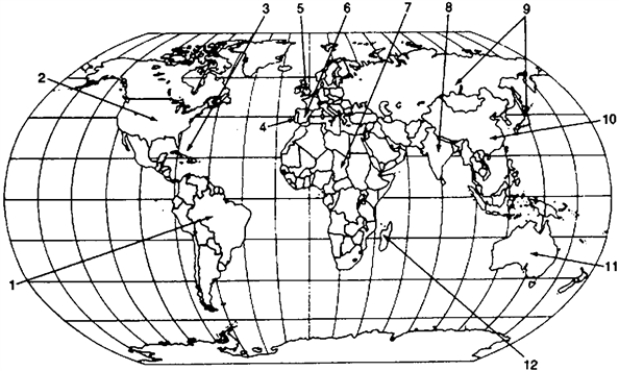 -____ Asia
 (68) Locate the following places by reference number on the map:
The World Known to Europe During the Age of Discovery, 1492-1609
-____ West Indies
-____ West Indies (97) Describe both the positive and negative effects of the Columbian Exchange on the New and Old World.
(79) Identify and state the historical significance of the following:
-Marco Polo
(64) Assess the validity of the following statement: "Columbus's sensational achievement obscures the fact that he was one of the most successful failures in history."
(77) All of the following were characteristics of the original thirteen colonies except
(84) Identify and state the historical significance of the following:
-Ferdinand Magellan
(89) Identify and state the historical significance of the following:
-Quetzalcoatl
(99) Which of the following is the false concept, which held that the Spanish conquerors merely tortured and butchered the Indians, stole their gold, infected them with smallpox, and left little but misery behind?
(91) 
Filters
- Essay(0)
- Multiple Choice(0)
- Short Answer(0)
- True False(0)
- Matching(0)