



 Chat with AI
Exam 3: Settling the Northern Colonies, 1619-1700


Identify and state the historical significance of the following:
-Peter Stuyvesant

 (96)
 Answered by Examlex AI Copilot
Peter Stuyvesant was a significant figure in the early history of what is now the United States. He served as the last Dutch Director-General of the colony of New Netherland from 1647 until it was ceded to the English in 1664. Stuyvesant was known for his strong leadership style and efforts to strengthen the defensive fortifications of the colony, particularly in the settlement of New Amsterdam, which would later become New York City.
Stuyvesant's historical significance lies in several key areas:
1. **Colonial Governance**: Stuyvesant's tenure as Director-General was marked by efforts to improve the administrative organization and financial stability of New Netherland. He worked to establish a more centralized form of government and attempted to enforce the Dutch Reformed Church's authority, which sometimes led to conflicts with the diverse population of settlers, including English, French, and Jewish inhabitants.
2. **Urban Development**: Under his leadership, New Amsterdam (Manhattan) saw significant development, including the construction of a protective wall on what is now Wall Street, the laying out of streets, and the establishment of the first municipal government in the colony.
3. **Religious Tolerance**: Despite his own strict adherence to the Dutch Reformed Church, Stuyvesant's rule saw the early seeds of religious tolerance in the American colonies. He was famously petitioned by a group of Jewish refugees for the right to settle and worship freely in New Amsterdam, which was granted despite his initial reluctance.
4. **Surrender to the English**: Stuyvesant's role in the history of New Netherland culminated in the peaceful surrender of the colony to the English in 1664. The English fleet arrived to claim the territory for England, and despite Stuyvesant's initial desire to resist, he was persuaded by the residents to avoid bloodshed and capitulate. The colony was renamed New York in honor of the Duke of York, the brother of King Charles II of England.
5. **Legacy**: Peter Stuyvesant's legacy is still visible in New York City today. Stuyvesant Street, Stuyvesant Town, and the Stuyvesant High School are all named after him, and his family's farm, the "Bouwerij," is the origin of the name of the Bowery neighborhood in Manhattan.
In summary, Peter Stuyvesant played a crucial role in the development of New Netherland and its transition into an English colony. His leadership helped shape the early character of New York City, and his actions had a lasting impact on the region's governance, urban planning, and cultural diversity.
Identify and state the historical significance of the following:
-John Cotton
(81) Answered by Examlex AI CopilotJohn Cotton (1585–1652) was a highly influential Puritan minister in the Massachusetts Bay Colony during the early colonial period of American history. Born in Derby, England, he was educated at Trinity College, Cambridge, and became a prominent minister in England before emigrating to the New World in 1633 to escape persecution for his nonconformist beliefs.
The historical significance of John Cotton lies in several key areas:
1. **Puritan Theology and Practice**: Cotton was a leading figure in the development of Puritan theology and ecclesiastical practice. His sermons and writings helped shape the religious character of the Massachusetts Bay Colony and influenced the development of Congregational church governance, which emphasized local control and the autonomy of individual congregations.
2. **Advocate of Civil Government**: Cotton played a significant role in the intersection of church and state in the colony. He was a proponent of the idea that civil government should enforce religious conformity and support the true religion, which for him was Puritanism. His views helped shape the theocratic elements of the early colonial government.
3. **The New England Way**: He was instrumental in the establishment of the "New England Way," a religious and social framework that sought to create a harmonious and pious community. This included the emphasis on a learned ministry and the importance of education, which would later lead to the founding of institutions like Harvard College.
4. **Controversial Figure**: Cotton was a controversial figure, both in his time and in historical assessments. He was involved in the Antinomian Controversy, a theological conflict within the colony that pitted him against other Puritan leaders like John Winthrop. The controversy centered around the role of "free grace" versus "works" in salvation and led to the banishment of Anne Hutchinson, a key figure in the dispute.
5. **Legacy**: Cotton's legacy is complex. While he contributed to the establishment of a strict, religiously oriented society that had little tolerance for dissent, his emphasis on education and local church autonomy had lasting impacts on American religious and political culture.
In summary, John Cotton's historical significance is tied to his role as a leading Puritan minister who shaped the religious, educational, and political landscape of the early Massachusetts Bay Colony, influencing the broader development of American society. His work and thought reflect the complexities of early colonial life and the enduring tensions between religious conformity and individual liberty.
Identify and state the historical significance of the following:
-sumptuary laws
(59) Identify and state the historical significance of the following:
-Institutes of the Christian Religion
(77) Identify and state the historical significance of the following:
-Thomas Hooker
(83) Identify and state the historical significance of the following:
-Write your interpretation of John Winthrop's comment that Massachusetts Bay was to be "as a city upon a hill" and "a beacon to mankind." In your opinion, do Americans still hold this view of their nation's role in the world? Why or why not?
(88) Identify and state the historical significance of the following:
-Analyze the extent to which the government of Massachusetts Bay was simultaneously theocratic, democratic, oligarchic, and authoritarian.
(72) Identify and state the historical significance of the following:
-To what extent was the New England Confederation a first step toward colonial unity?
(87) John Calvin profoundly affected the thought of all of the following except
(81) One of the traits that made Quakers unpopular in England was
(75) As the head of Dominion of New England, Sir Edmund Andros was all of the following except
(74) All of the following were characteristics of New Netherland except
(88) Locate the following places by reference number on the map:
Key Locales of Political, Economic, and Religious Ferment and Development in the Northern Colonies, 1619-1700
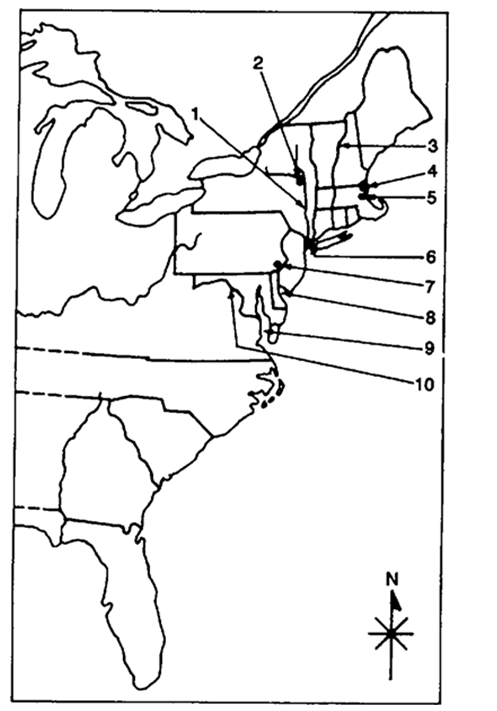 -____ Connecticut River
 (90) Identify and state the historical significance of the following:
-"visible saints"
(67) Identify and state the historical significance of the following:
-Why was King Philip's War of 1675-1676 considered a turning point in the relationship between English settlers in New England and Indian peoples? What role did new economic conflicts, Indian land sales to the English, and breakdowns in the personal relationships between leaders in the English colonial and Indian communities have in contributing to the start of the war?
(72) Recently, historians have increasingly viewed the colonial period as one
(79) 
Filters
- Essay(0)
- Multiple Choice(0)
- Short Answer(0)
- True False(0)
- Matching(0)