



 Chat with AI
Exam 16: Kinetics: Rates and Mechanisms of Chemical Reactions

Exam 1: Keys to the Study of Chemistry: Definitions, Units, and Problem Solving71 Questions
Exam 2: The Components of Matter101 Questions
Exam 3: Stoichiometry of Formulas and Equations72 Questions
Exam 4: Three Major Classes of Chemical Reactions111 Questions
Exam 5: Gases and the Kinetic-Molecular Theory98 Questions
Exam 6: Thermochemistry: Energy Flow and Chemical Change71 Questions
Exam 7: Quantum Theory and Atomic Structure69 Questions
Exam 8: Electron Configuration and Chemical Periodicity77 Questions
Exam 9: Models of Chemical Bonding61 Questions
Exam 10: The Shapes of Molecules98 Questions
Exam 11: Theories of Covalent Bonding48 Questions
Exam 12: Intermolecular Forces: Liquids, Solids, and Phase Changes95 Questions
Exam 13: The Properties of Mixtures: Solutions and Colloids96 Questions
Exam 14: Periodic Patterns in the Main-Group Elements103 Questions
Exam 15: Organic Compounds and the Atomic Properties of Carbon107 Questions
Exam 16: Kinetics: Rates and Mechanisms of Chemical Reactions78 Questions
Exam 17: Equilibrium: the Extent of Chemical Reactions98 Questions
Exam 18: Acid-Base Equilibria100 Questions
Exam 19: Ionic Equilibria in Aqueous Systems114 Questions
Exam 20: Thermodynamics: Entropy, Free Energy, and Reaction Direction85 Questions
Exam 21: Electrochemistry: Chemical Change and Electrical Work101 Questions
Exam 22: The Elements in Nature and Industry45 Questions
Exam 23: Transition Elements and Their Coordination Compounds81 Questions
Exam 24: Nuclear Reactions and Their Applications82 Questions
Select questions type


A catalyst lowers the activation energy but does not affect the mechanism of a reaction.
(True/False)
4.8/5  (57)
(57) Sucrose decomposes to fructose and glucose in acid solution. When ln [sucrose] is plotted vs. time, a straight line with slope of −0.208 hr−1 results. What is the rate law for the reaction?
(Multiple Choice)
4.9/5 (71)
(71) A reactant R is being consumed in a first-order reaction. What fraction of the initial R is consumed in 4.0 half-lives?
(Multiple Choice)
4.8/5 (74)
(74) The greater the energy of activation, Ea, the faster will be the reaction.
(True/False)
4.8/5 (90)
(90) The decomposition of SOCl2 is first-order in SOCl2. If the half-life for the reaction is 4.1 hr, how long would it take for the concentration of SOCl2 to drop from 0.36 M to 0.045 M?
(Multiple Choice)
4.8/5 (86)
(86) Which one of the following sets of units is appropriate for a third-order rate constant?
(Multiple Choice)
4.9/5 (66)
(66) A study of the decomposition reaction 3RS2 → 3R + 6S yields the following initial rate data. 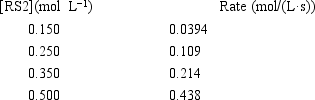 What is the rate constant for the reaction?
 (Multiple Choice)
4.9/5 (87)
(87) A reaction has an activation energy of 195.0 kJ/mol. When the temperature is increased from 200°C to 220°C, the rate constant will increase by a factor of
(Multiple Choice)
4.9/5 (83)
(83) In the lock and key model of enzyme action, the active site on the enzyme provides an exact fit for the substrate.
(True/False)
4.9/5 (75)
(75) The active ingredient in an over the counter pain killer analgesic decomposes with a rate constant, k = 9.05 × 10⁻⁴ day−1. How many days does it take for 15% of the original ingredient to decompose?
(Multiple Choice)
4.9/5 (82)
(82) A reaction is first-order with respect to the reactant R. Which of the following plots will produce a straight line?
(Multiple Choice)
4.8/5 (66)
(66) Carbon-14 is a radioactive isotope which decays with a half-life of 5730 years. What is the first-order rate constant for its decay, in units of years−1?
(Multiple Choice)
4.7/5 (75)
(75) The rate law for the reaction 3A → 2B is rate = k[A] with a rate constant of 0.0447 hr−1. What is the half-life of the reaction?
(Multiple Choice)
4.9/5 (77)
(77) Consider the following mechanism for the oxidation of bromide ions by hydrogen peroxide in aqueous acid solution. H+ + H2O2 ⇄ H2O+−OH (rapid equilibrium)H2O+−OH + Br− → HOBr + H2O (slow)HOBr + H+ + Br− → Br2 + H2O (fast)
Which of the following rate laws is consistent with the mechanism?
(Multiple Choice)
4.7/5 (83)
(83) The rate constant for the reaction 3A → 4B is 6.00 × 10⁻³ L mol−1min−1. How long will it take the concentration of A to drop from 0.75 M to 0.25 M?
(Multiple Choice)
4.7/5 (82)
(82) The rate law cannot be predicted from the stoichiometry of a reaction.
(True/False)
4.8/5 (79)
(79) For the reaction A(g) + 2B(g) → 2C(g) + 2D(g)
The following data were collected at constant temperature. Determine the correct rate law for this reaction.

(Multiple Choice)
4.9/5 (89)
(89) 
Filters
- Essay(0)
- Multiple Choice(0)
- Short Answer(0)
- True False(0)
- Matching(0)