



 Chat with AI
Exam 16: Kinetics: Rates and Mechanisms of Chemical Reactions

Exam 1: Keys to the Study of Chemistry: Definitions, Units, and Problem Solving71 Questions
Exam 2: The Components of Matter101 Questions
Exam 3: Stoichiometry of Formulas and Equations72 Questions
Exam 4: Three Major Classes of Chemical Reactions111 Questions
Exam 5: Gases and the Kinetic-Molecular Theory98 Questions
Exam 6: Thermochemistry: Energy Flow and Chemical Change71 Questions
Exam 7: Quantum Theory and Atomic Structure69 Questions
Exam 8: Electron Configuration and Chemical Periodicity77 Questions
Exam 9: Models of Chemical Bonding61 Questions
Exam 10: The Shapes of Molecules98 Questions
Exam 11: Theories of Covalent Bonding48 Questions
Exam 12: Intermolecular Forces: Liquids, Solids, and Phase Changes95 Questions
Exam 13: The Properties of Mixtures: Solutions and Colloids96 Questions
Exam 14: Periodic Patterns in the Main-Group Elements103 Questions
Exam 15: Organic Compounds and the Atomic Properties of Carbon107 Questions
Exam 16: Kinetics: Rates and Mechanisms of Chemical Reactions78 Questions
Exam 17: Equilibrium: the Extent of Chemical Reactions98 Questions
Exam 18: Acid-Base Equilibria100 Questions
Exam 19: Ionic Equilibria in Aqueous Systems114 Questions
Exam 20: Thermodynamics: Entropy, Free Energy, and Reaction Direction85 Questions
Exam 21: Electrochemistry: Chemical Change and Electrical Work101 Questions
Exam 22: The Elements in Nature and Industry45 Questions
Exam 23: Transition Elements and Their Coordination Compounds81 Questions
Exam 24: Nuclear Reactions and Their Applications82 Questions
Select questions type


The decomposition of dinitrogen pentaoxide has an activation energy of 102 kJ/mol and ΔH°rxn = + 55 kJ/mol. What is the activation energy for the reverse reaction?
(Multiple Choice)
4.9/5  (79)
(79) Which one of the following sets of units is appropriate for a second-order rate constant?
(Multiple Choice)
4.9/5 (80)
(80) Reaction intermediates differ from activated complexes in that
(Multiple Choice)
4.8/5 (83)
(83) Consider the reaction 2NH3(g) → N2(g) + 3H2(g)
If the rate Δ[H2]/Δt is 0.030 mol L−1s−1, then Δ[NH3 ]/Δt is
(Multiple Choice)
4.9/5 (74)
(74) A reaction intermediate is a species corresponding to a local energy maximum on a reaction energy diagram.
(True/False)
4.8/5 (88)
(88) The half-life of a second-order reaction does not depend on the initial concentration of reactant.
(True/False)
4.9/5 (81)
(81) Butadiene, C4H6 (used to make synthetic rubber and latex paints) reacts to C8H12 with a rate law of rate = 0.014 L/(mol·s) [C4H6]2. What will be the concentration of C4H6 after 3.0 hours if the initial concentration is 0.025 M?
(Multiple Choice)
4.9/5 (77)
(77) In order to obtain the activation energy of a reaction using a graphical method, __________ is plotted against __________, giving a straight line whose slope is equal to __________.
(Multiple Choice)
4.8/5 (72)
(72) The reaction X → Y is first-order overall and first-order with respect to the reactant X. The result of doubling the initial concentration of X will be to
(Multiple Choice)
4.8/5 (86)
(86) The compound RX3 decomposes according to the equation 3RX3 → R + R2X3 + 3X2
In an experiment the following data were collected for the decomposition at 100°C. What is the average rate at which RX3 is disappearing over the entire experiment?
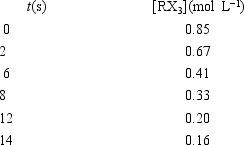
(Multiple Choice)
5.0/5 (84)
(84) In going from room temperature (25.0°C) to 10°C above room temperature, the rate of a reaction doubles. Calculate the activation energy for the reaction.
(Multiple Choice)
4.8/5 (82)
(82) The rate of a reaction is determined by the rate of the fastest step in the mechanism.
(True/False)
4.9/5 (80)
(80) The half-life of a first-order reaction does not depend on the initial concentration of reactant.
(True/False)
4.9/5 (76)
(76) Dinitrogen tetraoxide, N2O4, decomposes to nitrogen dioxide, NO2, in a first-order process. If k = 2.5 × 10³ s−1 at −5°C and k = 3.5 × 10⁴ s−1 at 25°C, what is the activation energy for the decomposition?
(Multiple Choice)
4.9/5 (72)
(72) For the reaction 2A + B + 2C → D + E
The following initial rate data were collected at constant temperature. Determine the correct rate law for this reaction. All units are arbitrary.

(Multiple Choice)
4.9/5 (82)
(82) A boiled egg can be cooked at 100.0°C in exactly 5 minutes. At an altitude of around 2000 m where the boiling point of water is 93.0°C, it takes exactly 7.5 minutes to cook the egg to the same amount. What is the activation energy for the reaction involved when an egg is boiled?
(Multiple Choice)
4.7/5 (82)
(82) 2NOBr(g) → 2NO(g) + Br2(g) 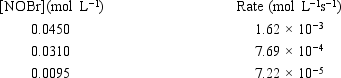 Based on the initial rate data above, what is the value of the rate constant?
 (Multiple Choice)
4.9/5 (79)
(79) For the reaction A(g) + 2B(g) → 2C(g) + 2D(g)
The following data were collected at constant temperature. Determine the correct rate law for this reaction.

(Multiple Choice)
4.9/5 (78)
(78) 
Filters
- Essay(0)
- Multiple Choice(0)
- Short Answer(0)
- True False(0)
- Matching(0)