



 Chat with AI
Exam 20: Thermodynamics: Entropy, Free Energy, and Reaction Direction

Exam 1: Keys to the Study of Chemistry: Definitions, Units, and Problem Solving71 Questions
Exam 2: The Components of Matter101 Questions
Exam 3: Stoichiometry of Formulas and Equations72 Questions
Exam 4: Three Major Classes of Chemical Reactions111 Questions
Exam 5: Gases and the Kinetic-Molecular Theory98 Questions
Exam 6: Thermochemistry: Energy Flow and Chemical Change71 Questions
Exam 7: Quantum Theory and Atomic Structure69 Questions
Exam 8: Electron Configuration and Chemical Periodicity77 Questions
Exam 9: Models of Chemical Bonding61 Questions
Exam 10: The Shapes of Molecules98 Questions
Exam 11: Theories of Covalent Bonding48 Questions
Exam 12: Intermolecular Forces: Liquids, Solids, and Phase Changes95 Questions
Exam 13: The Properties of Mixtures: Solutions and Colloids96 Questions
Exam 14: Periodic Patterns in the Main-Group Elements103 Questions
Exam 15: Organic Compounds and the Atomic Properties of Carbon107 Questions
Exam 16: Kinetics: Rates and Mechanisms of Chemical Reactions78 Questions
Exam 17: Equilibrium: the Extent of Chemical Reactions98 Questions
Exam 18: Acid-Base Equilibria100 Questions
Exam 19: Ionic Equilibria in Aqueous Systems114 Questions
Exam 20: Thermodynamics: Entropy, Free Energy, and Reaction Direction85 Questions
Exam 21: Electrochemistry: Chemical Change and Electrical Work101 Questions
Exam 22: The Elements in Nature and Industry45 Questions
Exam 23: Transition Elements and Their Coordination Compounds81 Questions
Exam 24: Nuclear Reactions and Their Applications82 Questions
Select questions type


For a chemical reaction to be spontaneous at all temperatures, which of the following conditions must be met?

Free
(Multiple Choice)
4.9/5  (87)
(87) Correct Answer: Verified
B
The term microstate refers to the energy state of a single molecule in a system of many molecules.
Free
(True/False)
4.8/5 (82)
(82) Correct Answer:Verified
VerifiedFalse
"A diamond is forever" is one of the most successful advertising slogans of all time. But is it true? For the reaction shown below, calculate the standard free energy change at 298K and determine whether or not a diamond is "forever". C(diamond) → C(graphite)
Data: ΔHf°(diamond) = 1.895 kJ/mol; S°(diamond) = 2.337 J mol−1K−1; S°(graphite) = 5.740 J mol−1K−1.
Free
(Multiple Choice)
4.8/5 (84)
(84) Correct Answer:Verified
VerifiedC
Which one of the following phase changes decreases the entropy of the system?
(Multiple Choice)
4.8/5 (91)
(91) A reaction has ΔG = 10.0 kJ and ΔG° = 15.0 kJ at a temperature of 50°C. Calculate the value of the reaction quotient  under these conditions.
 (Multiple Choice)
4.7/5 (84)
(84) Hydrogen sulfide decomposes according to the following reaction 2H2S(g) → 2H2(g) + S2(g)
For this reaction at 298K ΔS° = 78.1 J/K, ΔH° = 169.4 kJ, and ΔG° = 146.1 kJ. What is the value of ΔG° at 900 K?
(Multiple Choice)
4.9/5 (80)
(80) Calculate the equilibrium constant at 25°C for the reaction of methane with water to form carbon dioxide and hydrogen. The data refer to 25°C. CH4(g) + 2H2O(g) ⇄ CO2(g) + 4H2(g)

(Multiple Choice)
4.9/5 (64)
(64) Which of the following should have the greatest molar entropy at 298 K?
(Multiple Choice)
4.8/5 (85)
(85) Given: H2O(l) → H2O(s) ΔH° = −6.02 kJ at 273K Calculate the entropy change of the surroundings (ΔSsurr) when one mole of water freezes at 0°C and a pressure of one atmosphere.
(Multiple Choice)
4.7/5 (93)
(93) What is the free energy change, ΔG°, for the equilibrium between hydrogen iodide, hydrogen, and iodine at 453°C? Kc = 0.020 2HI(g) ⇄ H2(g) + I2(g)
(Multiple Choice)
4.8/5 (84)
(84) You are given pure samples of ammonia, NH3(g), and nitrogen trifluoride, NF3(g). What prediction would you make concerning their standard molar entropies at 298 K?
(Multiple Choice)
4.8/5 (74)
(74) As a chemical reaction proceeds toward equilibrium, the free energy of the system decreases.
(True/False)
4.9/5 (76)
(76) Elemental boron can be formed by reaction of boron trichloride with hydrogen. BCl3(g) + 1.5H2(g) → B(s) + 3HCl(g)
Calculate ΔG° for the reaction.

(Multiple Choice)
5.0/5 (76)
(76) A sample of water is heated at a constant pressure of one atmosphere. Initially, the sample is ice at 260 K, and at the end the sample consists of steam at 400 K. In which of the following 5K temperature intervals would there be the greatest increase in the entropy of the sample?
(Multiple Choice)
4.7/5 (69)
(69) Consider the figure that shows ΔG° for a chemical process plotted against absolute temperature. From this plot, it is reasonable to conclude that 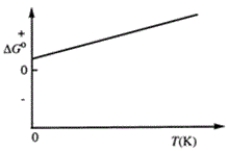
(Multiple Choice)
4.9/5 (75)
(75) Sulfuryl dichloride is formed when sulfur dioxide reacts with chlorine. The data refer to 298 K. SO2(g) + Cl2(g) → SO2Cl2(g)
 What is the value of ΔG° for this reaction at 600 K?
 (Multiple Choice)
4.8/5 (87)
(87) Consider the following quantities used in thermodynamics: E, H, q, w, S, G. How many of them are state functions?
(Multiple Choice)
4.9/5 (80)
(80) In which one of these pairs will the entropy of the first substance be greater than that of the second? Assume P and T are the same for each pair, unless stated otherwise.
(Multiple Choice)
4.9/5 (80)
(80) Which of the following is true for pure oxygen gas, O2(g) at 25°C?
(Multiple Choice)
4.8/5 (75)
(75) Which of the following values is based on the Third Law of Thermodynamics?
(Multiple Choice)
4.9/5 (75)
(75) 
Filters
- Essay(0)
- Multiple Choice(0)
- Short Answer(0)
- True False(0)
- Matching(0)