



 Chat with AI
Exam 12: Intermolecular Forces: Liquids, Solids, and Phase Changes

Exam 1: Keys to the Study of Chemistry: Definitions, Units, and Problem Solving71 Questions
Exam 2: The Components of Matter101 Questions
Exam 3: Stoichiometry of Formulas and Equations72 Questions
Exam 4: Three Major Classes of Chemical Reactions111 Questions
Exam 5: Gases and the Kinetic-Molecular Theory98 Questions
Exam 6: Thermochemistry: Energy Flow and Chemical Change71 Questions
Exam 7: Quantum Theory and Atomic Structure69 Questions
Exam 8: Electron Configuration and Chemical Periodicity77 Questions
Exam 9: Models of Chemical Bonding61 Questions
Exam 10: The Shapes of Molecules98 Questions
Exam 11: Theories of Covalent Bonding48 Questions
Exam 12: Intermolecular Forces: Liquids, Solids, and Phase Changes95 Questions
Exam 13: The Properties of Mixtures: Solutions and Colloids96 Questions
Exam 14: Periodic Patterns in the Main-Group Elements103 Questions
Exam 15: Organic Compounds and the Atomic Properties of Carbon107 Questions
Exam 16: Kinetics: Rates and Mechanisms of Chemical Reactions78 Questions
Exam 17: Equilibrium: the Extent of Chemical Reactions98 Questions
Exam 18: Acid-Base Equilibria100 Questions
Exam 19: Ionic Equilibria in Aqueous Systems114 Questions
Exam 20: Thermodynamics: Entropy, Free Energy, and Reaction Direction85 Questions
Exam 21: Electrochemistry: Chemical Change and Electrical Work101 Questions
Exam 22: The Elements in Nature and Industry45 Questions
Exam 23: Transition Elements and Their Coordination Compounds81 Questions
Exam 24: Nuclear Reactions and Their Applications82 Questions
Select questions type


When silicon is doped with an element from group 3A(13), the device/material produced is a/an

Free
(Multiple Choice)
4.8/5  (87)
(87) Correct Answer: Verified
B
Which of the following properties measures the energy needed to increase the surface area of a liquid?
Free
(Multiple Choice)
4.8/5 (88)
(88) Correct Answer:Verified
VerifiedB
Acetic acid has a heat of fusion of 10.8 kJ/mol and a heat of vaporization of 24.3 kJ/mol. Estimate the value for the heat of sublimation.
Free
(Multiple Choice)
4.9/5 (86)
(86) Correct Answer:Verified
VerifiedA
A single water molecule can participate in at most two hydrogen bonds at any instant.
(True/False)
4.9/5 (72)
(72) Which of the following statements about the packing of monatomic solids with different unit cells is incorrect?
(Multiple Choice)
4.8/5 (75)
(75) Which one of the following quantities is generally not obtainable from a single heating or cooling curve of a substance, measured at atmospheric pressure?
(Multiple Choice)
4.9/5 (70)
(70) The highest temperature at which superconductivity has been achieved is approximately
(Multiple Choice)
4.9/5 (71)
(71) The phase diagram of a substance can be used to obtain the vapor pressure of that substance at a given temperature.
(True/False)
4.9/5 (83)
(83) Which of the following liquids is likely to have the highest surface tension?
(Multiple Choice)
5.0/5 (97)
(97) Consider the following phase diagram and identify the process occurring as one goes from point C to point D. 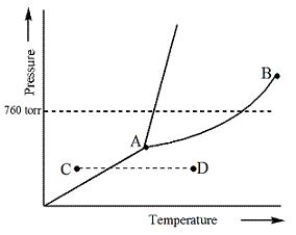
(Multiple Choice)
4.9/5 (93)
(93) The coordination number of sodium and chloride ions in the NaCl lattice, are, respectively
(Multiple Choice)
4.8/5 (80)
(80) Which of the following should have the lowest boiling point?
(Multiple Choice)
4.9/5 (86)
(86) Which of the following pairs is arranged with the particle of higher polarizability listed first?
(Multiple Choice)
4.8/5 (84)
(84) In a transistor, the current through one semiconductor junction controls the current through a neighboring junction.
(True/False)
4.9/5 (77)
(77) When the adhesive forces between a liquid and the walls of a capillary tube are greater than the cohesive forces within the liquid
(Multiple Choice)
4.9/5 (81)
(81) Which of the following pairs is arranged with the particle of higher polarizability listed first?
(Multiple Choice)
4.9/5 (91)
(91) A 5.00 g sample of water vapor, initially at 155°C is cooled at atmospheric pressure, producing ice at −55°C. Calculate the amount of heat energy lost by the water sample in this process, in kJ. Use the following data: specific heat capacity of ice is 2.09 J/g·K; specific heat capacity of liquid water is 4.18 J/g·K; specific heat capacity of water vapor is 1.84 J/g·K; heat of fusion of ice is 336 J/g; heat of vaporization of water is 2260 J/g.
(Multiple Choice)
4.8/5 (75)
(75) In the packing of identical atoms with cubic unit cells, the packing efficiency increases as the coordination number increases.
(True/False)
4.8/5 (89)
(89) 
Filters
- Essay(0)
- Multiple Choice(0)
- Short Answer(0)
- True False(0)
- Matching(0)