



 Chat with AI
Exam 12: Intermolecular Forces: Liquids, Solids, and Phase Changes

Exam 1: Keys to the Study of Chemistry: Definitions, Units, and Problem Solving71 Questions
Exam 2: The Components of Matter101 Questions
Exam 3: Stoichiometry of Formulas and Equations72 Questions
Exam 4: Three Major Classes of Chemical Reactions111 Questions
Exam 5: Gases and the Kinetic-Molecular Theory98 Questions
Exam 6: Thermochemistry: Energy Flow and Chemical Change71 Questions
Exam 7: Quantum Theory and Atomic Structure69 Questions
Exam 8: Electron Configuration and Chemical Periodicity77 Questions
Exam 9: Models of Chemical Bonding61 Questions
Exam 10: The Shapes of Molecules98 Questions
Exam 11: Theories of Covalent Bonding48 Questions
Exam 12: Intermolecular Forces: Liquids, Solids, and Phase Changes95 Questions
Exam 13: The Properties of Mixtures: Solutions and Colloids96 Questions
Exam 14: Periodic Patterns in the Main-Group Elements103 Questions
Exam 15: Organic Compounds and the Atomic Properties of Carbon107 Questions
Exam 16: Kinetics: Rates and Mechanisms of Chemical Reactions78 Questions
Exam 17: Equilibrium: the Extent of Chemical Reactions98 Questions
Exam 18: Acid-Base Equilibria100 Questions
Exam 19: Ionic Equilibria in Aqueous Systems114 Questions
Exam 20: Thermodynamics: Entropy, Free Energy, and Reaction Direction85 Questions
Exam 21: Electrochemistry: Chemical Change and Electrical Work101 Questions
Exam 22: The Elements in Nature and Industry45 Questions
Exam 23: Transition Elements and Their Coordination Compounds81 Questions
Exam 24: Nuclear Reactions and Their Applications82 Questions
Select questions type


Which of the following pairs of substances is arranged so that the one with higher viscosity is listed first? 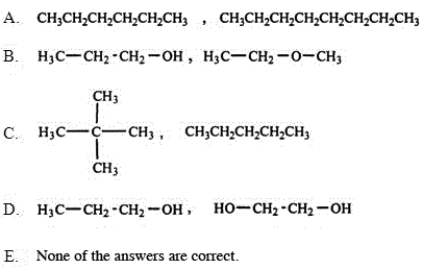
(Multiple Choice)
4.7/5  (90)
(90) The surface tension of water is lowered when a detergent is present in solution.
(True/False)
4.7/5 (75)
(75) Iron crystallizes in the body-centered cubic lattice. What is the coordination number for Fe?
(Multiple Choice)
4.9/5 (85)
(85) Which of the following is true about kinetic energy, Ek, and potential energy, Ep, when ethyl alcohol at 40°C is compared with ethyl alcohol at 20°C?
(Multiple Choice)
4.7/5 (92)
(92) Which one of the following substances will have hydrogen bonds between molecules?
(Multiple Choice)
5.0/5 (78)
(78) A sample of octane in equilibrium with its vapor in a closed 1.0-L container has a vapor pressure of 50.0 torr at 45°C. The container's volume is increased to 2.0 L at constant temperature and the liquid/vapor equilibrium is reestablished. What is the vapor pressure?
(Multiple Choice)
4.9/5 (87)
(87) Which of the following has a boiling point that does not fit the general trend?
(Multiple Choice)
4.9/5 (83)
(83) Which of the following should have the highest surface tension at a given temperature?
(Multiple Choice)
4.7/5 (78)
(78) A metal such with a face-centered cubic lattice will have __________ atom(s) per unit cell.
(Multiple Choice)
4.8/5 (72)
(72) A temperature increase causes __________ in the conductivity of a conductor.
(Multiple Choice)
4.9/5 (69)
(69) Comparing the energies of the following intermolecular forces on a kJ/mol basis, which would normally have the highest energy (i.e., be the strongest force)?
(Multiple Choice)
4.8/5 (82)
(82) The maximum number of phases of a single substance which can coexist in equilibrium is two.
(True/False)
4.7/5 (84)
(84) Which of the following terms refers to the resistance of a liquid to flow?
(Multiple Choice)
4.8/5 (84)
(84) Octane is a component of fuel used in internal combustion engines. The dominant intermolecular forces in octane are
(Multiple Choice)
4.9/5 (84)
(84) 
Filters
- Essay(0)
- Multiple Choice(0)
- Short Answer(0)
- True False(0)
- Matching(0)