



 Chat with AI
Exam 5: Gases and the Kinetic-Molecular Theory

Exam 1: Keys to the Study of Chemistry: Definitions, Units, and Problem Solving71 Questions
Exam 2: The Components of Matter101 Questions
Exam 3: Stoichiometry of Formulas and Equations72 Questions
Exam 4: Three Major Classes of Chemical Reactions111 Questions
Exam 5: Gases and the Kinetic-Molecular Theory98 Questions
Exam 6: Thermochemistry: Energy Flow and Chemical Change71 Questions
Exam 7: Quantum Theory and Atomic Structure69 Questions
Exam 8: Electron Configuration and Chemical Periodicity77 Questions
Exam 9: Models of Chemical Bonding61 Questions
Exam 10: The Shapes of Molecules98 Questions
Exam 11: Theories of Covalent Bonding48 Questions
Exam 12: Intermolecular Forces: Liquids, Solids, and Phase Changes95 Questions
Exam 13: The Properties of Mixtures: Solutions and Colloids96 Questions
Exam 14: Periodic Patterns in the Main-Group Elements103 Questions
Exam 15: Organic Compounds and the Atomic Properties of Carbon107 Questions
Exam 16: Kinetics: Rates and Mechanisms of Chemical Reactions78 Questions
Exam 17: Equilibrium: the Extent of Chemical Reactions98 Questions
Exam 18: Acid-Base Equilibria100 Questions
Exam 19: Ionic Equilibria in Aqueous Systems114 Questions
Exam 20: Thermodynamics: Entropy, Free Energy, and Reaction Direction85 Questions
Exam 21: Electrochemistry: Chemical Change and Electrical Work101 Questions
Exam 22: The Elements in Nature and Industry45 Questions
Exam 23: Transition Elements and Their Coordination Compounds81 Questions
Exam 24: Nuclear Reactions and Their Applications82 Questions
Select questions type


If 0.750 L of argon at 1.50 atm and 177°C and 0.235 L of sulfur dioxide at 95.0 kPa and 63.0°C are added to a 1.00-L flask and the flask's temperature is adjusted to 25.0°C, what is the resulting pressure in the flask?
(Multiple Choice)
4.8/5  (79)
(79) Methane, CH4(g), reacts with steam to give synthesis gas, a mixture of carbon monoxide and hydrogen, which is used as starting material for the synthesis of a number of organic and inorganic compounds. CH4(g) + H2O(g) → CO(g) + H2(g) [unbalanced]
What mass of hydrogen is formed if 275 L of methane (measured at STP) is converted to synthesis gas?
(Multiple Choice)
5.0/5 (70)
(70) What is the pressure in a 7.50-L flask if 0.15 mol of carbon dioxide is added to 0.33 mol of oxygen? The temperature of the mixture is 48.0°C.
(Multiple Choice)
4.8/5 (89)
(89) What is the density of carbon dioxide gas at −25.2°C and 98.0 kPa?
(Multiple Choice)
4.7/5 (89)
(89) A compressed gas cylinder containing 1.50 mol methane has a volume of 3.30 L. What pressure does the methane exert on the walls of the cylinder if its temperature is 25°C?
(Multiple Choice)
4.8/5 (82)
(82) Lithium oxide is an effective absorber of carbon dioxide and can be used to purify air in confined areas such as space vehicles. What volume of carbon dioxide can be absorbed by 1.00 kg of lithium oxide at 25°C and 1.00 atm? Li2O(aq) + CO2(g) → Li2CO3(s)
(Multiple Choice)
4.9/5 (76)
(76) Which of the lines on the figure below is the best representation of the relationship between the volume of a gas and its Celsius temperature, other factors remaining constant? 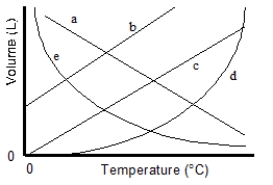
(Multiple Choice)
4.9/5 (83)
(83) Freon-12, CF2Cl2, which has been widely used in air conditioning systems, is considered a threat to the ozone layer in the stratosphere. Calculate the root-mean-square velocity of Freon-12 molecules in the lower stratosphere where the temperature is −65°C.
(Multiple Choice)
4.8/5 (77)
(77) At what temperature in kelvin is the root mean square speed of helium atoms (atomic weight = 4.00) equal to that of oxygen molecules (molecular weight = 32.00) at 300. K?
(Multiple Choice)
4.7/5 (75)
(75) The pressure of sulfur dioxide in a container is 159 kPa. What is this pressure in atmospheres?
(Multiple Choice)
4.8/5 (91)
(91) For an ideal gas, a plot of PV/nRT versus P gives a straight line with a positive slope.
(True/False)
4.8/5 (83)
(83) Use the van der Waals equation for real gases to calculate the pressure exerted by 1.00 mole of ammonia at 27°C in a 750-mL container. (a = 4.17 L2·atm/mol2, b = 0.0371 L/mol)
(Multiple Choice)
4.8/5 (80)
(80) A sample of ammonia gas at 65.5°C and 524 torr has a volume of 15.31 L. What is its volume when the temperature is −15.8°C and its pressure is 524 torr?
(Multiple Choice)
5.0/5 (69)
(69) A flask containing helium gas is connected to an open-ended mercury manometer. The open end is exposed to the atmosphere, where the prevailing pressure is 752 torr. The mercury level in the open arm is 26 mm above that in the arm connected to the flask of helium. What is the helium pressure, in torr?
(Multiple Choice)
4.9/5 (87)
(87) 
Filters
- Essay(0)
- Multiple Choice(0)
- Short Answer(0)
- True False(0)
- Matching(0)