



 Chat with AI
Exam 5: Gases and the Kinetic-Molecular Theory

Exam 1: Keys to the Study of Chemistry: Definitions, Units, and Problem Solving71 Questions
Exam 2: The Components of Matter101 Questions
Exam 3: Stoichiometry of Formulas and Equations72 Questions
Exam 4: Three Major Classes of Chemical Reactions111 Questions
Exam 5: Gases and the Kinetic-Molecular Theory98 Questions
Exam 6: Thermochemistry: Energy Flow and Chemical Change71 Questions
Exam 7: Quantum Theory and Atomic Structure69 Questions
Exam 8: Electron Configuration and Chemical Periodicity77 Questions
Exam 9: Models of Chemical Bonding61 Questions
Exam 10: The Shapes of Molecules98 Questions
Exam 11: Theories of Covalent Bonding48 Questions
Exam 12: Intermolecular Forces: Liquids, Solids, and Phase Changes95 Questions
Exam 13: The Properties of Mixtures: Solutions and Colloids96 Questions
Exam 14: Periodic Patterns in the Main-Group Elements103 Questions
Exam 15: Organic Compounds and the Atomic Properties of Carbon107 Questions
Exam 16: Kinetics: Rates and Mechanisms of Chemical Reactions78 Questions
Exam 17: Equilibrium: the Extent of Chemical Reactions98 Questions
Exam 18: Acid-Base Equilibria100 Questions
Exam 19: Ionic Equilibria in Aqueous Systems114 Questions
Exam 20: Thermodynamics: Entropy, Free Energy, and Reaction Direction85 Questions
Exam 21: Electrochemistry: Chemical Change and Electrical Work101 Questions
Exam 22: The Elements in Nature and Industry45 Questions
Exam 23: Transition Elements and Their Coordination Compounds81 Questions
Exam 24: Nuclear Reactions and Their Applications82 Questions
Select questions type


A flask with a volume of 3.16 L contains 9.33 grams of an unknown gas at 32.0°C and 1.00 atm. What is the molar mass of the gas?
(Multiple Choice)
4.9/5  (76)
(76) Nitrogen dioxide is a red-brown gas that is responsible for the color of photochemical smog. A sample of nitrogen dioxide has a volume of 28.6 L at 45.3°C and 89.9 kPa. What is its volume at STP?
(Multiple Choice)
4.8/5 (76)
(76) The volume of a single molecule of water is 2.99 × 10⁻²³ mL. For a sample of gaseous water at 1.00 atm and 150°C, what fraction of the container's volume is occupied by the molecules themselves?
(Multiple Choice)
4.9/5 (85)
(85) A flask containing neon gas is connected to an open-ended mercury manometer. The open end is exposed to the atmosphere, where the prevailing pressure is 745 torr. The mercury level in the open arm is 50. mm below that in the arm connected to the flask of neon. What is the neon pressure, in torr?
(Multiple Choice)
4.9/5 (84)
(84) A 750-mL sample of hydrogen exerts a pressure of 822 torr at 325 K. What pressure does it exert if the temperature is raised to 475 K at constant volume?
(Multiple Choice)
4.9/5 (74)
(74) Hydrogen gas exerts a pressure of 466 torr in a container. What is this pressure in atmospheres?
(Multiple Choice)
4.8/5 (81)
(81) A sample of methane gas, CH4(g), occupies a volume of 60.3 L at a pressure of 469 torr and a temperature of 29.3°C. What would be its temperature at a pressure of 243 torr and volume of 60.3 L?
(Multiple Choice)
4.9/5 (75)
(75) A 3.0-L sample of helium was placed in a container fitted with a porous membrane. Half of the helium effused through the membrane in 24 hours. A 3.0-L sample of oxygen was placed in an identical container. How many hours will it take for half of the oxygen to effuse through the membrane?
(Multiple Choice)
4.7/5 (79)
(79) Assuming ideal behavior, what is the density of argon gas at STP, in g/L?
(Multiple Choice)
4.8/5 (64)
(64) Magnesium metal (0.100 mol) and a volume of aqueous hydrochloric acid that contains 0.500 mol of HCl are combined and react to completion. How many liters of hydrogen gas, measured at STP, are produced? Mg(s) + 2HCl(aq) → MgCl2(aq) + H2(g)
(Multiple Choice)
4.9/5 (81)
(81) A flask containing argon gas is connected to a closed-ended mercury manometer. The closed end is under vacuum. If the mercury level in the closed arm is 230. mm above that in the arm connected to the flask, what is the argon pressure, in torr?
(Multiple Choice)
4.9/5 (67)
(67) According to the postulates of kinetic-molecular theory, the molecules of all gases at a given temperature have the same average speed.
(True/False)
4.9/5 (82)
(82) Dr. I. M. A. Brightguy adds 0.1727 g of an unknown gas to a 125-mL flask. If Dr. B finds the pressure to be 736 torr at 20.0°C, is the gas likely to be methane, CH4, nitrogen, N2, oxygen, O2, neon, Ne, or argon, Ar?
(Multiple Choice)
4.9/5 (81)
(81) A sample of an ideal gas has its volume doubled while its temperature remains constant. If the original pressure was 100 torr, what is the new pressure?
(Multiple Choice)
4.9/5 (90)
(90) Which of the following gases will be the slowest to diffuse through a room?
(Multiple Choice)
4.8/5 (80)
(80) "The pressure of an ideal gas is inversely proportional to its volume at constant temperature and number of moles" is a statement of __________ Law.
(Multiple Choice)
5.0/5 (65)
(65) Hydrogen peroxide was catalytically decomposed and 75.3 mL of oxygen gas was collected over water at 25°C and 742 torr. What mass of oxygen was collected? (Pwater = 24 torr at 25°C)
(Multiple Choice)
4.8/5 (82)
(82) If the molecular mass of a gas increases by a factor of 4 at constant temperature, its rms speed will
(Multiple Choice)
4.8/5 (89)
(89) A 250.0-mL sample of ammonia, NH3(g), exerts a pressure of 833 torr at 42.4°C. What mass of ammonia is in the container?
(Multiple Choice)
4.9/5 (93)
(93) Which of the lines on the figure below is the best representation of the relationship between the volume and the number of moles of a gas, measured at constant temperature and pressure? 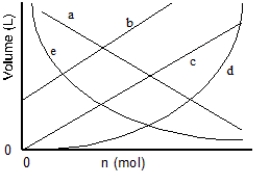
(Multiple Choice)
4.9/5 (85)
(85) 
Filters
- Essay(0)
- Multiple Choice(0)
- Short Answer(0)
- True False(0)
- Matching(0)