



 Chat with AI
Exam 4: Process Costing and Hybrid Product-Costing Systems

Exam 1: The Changing Role of Managerial Accounting in a Dynamic Business Environment85 Questions
Exam 2: Basic Cost Management Concepts115 Questions
Exam 3: Product Costing and Cost Accumulation in a Batch Production Environment95 Questions
Exam 4: Process Costing and Hybrid Product-Costing Systems88 Questions
Exam 5: Activity-Based Costing and Management103 Questions
Exam 6: Activity Analysis, Cost Behavior, and Cost Estimation90 Questions
Exam 7: Cost-Volume-Profit Analysis109 Questions
Exam 8: Variable Costing and the Costs of Quality and Sustainability74 Questions
Exam 9: Financial Planning and Analysis: the Master Budget112 Questions
Exam 10: Standard Costing and Analysis of Direct Costs97 Questions
Exam 11: Flexible Budgeting and Analysis of Overhead Costs89 Questions
Exam 12: Responsibility Accounting, Operational Performance Measures, and the Balanced Scorecard89 Questions
Exam 13: Investment Centers and Transfer Pricing101 Questions
Exam 14: Decision Making: Relevant Costs and Benefits96 Questions
Exam 15: Target Costing and Cost Analysis for Pricing Decisions107 Questions
Exam 16: Capital Expenditure Decisions120 Questions
Exam 17: Allocation of Support Activity Costs and Joint Costs81 Questions
Exam 18: The Sarbanes-Oxley Act, Internal Controls, and Management Accounting20 Questions
Exam 19: Compound Interest and the Concept of Present Value27 Questions
Exam 20: Inventory Management20 Questions
Select questions type


Sun Chemicals uses a weighted-average process-costing system. The following data relate to May:
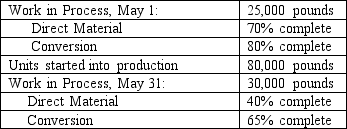 Required:
A. Calculate the number of pounds completed during May.
B. Calculate equivalent units of materials and conversion for May.
C. Does Sun introduce all of its direct materials at the very beginning of production? Explain your answer.
Required:
A. Calculate the number of pounds completed during May.
B. Calculate equivalent units of materials and conversion for May.
C. Does Sun introduce all of its direct materials at the very beginning of production? Explain your answer. (Essay)
4.8/5  (73)
(73) All of the following statements about an operation-costing system are true except:
(Multiple Choice)
4.8/5 (68)
(68) Which of the following is a key document in a typical process-costing system?
(Multiple Choice)
4.9/5 (68)
(68) Ashley Corporation uses a process-cost accounting system. The company adds direct materials and direct labor at the start of its production process; overhead cost is incurred evenly throughout manufacturing. The firm has no beginning work-in-process inventory; its ending work in process is 40% complete. Which of the following sets of percentages would be used to calculate the correct number of equivalent units in the ending work-in-process inventory?
(Multiple Choice)
4.8/5 (80)
(80) Use the following information to answer the following Questions
Lakeland Chemical manufactures a product called Zing. Direct materials are added at the beginning of the process, and conversion activity occurs uniformly throughout production. The beginning work-in-process inventory is 60% complete with respect to conversion; the ending work-in-process inventory is 20% complete. The following data pertain to May:
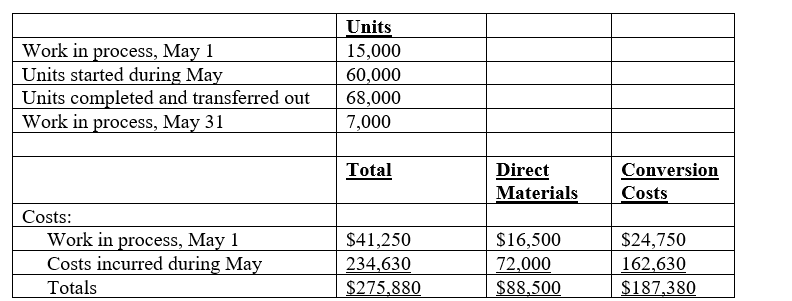 -Using the weighted-average method of process costing, the cost per unit of conversion activity is:
 (Multiple Choice)
4.8/5 (77)
(77) When calculating equivalent units using the weighted average method, the number of equivalent units of activity is calculated without making a distinction as to whether the activity occurred in the current accounting period or the preceding period.
(True/False)
4.7/5 (80)
(80) When goods are sold, their costs are transferred to Finished Goods Inventory.
(True/False)
4.9/5 (86)
(86) Process costing would likely be used in all of the following industries except:
(Multiple Choice)
4.7/5 (81)
(81) Direct labor and manufacturing overhead often are combined into a single cost category termed conversion costs.
(True/False)
4.9/5 (79)
(79) Upton Knitters manufactures sweaters and uses an operation-costing system. All sweaters are processed through Department no. 1, with subsequent processing taking place in Department no. 2 or Department no. 3, depending on the type of fabric used. Twenty thousand sweaters were produced during the year; there was no beginning or ending work in process. Sixty percent of the goods were sent to Department no. 2 for manufacturing.
Conversion cost incurred in the three departments totaled $504,000, subdivided as follows: Department no. 1, $360,000; Department no. 2, $60,000; and Department no. 3, $84,000.
Data pertaining to two representative orders, nos. 545 and 567, were:
 Required:
A. Explain the nature of operation costing.
B. Determine the cost of order nos. 545 and 567.
Required:
A. Explain the nature of operation costing.
B. Determine the cost of order nos. 545 and 567. (Essay)
4.8/5 (79)
(79) Linder Corporation had 8,200 units of work in process on November 1. During November, 26,800 units were started and as of November 30, 7,900 units remained in production. How many units were completed during November?
(Multiple Choice)
4.8/5 (82)
(82) Gulliver, Inc., which uses a process-costing system, transfers completed production from Department no. 1 to Department no. 2 for further work. Which of the following best describes the account that would be debited to record this transfer?
(Multiple Choice)
4.8/5 (84)
(84) Use the following information to answer the following Questions
Claremore Industries uses a weighted-average process-costing system. All materials are added at the beginning of the process; conversion costs are incurred evenly throughout production. The company finished 40,000 units during the period and had 15,000 units in progress at year-end, the latter at the 40% stage of completion. Total material costs amounted to $220,000; conversion costs were $414,000.
-The cost of goods completed is:
(Multiple Choice)
4.9/5 (79)
(79) Which of the following statements about similarities between process costing and job-order costing are true?
I. Both systems assign production costs to units of output.
II. Both systems require extensive knowledge of financial accounting.
III. The flow of costs through the manufacturing accounts is essentially the same.
(Multiple Choice)
4.7/5 (78)
(78) Operation costing tends to parallel job-order costing with respect to the treatment of conversion cost.
(True/False)
4.9/5 (93)
(93) When the cutting process in a manufacturing firm has been finished and the goods are transferred into the assembly department, the journal entry to record the transfer will debit Finished Goods Inventory and credit Work in Process - Assembly.
(True/False)
4.9/5 (83)
(83) Frankoff Company had a beginning work-in-process inventory of 30,000 units on June 1. These units contained $120,000 of direct materials and $272,000 of conversion cost. The following data relate to activity during June:
 Frankoff uses a weighted-average process-costing system. All materials are added at the start of manufacturing; in contrast, conversion cost is incurred evenly throughout production.
Required:
A. Compute the total equivalent units for direct material and conversion cost.
B. Compute the cost per equivalent unit of direct material and conversion cost.
C. Determine the cost of completed production.
D. Determine the cost of the June 30 work in process.
Frankoff uses a weighted-average process-costing system. All materials are added at the start of manufacturing; in contrast, conversion cost is incurred evenly throughout production.
Required:
A. Compute the total equivalent units for direct material and conversion cost.
B. Compute the cost per equivalent unit of direct material and conversion cost.
C. Determine the cost of completed production.
D. Determine the cost of the June 30 work in process. (Essay)
5.0/5 (63)
(63) Use the following information to answer the following Questions
Universal Manufacturing uses a weighted-average process-costing system. All materials are introduced at the start of manufacturing, and conversion costs are incurred evenly throughout the process. The company's beginning and ending work-in-process inventories totaled 10,000 units and 15,000 units, respectively, with the latter units being 2/3 complete at the end of the period. Universal started 30,000 units into production and completed 25,000 units. Manufacturing costs follow.
Beginning work in process: Materials, $60,000; conversion cost, $150,000
Current costs: Materials, $180,000; conversion cost, $480,000
-Universal's equivalent-unit cost for conversion cost is:
(Multiple Choice)
4.8/5 (79)
(79) 
Filters
- Essay(0)
- Multiple Choice(0)
- Short Answer(0)
- True False(0)
- Matching(0)