



 Chat with AI
Exam 4: Process Costing and Hybrid Product-Costing Systems

Exam 1: The Changing Role of Managerial Accounting in a Dynamic Business Environment85 Questions
Exam 2: Basic Cost Management Concepts115 Questions
Exam 3: Product Costing and Cost Accumulation in a Batch Production Environment95 Questions
Exam 4: Process Costing and Hybrid Product-Costing Systems88 Questions
Exam 5: Activity-Based Costing and Management103 Questions
Exam 6: Activity Analysis, Cost Behavior, and Cost Estimation90 Questions
Exam 7: Cost-Volume-Profit Analysis109 Questions
Exam 8: Variable Costing and the Costs of Quality and Sustainability74 Questions
Exam 9: Financial Planning and Analysis: the Master Budget112 Questions
Exam 10: Standard Costing and Analysis of Direct Costs97 Questions
Exam 11: Flexible Budgeting and Analysis of Overhead Costs89 Questions
Exam 12: Responsibility Accounting, Operational Performance Measures, and the Balanced Scorecard89 Questions
Exam 13: Investment Centers and Transfer Pricing101 Questions
Exam 14: Decision Making: Relevant Costs and Benefits96 Questions
Exam 15: Target Costing and Cost Analysis for Pricing Decisions107 Questions
Exam 16: Capital Expenditure Decisions120 Questions
Exam 17: Allocation of Support Activity Costs and Joint Costs81 Questions
Exam 18: The Sarbanes-Oxley Act, Internal Controls, and Management Accounting20 Questions
Exam 19: Compound Interest and the Concept of Present Value27 Questions
Exam 20: Inventory Management20 Questions
Select questions type


Use this information to answer Questions
Norton Textile Co. manufactures a variety of fabrics. All materials are introduced at the beginning of production; conversion cost is incurred evenly through manufacturing. The Weaving Department had 2,000 units of work in process on April 1 that were 30% complete as to conversion costs. During April, 9,000 units were completed and on April 30, 4,000 units remained in production, 40% complete with respect to conversion costs.
-The equivalent units of conversion for April total:
(Multiple Choice)
5.0/5  (71)
(71) Peach Company uses a weighted-average process-costing system. Company records disclosed that the firm completed 40,000 units during the month and had 10,000 units in process at month-end, 20% complete. Conversion costs associated with the beginning work-in-process inventory amounted to $231,000, and amounts that relate to the current month totaled $966,000. If conversion is incurred uniformly throughout manufacturing, Peach's equivalent-unit cost is:
(Multiple Choice)
4.9/5 (78)
(78) Minnon, Inc., uses a weighted-average process-costing system. All materials are introduced at the beginning of production; conversion cost is incurred evenly throughout manufacturing. The following information pertains to April:
 The company's accountant has already computed the cost per equivalent unit, as follows: materials, $5; conversion, $14.
Required:
Calculate the cost of goods completed during April and the cost of the ending work-in-process inventory.
The company's accountant has already computed the cost per equivalent unit, as follows: materials, $5; conversion, $14.
Required:
Calculate the cost of goods completed during April and the cost of the ending work-in-process inventory.
(Essay)
4.7/5 (69)
(69) California Products employs a process-costing system for its manufacturing operations. All materials are added at the beginning of the process, and conversion costs are incurred uniformly throughout production. The information that follows relates to September.
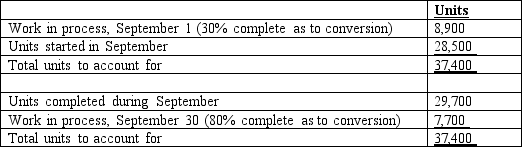 Required:
A. Calculate equivalent units of direct material for September.
B. Calculate equivalent units of conversion activity for September.
Required:
A. Calculate equivalent units of direct material for September.
B. Calculate equivalent units of conversion activity for September. (Essay)
4.9/5 (85)
(85) Fulton Corporation adds all materials at the beginning of production and incurs conversion cost evenly throughout manufacturing. The company completed 70,000 units during the year and had 12,000 units in process at year end, 20% complete with respect to conversion cost. Equivalent units for the year total:
(Multiple Choice)
4.9/5 (79)
(79) Zorbex Company refines a variety of petrochemical products. The following data pertain to the firm's Baton Rouge plant:
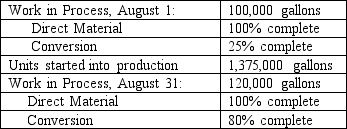 Required:
Compute the equivalent units of direct materials and conversion for August.
Required:
Compute the equivalent units of direct materials and conversion for August.
(Essay)
4.9/5 (91)
(91) Which of the following is a nonmanufacturing business where process costing would most likely be used?
(Multiple Choice)
4.8/5 (82)
(82) Oxford, Inc., which uses a process-cost accounting system, began operations on January 1 of the current year. The company incurs conversion cost evenly throughout manufacturing. If Oxford started work on 3,000 units during the period and these units were 70% of the way through manufacturing, it would be correct to say that the company has:
(Multiple Choice)
5.0/5 (99)
(99) Use the following information to answer the following Questions
Lakeland Chemical manufactures a product called Zing. Direct materials are added at the beginning of the process, and conversion activity occurs uniformly throughout production. The beginning work-in-process inventory is 60% complete with respect to conversion; the ending work-in-process inventory is 20% complete. The following data pertain to May:
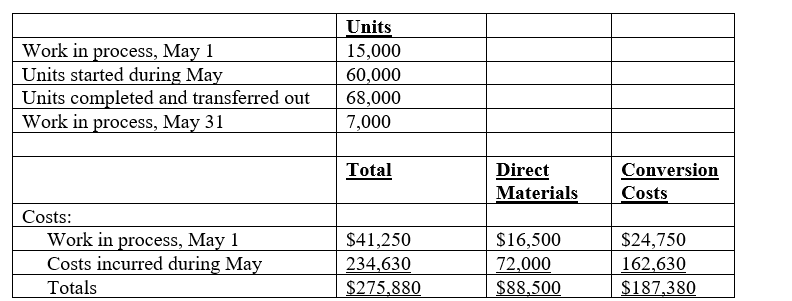 -Using the weighted-average method of process costing, the cost of goods completed and transferred during May is:
 (Multiple Choice)
4.8/5 (72)
(72) Domkowski began operations on January 1 of the current year. The company uses a process-costing system, and conversion cost is incurred evenly throughout manufacturing. By January 31, the firm had completed 56,000 units. Which of the following statements is true about the ending work-in-process inventory if equivalent units for conversion cost totaled 59,000 units?
(Multiple Choice)
4.9/5 (72)
(72) When calculating unit costs under the weighted-average process-costing method, the unit cost is based on:
(Multiple Choice)
4.9/5 (66)
(66) Only normal costing may be used in conjunction with a process-costing system.
(True/False)
4.9/5 (66)
(66) A departmental production report under weighted-average process costing would most likely present total costs for two different processes.
(True/False)
4.9/5 (82)
(82) Lowery Corporation, which uses an operation-costing system, has three processing departments. All units pass through Department no. 1; upon completion, 70% of the goods are sent to Department no. 2 and 30% are sent to Department no. 3. Additional data follow.
· Forty thousand units were manufactured during the year.
· Conversion cost in each department was: No. 1, $380,000; no. 2, $196,000; and no. 3, $150,000.
· Batch no. 67, which consisted of 500 units, was sent to Department no. 3 for its additional processing. Direct materials of $23,500 and $11,900 were introduced to this batch in Department nos. 1 and 3, respectively.
Lowery assigns conversion cost to goods manufactured on the basis of units produced.
Required:
A. Determine the conversion cost per unit in Department no. 1, Department no. 2, and Department no. 3.
B. Compute the total cost of batch no. 67.
C. Operation costing is sometimes referred to as a hybrid costing system. Briefly explain.
(Essay)
4.9/5 (78)
(78) Frankenberger Company, which uses a weighted-average process-costing system, had 7,000 units in production at the end of the current period that were 60% complete. Material A is introduced at the beginning of the process; material B is introduced at the end of the process; and conversion cost is introduced evenly throughout manufacturing. Equivalent-unit production costs follow.
Material A: $12.50
Material B: $2.00
Conversion cost: $6.60
The cost of the company's ending work-in-process inventory is:
(Multiple Choice)
4.8/5 (70)
(70) Companies that use a process-cost accounting system would establish a separate Work-in-Process Inventory account for each manufacturing department.
(True/False)
4.9/5 (90)
(90) A considerable portion of the text's process-costing presentation illustrated the proper way to allocate manufacturing costs to the units completed during the period and the ending work-in-process inventory. For companies that have a single manufacturing department, the journal entry to recognize completed production involves a debit to Finished-Goods Inventory and a credit to Work-in-Process Inventory.
Required:
What journal entry, if any, is needed for these same companies to properly account for ending work in process?
(Essay)
4.8/5 (79)
(79) Use the following information to answer the following Questions
Forrest Corporation, a new company, adds material at the beginning of its production process; conversion cost, in contrast, is incurred evenly throughout manufacturing. During May, the firm completed 15,000 units and had ending work in process of 2,000 units, 60% complete. Equivalent-unit costs were: materials, $15; conversion, $22.
-The cost of Forrest's completed production is:
(Multiple Choice)
4.9/5 (72)
(72) Agee Company uses a process-costing system for its single product. Material A is added at the beginning of the process; in contrast, material B is added when the units are 50% complete. The firm's ending work-in-process inventory consists of 4,000 units that are 75% complete. Which of the following correctly expresses the equivalent units of production with respect to materials A and B in the ending work-in-process inventory?
(Multiple Choice)
4.8/5 (71)
(71) 
Filters
- Essay(0)
- Multiple Choice(0)
- Short Answer(0)
- True False(0)
- Matching(0)