



 Chat with AI
Exam 4: Process Costing and Hybrid Product-Costing Systems

Exam 1: The Changing Role of Managerial Accounting in a Dynamic Business Environment85 Questions
Exam 2: Basic Cost Management Concepts115 Questions
Exam 3: Product Costing and Cost Accumulation in a Batch Production Environment95 Questions
Exam 4: Process Costing and Hybrid Product-Costing Systems88 Questions
Exam 5: Activity-Based Costing and Management103 Questions
Exam 6: Activity Analysis, Cost Behavior, and Cost Estimation90 Questions
Exam 7: Cost-Volume-Profit Analysis109 Questions
Exam 8: Variable Costing and the Costs of Quality and Sustainability74 Questions
Exam 9: Financial Planning and Analysis: the Master Budget112 Questions
Exam 10: Standard Costing and Analysis of Direct Costs97 Questions
Exam 11: Flexible Budgeting and Analysis of Overhead Costs89 Questions
Exam 12: Responsibility Accounting, Operational Performance Measures, and the Balanced Scorecard89 Questions
Exam 13: Investment Centers and Transfer Pricing101 Questions
Exam 14: Decision Making: Relevant Costs and Benefits96 Questions
Exam 15: Target Costing and Cost Analysis for Pricing Decisions107 Questions
Exam 16: Capital Expenditure Decisions120 Questions
Exam 17: Allocation of Support Activity Costs and Joint Costs81 Questions
Exam 18: The Sarbanes-Oxley Act, Internal Controls, and Management Accounting20 Questions
Exam 19: Compound Interest and the Concept of Present Value27 Questions
Exam 20: Inventory Management20 Questions
Select questions type


St. Onge, Inc. uses a process-costing system. A newly-hired accountant identified the following procedures that must be performed by the close of business on Friday:
1-Calculation of equivalent units
2-Analysis of physical flows of units
3-Assignment of costs to completed units and units still in process
4-Calculation of unit costs
Which of the following choices correctly expresses the proper order of the preceding tasks?
(Multiple Choice)
4.8/5  (69)
(69) Which of the following data are needed to calculate total equivalent units under the weighted-average method?
(Multiple Choice)
4.8/5 (80)
(80) Professor Jones is concerned that her students do not understand the concept of equivalent units. She has therefore prepared the following questions, to appear on an upcoming examination:
Equivalent units are used in a process-costing accounting system.
Required:
A. Explain the need for equivalent units and why separate equivalent-unit totals are calculated for direct materials and conversion cost.
B. If an examination of goods in production at the end of the period revealed 12,000 units that are, on average, 75% complete, would it be correct to say that 9,000 units were finished during the period? Why?
Required:
Prepare a complete answer key that can be used in grading the examination questions.
(Essay)
4.9/5 (84)
(84) Xin Co., had 3,000 units of work in process on April 1 that were 60% complete. During April, 10,000 units were completed and as of April 30, 4,000 units that were 40% complete remained in production. How many units were started during April?
(Multiple Choice)
4.8/5 (79)
(79) Breight, Inc., which uses a process-costing system, transfers completed production from Department no. 1 to Department no. 2 for further work. Which of the following best describes the account that would be credited to record this transfer?
(Multiple Choice)
4.9/5 (76)
(76) 
Equivalent units and physical units are the same in manufacturing inventories.
(True/False)
4.8/5 (81)
(81) California Corporation overstated the percentage of work completed with respect to conversion cost on the ending work-in-process inventory. This overstatement caused conversion-cost equivalent units to be overstated.
(True/False)
4.8/5 (75)
(75) Fedora, Inc, uses a weighted-average process-costing system and has one production department. All materials are introduced at the start of manufacturing; in contrast, conversion cost is incurred uniformly throughout production. The company had respective work-in-process inventories on May 1 and May 31 of 62,000 units and 70,000 units, the latter of which was 40% complete. The production supervisor noted that Fedora completed 100,000 units during the month.
Costs in the May 1 work-in-process inventory were subdivided as follows: materials, $40,000; conversion, $90,000. During May, Fedora charged production with $300,000 of material and $710,000 of conversion, resulting in a material cost per equivalent unit of $2.
Required:
A. Determine the number of units that Fedora started during May.
B. Compute the number of equivalent units with respect to conversion cost.
C. Determine the conversion cost per equivalent unit.
D. Compute the cost of the May 31 work-in-process inventory.
E. What account would have been credited to record Fedora's completed production?
(Essay)
4.7/5 (91)
(91) Use the following information to answer the following Questions
Universal Manufacturing uses a weighted-average process-costing system. All materials are introduced at the start of manufacturing, and conversion costs are incurred evenly throughout the process. The company's beginning and ending work-in-process inventories totaled 10,000 units and 15,000 units, respectively, with the latter units being 2/3 complete at the end of the period. Universal started 30,000 units into production and completed 25,000 units. Manufacturing costs follow.
Beginning work in process: Materials, $60,000; conversion cost, $150,000
Current costs: Materials, $180,000; conversion cost, $480,000
-Universal's equivalent-unit cost for materials is:
(Multiple Choice)
4.8/5 (88)
(88) Markus Corporation reported the following as of February 1, (weighted-average method).
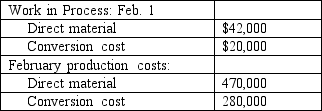 Conversations with the production supervisor revealed that materials are introduced at the start of the process and conversion cost is incurred evenly throughout manufacturing. The company started 29,000 units during the month. Goods in process at the beginning and end of February totaled 3,000 units and 5,000 units, respectively, the latter batch being 60% complete.
Just prior to leaving on vacation, a trusted staff assistant was asked to compute the cost of February's ending work-in-process inventory. Her calculations showed a huge rise in unit cost when compared with the February 1 figures, soaring to $250 [($470,000 + $280,000) / 3,000 units (5,000 units *60%)].
Required:
A. Did the staff assistant make any errors in her calculations? Explain.
B. Analyze the company's production volume and determine the proper equivalent-unit figures for February.
C. Calculate the proper unit costs for February.
D. Calculate the cost of the February 28 work-in-process inventory.
Conversations with the production supervisor revealed that materials are introduced at the start of the process and conversion cost is incurred evenly throughout manufacturing. The company started 29,000 units during the month. Goods in process at the beginning and end of February totaled 3,000 units and 5,000 units, respectively, the latter batch being 60% complete.
Just prior to leaving on vacation, a trusted staff assistant was asked to compute the cost of February's ending work-in-process inventory. Her calculations showed a huge rise in unit cost when compared with the February 1 figures, soaring to $250 [($470,000 + $280,000) / 3,000 units (5,000 units *60%)].
Required:
A. Did the staff assistant make any errors in her calculations? Explain.
B. Analyze the company's production volume and determine the proper equivalent-unit figures for February.
C. Calculate the proper unit costs for February.
D. Calculate the cost of the February 28 work-in-process inventory.
(Essay)
4.9/5 (77)
(77) Corrigan, Inc. overstated the percentage of work completed with respect to conversion cost on the ending work-in-process inventory. What is the effect of this overstatement on conversion-cost equivalent units and physical units manufactured, respectively?
(Multiple Choice)
4.8/5 (84)
(84) Under weighted-average process costing, unit-cost figures are weighted averages of costs incurred over two or more accounting periods.
(True/False)
4.7/5 (97)
(97) On May 1, Diggton Company had a work-in-process inventory of 10,000 units. The units were 100% complete for material and 30% complete for conversion, with respective costs of $30,000 and $1,850.
During the month, 150,000 units were completed and transferred to finished goods. The May 31 ending work-in-process inventory consisted of 10,000 units that were 100% complete with respect to materials and 80% complete with respect to conversion.
Costs added during the month were $330,000 for materials and $503,750 for conversion.
Required:
Using the weighted-average method, calculate:
A. total equivalent units for material and conversion.
B. the cost per equivalent unit for material and conversion.
C. the cost transferred to finished goods.
D. the cost of ending work in process.
(Essay)
4.9/5 (69)
(69) Use the following information to answer the following Questions
Forrest Corporation, a new company, adds material at the beginning of its production process; conversion cost, in contrast, is incurred evenly throughout manufacturing. During May, the firm completed 15,000 units and had ending work in process of 2,000 units, 60% complete. Equivalent-unit costs were: materials, $15; conversion, $22.
-The cost of the company's ending work-in-process inventory is:
(Multiple Choice)
4.8/5 (76)
(76) Mortensen Industries, which uses a process-costing system, adds material at the beginning of production and incurs conversion cost evenly throughout manufacturing. The following selected information was taken from the company's accounting records:
Total equivalent units of materials: 5,000
Total equivalent units of conversion: 4,400
Units started and completed during the period: 3,500
On the basis of this information, the ending work-in-process inventory's stage of completion is:
(Multiple Choice)
4.9/5 (90)
(90) Use the following information to answer the following Questions
Claremore Industries uses a weighted-average process-costing system. All materials are added at the beginning of the process; conversion costs are incurred evenly throughout production. The company finished 40,000 units during the period and had 15,000 units in progress at year-end, the latter at the 40% stage of completion. Total material costs amounted to $220,000; conversion costs were $414,000.
-The cost of the ending work in process is:
(Multiple Choice)
4.8/5 (81)
(81) Forte Co., had 3,000 units of work in process on April 1 that were 60% complete. During April, 11,000 units were started and as of April 30, 4,000 units that were 40% complete remained in production. How many units were completed during April?
(Multiple Choice)
5.0/5 (75)
(75) When determining the cost of a manufactured good under an operation-costing system, a company would:
(Multiple Choice)
4.9/5 (71)
(71) 
Filters
- Essay(0)
- Multiple Choice(0)
- Short Answer(0)
- True False(0)
- Matching(0)