



 Chat with AI
Exam 16: Capital Expenditure Decisions

Exam 1: The Changing Role of Managerial Accounting in a Dynamic Business Environment85 Questions
Exam 2: Basic Cost Management Concepts115 Questions
Exam 3: Product Costing and Cost Accumulation in a Batch Production Environment95 Questions
Exam 4: Process Costing and Hybrid Product-Costing Systems88 Questions
Exam 5: Activity-Based Costing and Management103 Questions
Exam 6: Activity Analysis, Cost Behavior, and Cost Estimation90 Questions
Exam 7: Cost-Volume-Profit Analysis109 Questions
Exam 8: Variable Costing and the Costs of Quality and Sustainability74 Questions
Exam 9: Financial Planning and Analysis: the Master Budget112 Questions
Exam 10: Standard Costing and Analysis of Direct Costs97 Questions
Exam 11: Flexible Budgeting and Analysis of Overhead Costs89 Questions
Exam 12: Responsibility Accounting, Operational Performance Measures, and the Balanced Scorecard89 Questions
Exam 13: Investment Centers and Transfer Pricing101 Questions
Exam 14: Decision Making: Relevant Costs and Benefits96 Questions
Exam 15: Target Costing and Cost Analysis for Pricing Decisions107 Questions
Exam 16: Capital Expenditure Decisions120 Questions
Exam 17: Allocation of Support Activity Costs and Joint Costs81 Questions
Exam 18: The Sarbanes-Oxley Act, Internal Controls, and Management Accounting20 Questions
Exam 19: Compound Interest and the Concept of Present Value27 Questions
Exam 20: Inventory Management20 Questions
Select questions type


Tanner Corporation is considering the acquisition of a new machine that is expected to produce annual savings in cash operating costs of $30,000 before income taxes. The machine costs $100,000, has a useful life of five years, and no salvage value. Tanner uses straight-line depreciation on all assets, is subject to a 30% income tax rate, and has an after-tax hurdle rate of 8%.
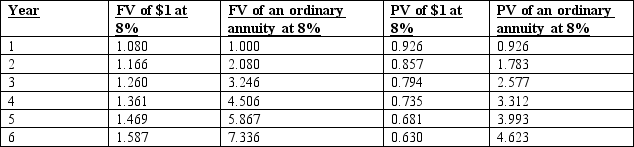 Required:
A. Compute the machine's accounting rate of return on the initial investment.
B. Compute the machine's net present value.
Required:
A. Compute the machine's accounting rate of return on the initial investment.
B. Compute the machine's net present value.
Free
(Essay)
4.9/5  (80)
(80) Correct Answer: Verified
A. Average income: ($30,000 ‒ $20,000) * 0.70 = $7,000
Accounting rate of return: $7,000 / $100,000 = 7%
B.
 Depreciation tax savings:
Year 1: 10,000 x .3 = 3,000 x .926 = 2,778
Year 2: 20,000 x .3 = 6,000 x .857 = 5,142
Year 3: 20,000 x .3 = 6,000 x .794 = 4,764
Year 4: 20,000 x .3 = 6,000 x .735 = 4,410
Year 5: 20,000 x .3 = 6,000 x .681 = 4,086
Year 6: 10,000 x .3 = 3,000 x .630 = 1,890
TOTAL $23,070
NPV = $6,923
The present value of the cash inflows from cost and tax savings = $106,923.
Consider the following statements about capital budgeting postaudits:
I. Postaudits can be used to detect desirable projects that were rejected.
II. Postaudits can be used to detect undesirable projects that were accepted.
III. Postaudits may reveal shortcomings in cash-flow projections, providing insights that allow a company to improve future predictions.
Which of the above statements is (are) correct?
Free
(Multiple Choice)
4.8/5 (100)
(100) Correct Answer:Verified
VerifiedD
A depreciation tax shield is a(n):
Free
(Multiple Choice)
4.9/5 (75)
(75) Correct Answer:Verified
VerifiedD
The payback method is a popular way to analyze investment proposals.
Required:
A. Explain how the payback period is determined. Generally speaking, from a payback perspective, which projects are viewed to be the most attractive?
B. Can the payback method take income taxes into consideration? Explain.
C. What are the deficiencies of the payback method?
(Essay)
4.8/5 (96)
(96) Generally speaking, which of the following would not directly affect a company's income tax payments?
(Multiple Choice)
4.8/5 (85)
(85) Canton Corporation is considering the acquisition of a new machine that costs $149,040. The machine is expected to have a four-year service life and will produce annual savings in cash operating costs of $45,000. Canton evaluates investments by using the internal rate of return and ignores income taxes.
Required:
A. Briefly define the internal rate of return.
B. What relationship holds true at the internal rate of return with respect to discounted cash inflows and discounted cash outflows? With respect to net present value?
C. Compute the machine's internal rate of return, using the tables that follow.
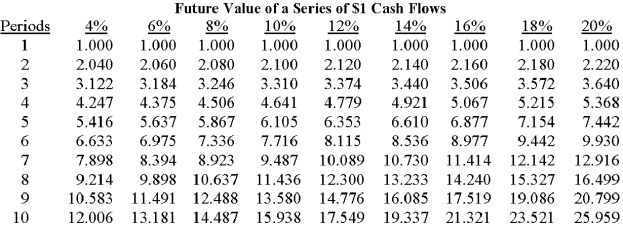
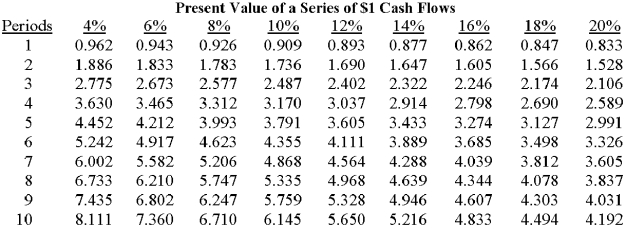
(Essay)
4.8/5 (67)
(67) When preparing an NPV analysis on the disposal of an asset, like equipment, capital gains and losses are taxed at the same rate as ordinary income in the analysis.
(True/False)
4.8/5 (99)
(99) In 10 years, Hopkins Company plans to receive $9,000 cash from the sale of a machine that has a $5,000 book value.
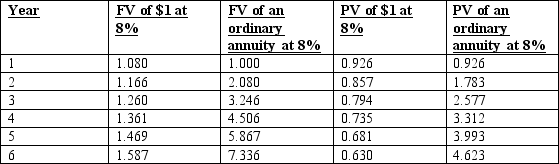 If the firm is subject to a 30% income tax rate and has an 8% after-tax hurdle rate, the correct discounted net cash flow would be:
 (Multiple Choice)
4.7/5 (90)
(90) Randi Corp. is considering the replacement of some machinery that has zero book value and a current market value of $2,800. One possible alternative is to invest in new machinery that costs $30,000. The new equipment has a four-year service life and an estimated salvage value of $3,500, will produce annual cash operating savings of $9,400, and will require a $2,200 overhaul in year 3. The company uses straight-line depreciation.
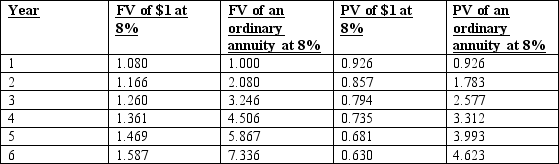 Required:
Prepare a net-present-value analysis of Randi’s replacement decision, assuming an 8% hurdle rate and no income taxes. Should the machinery be acquired? Note: Round calculations to the nearest dollar.
Required:
Prepare a net-present-value analysis of Randi’s replacement decision, assuming an 8% hurdle rate and no income taxes. Should the machinery be acquired? Note: Round calculations to the nearest dollar.
(Essay)
4.7/5 (89)
(89) Use the following information to answer the following Questions
Carmen Company has an asset that cost $5,000 and currently has accumulated depreciation of $2,000. Suppose the firm sold the asset for $2,500 and is subject to a 30% income tax rate.
-The loss on disposal would be:
(Multiple Choice)
4.8/5 (78)
(78) Consider the following statements about depreciation tax shields:
I. A depreciation tax shield provides distinct benefits to a business.
II. A depreciation tax shield should be ignored when doing a net-present-value analysis.
III. A depreciation tax shield can occur in more than one year.
Which of the above statements is (are) correct?
(Multiple Choice)
4.8/5 (72)
(72) Consider the following statements about taxes and after-tax cash flows:
I. Capital budgeting analyses should incorporate after-tax cash flows rather than before-tax cash flows.
II. Added company revenues will result in lower taxes for a firm.
III. Operating expenses may actually provide a tax benefit for an organization.
Which of the above statements is (are) correct?
(Multiple Choice)
5.0/5 (79)
(79) Consider the five items that follow, which are related to independent investment opportunities.
Purchase price of a new machine: $850,000
Annual straight-line depreciation: $75,000
Annual savings in cash operating costs: $120,000
Advertising expenses related to a new marketing campaign in year 2: $35,000
Sale of an asset in year 6: Loss on sale, $60,000; proceeds received by seller, $23,000
Required:
Complete the following table, inserting the (pre-discounted) cash flow amounts that would be used in a net-present-value analysis. Column A should be completed based on the assumption of no income taxes; in contrast, Column B should be completed assuming the relevant company is subject to a 30% income tax rate. Be sure to note cash outflows in parentheses.
(Essay)
5.0/5 (70)
(70) Consider the following statements about the investment in working capital in a capital budgeting analysis:
I. Working capital often increases as the result of higher balances in accounts receivable or inventory necessary to support a project.
II. Working capital increases are sources of cash and should be included in a discounted-cash-flow analysis.
III. The time 0 cash investment in working capital is included in a discounted-cash-flow analysis as a cash outflow.
Which of the above statements is (are) correct?
(Multiple Choice)
4.7/5 (70)
(70) A company's hurdle rate is generally influenced by whether management uses the net-present-value method or the internal-rate-of-return method.
(True/False)
4.8/5 (66)
(66) Consider the following statements about the accounting for inflation in a capital budgeting analysis:
I. An analyst can use nominal dollars in conjunction with a nominal interest rate.
II. An analyst can use real dollars in conjunction with a real interest rate.
III. An analyst can use nominal dollars in conjunction with a real interest rate.
Which of the above statements is (are) correct?
(Multiple Choice)
4.8/5 (77)
(77) Which of the following would not involve a capital-budgeting analysis?
(Multiple Choice)
4.9/5 (94)
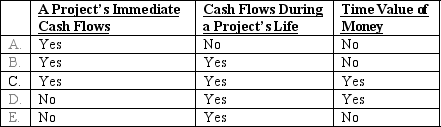
(94) Which of the following is taken into account by the net-present-value method?
(Short Answer)
4.9/5 (87)
(87) Inflation is defined as a decline in the general purchasing power of a monetary unit, such as a dollar, across time.
(True/False)
4.8/5 (76)
(76) 
Filters
- Essay(0)
- Multiple Choice(0)
- Short Answer(0)
- True False(0)
- Matching(0)