



 Chat with AI
Exam 4: Process Costing and Hybrid Product-Costing Systems


Which of the following is true concerning cost drivers for the predetermined overhead rate in a process-costing system?

 (75)
 Verified
D
A predetermined application rate for conversion costs is based on actual conversion costs divided by a budgeted cost driver.
(84) VerifiedFalse
Operation costing is a popular type of accounting system, one that combines selected features of job-order and process-cost accounting.
Required:
A. Briefly discuss the basic features that are associated with an operation-costing system.
B. Explain why a sweater manufacturer may have a need for an operation-costing system.
(73) VerifiedA. Operation costing is used by firms that produce different models of similar products. The products go through essentially the same manufacturing process, so conversion costs can be assigned in a manner similar to that used in process-costing systems. Materials, on the other hand, are unique to the individual goods being produced and, accordingly, the cost is assigned by batch (or in a manner similar to that used in job costing).
B. A sweater manufacturer produces multiple versions of its single product: sweaters. The garments likely incur roughly the same labor and overhead cost, with the major difference among models being in the areas of fabric, color, and patterns (i.e., materials). Thus, the material cost will often differ and the manufacturer should take these differences into account, not spread costs equally over all units produced as would be done in a process-costing type of procedure.
Which of the following statements about operation costing is (are) true?
I. Conversion costs are accumulated by department.
II. Direct material costs are accumulated by batch.
III. Operation costing is a hybrid product-costing system.
(69) When computing the conversion cost per equivalent unit under the weighted-average method of process costing, all of the following information would be needed except:
(78) Bratton Corporation had 6,500 units of work in process on April 1. During April, 19,100 units were completed and as of April 30, 5,100 units remained in production. How many units were started during April?
(75) Hornsby has a single production department, and uses a process-costing system. The balance in its Work-in-Process account on January 1 was $68,000. The account was charged with direct materials, direct labor, and manufacturing overhead of $450,000 throughout the year. If a review of the accounting records determined that $86,000 of goods were still in production at year-end, Hornsby should make a journal entry on December 31 that includes:
(75) Which of the following manufacturers would most likely not use a process-cost accounting system?
(84) Which method of process costing is almost always used in practice?
(72) Basil Manufacturing uses a weighted-average process-costing system. The following figures pertain to July:
 All materials are introduced at the start of the process, and conversion cost is incurred evenly throughout production. The company used direct materials that cost $640,000; conversion amounted to $8 per equivalent unit.
Required:
A. Calculate the direct materials cost per equivalent unit.
B. Calculate the cost of units completed and transferred.
C. What percentage of conversion work will be performed on the 40,000-unit ending work-in-process inventory during August?
D. In all likelihood, were all of the 120,000 completed units begun in July? Explain.
All materials are introduced at the start of the process, and conversion cost is incurred evenly throughout production. The company used direct materials that cost $640,000; conversion amounted to $8 per equivalent unit.
Required:
A. Calculate the direct materials cost per equivalent unit.
B. Calculate the cost of units completed and transferred.
C. What percentage of conversion work will be performed on the 40,000-unit ending work-in-process inventory during August?
D. In all likelihood, were all of the 120,000 completed units begun in July? Explain. (82) Use the following information to answer the following Questions
Lakeland Chemical manufactures a product called Zing. Direct materials are added at the beginning of the process, and conversion activity occurs uniformly throughout production. The beginning work-in-process inventory is 60% complete with respect to conversion; the ending work-in-process inventory is 20% complete. The following data pertain to May:
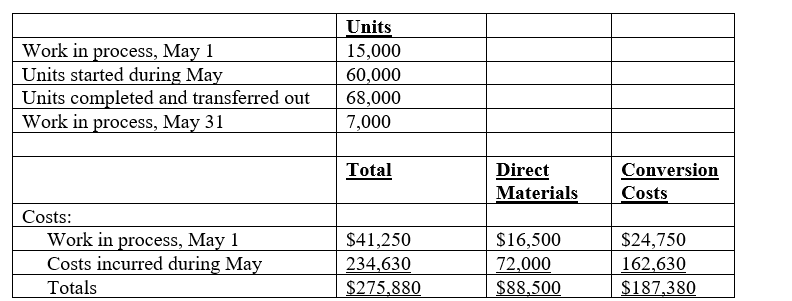 -Using the weighted-average method of process costing, the equivalent units of direct materials total:
 (96) Unit costs in a process-costing system are derived by using:
(77) Barton Corporation, which adds materials at the beginning of production, uses a weighted-average process-costing system. Consider the data that follow.
 The company's cost per equivalent unit for materials is:
 (95) Alton Company uses a process-costing system for its single product. Material A is added at the beginning of the process; in contrast, material B is added when the units are 75% complete. The firm's ending work-in-process inventory consists of 6,000 units that are 80% complete. Which of the following correctly expresses the equivalent units of production with respect to materials A and B in the ending work-in-process inventory?
(79) In a process-costing system, manufacturing costs are accumulated by:
(67) Operation costing is a hybrid type of accounting system that combines features of job-order and process-cost accounting.
Required:
A. Briefly discuss the similarities and differences of an operation-costing system and a job-order costing system.
B. Briefly discuss the similarities and differences of an operation-costing system and a process-costing system.
(97) Use the following information to answer the following Questions
Lakeland Chemical manufactures a product called Zing. Direct materials are added at the beginning of the process, and conversion activity occurs uniformly throughout production. The beginning work-in-process inventory is 60% complete with respect to conversion; the ending work-in-process inventory is 20% complete. The following data pertain to May:
-Using the weighted-average method of process costing, the cost per unit of direct materials is:
-Using the weighted-average method of process costing, the cost per unit of direct materials is: (78) Mohawk Machining, which uses a process-costing system, adds material at the beginning of production and incurs conversion cost evenly throughout manufacturing. The following selected information was taken from the company's accounting records:
Total equivalent units of materials: 8,000
Total equivalent units of conversion: 7,400
Units started and completed during the period: 6,500
On the basis of this information, the ending work-in-process inventory's stage of completion is:
(83) Equivalent-unit calculations are necessary to allocate manufacturing costs between:
(81) Use the following information to answer the following Questions
Lakeland Chemical manufactures a product called Zing. Direct materials are added at the beginning of the process, and conversion activity occurs uniformly throughout production. The beginning work-in-process inventory is 60% complete with respect to conversion; the ending work-in-process inventory is 20% complete. The following data pertain to May:
-Using the weighted-average method of process costing, the total costs remaining in work in process on May 31 are:
-Using the weighted-average method of process costing, the total costs remaining in work in process on May 31 are: (68) 
Filters
- Essay(0)
- Multiple Choice(0)
- Short Answer(0)
- True False(0)
- Matching(0)