



 Chat with AI
Exam 9: Financial Planning and Analysis: the Master Budget

Exam 1: The Changing Role of Managerial Accounting in a Dynamic Business Environment85 Questions
Exam 2: Basic Cost Management Concepts115 Questions
Exam 3: Product Costing and Cost Accumulation in a Batch Production Environment95 Questions
Exam 4: Process Costing and Hybrid Product-Costing Systems88 Questions
Exam 5: Activity-Based Costing and Management103 Questions
Exam 6: Activity Analysis, Cost Behavior, and Cost Estimation90 Questions
Exam 7: Cost-Volume-Profit Analysis109 Questions
Exam 8: Variable Costing and the Costs of Quality and Sustainability74 Questions
Exam 9: Financial Planning and Analysis: the Master Budget112 Questions
Exam 10: Standard Costing and Analysis of Direct Costs97 Questions
Exam 11: Flexible Budgeting and Analysis of Overhead Costs89 Questions
Exam 12: Responsibility Accounting, Operational Performance Measures, and the Balanced Scorecard89 Questions
Exam 13: Investment Centers and Transfer Pricing101 Questions
Exam 14: Decision Making: Relevant Costs and Benefits96 Questions
Exam 15: Target Costing and Cost Analysis for Pricing Decisions107 Questions
Exam 16: Capital Expenditure Decisions120 Questions
Exam 17: Allocation of Support Activity Costs and Joint Costs81 Questions
Exam 18: The Sarbanes-Oxley Act, Internal Controls, and Management Accounting20 Questions
Exam 19: Compound Interest and the Concept of Present Value27 Questions
Exam 20: Inventory Management20 Questions
Select questions type


The following information is from Barkley's Auto Alarm Company financial records. Collections from customers are normally 70 percent in the month of sale, 20 percent in the month following the sale, and 9 percent in the second month following the sale. The balance is expected to be uncollectible. All purchases are on account. Management takes full advantage of the 2 percent discount allowed on purchases paid for by the tenth of the following month. Purchases for December are budgeted at $60,000, and sales for December are forecasted at $66,000. Cash disbursements for expenses are expected to be $14,400 for the month of December. The company's cash balance on December 1 was $22,000.
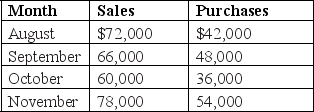 Required:
A. Expected cash collections during December.
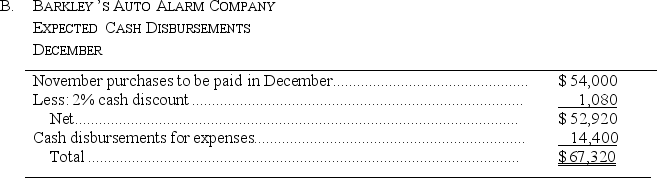
B. Expected cash disbursements during December.
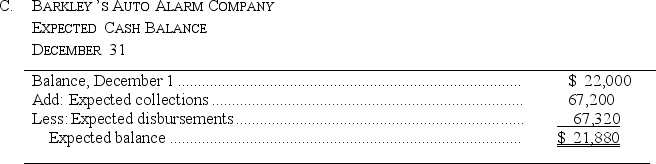
C. Expected cash balance on December 31.
Required:
A. Expected cash collections during December.
B. Expected cash disbursements during December.
C. Expected cash balance on December 31.
Free
(Essay)
4.8/5  (82)
(82) Correct Answer: Verified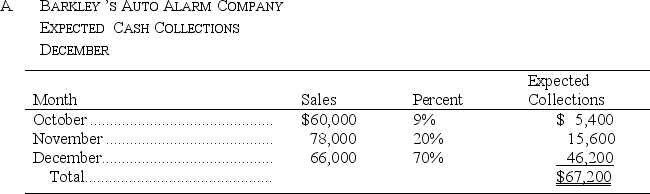
Companies develop a set of operating budgets to project cash flow and likely cash shortfalls and/or surpluses.
Free
(True/False)
4.8/5 (85)
(85) Correct Answer:Verified
VerifiedFalse
Bacon Industries manufactures two products: A andB.
The company predicts a sales volume of 10,000 units for product A and ending finished-goods inventory of 2,000 units. These numbers for product B are 12,000 and 3,000, respectively. Bacon currently has 7,000 units of A in inventory and 9,000 units of B.
The following raw materials are required to manufacture these products:
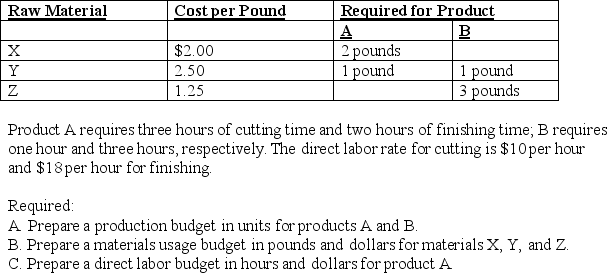 B. The company predicts a sales volume of 10,000 units for product A and ending finished-goods inventory of 2,000 units. These numbers for product B are 12,000 and 3,000, respectively. Bacon currently has 7,000 units of A in inventory and 9,000 units of
Free
(Essay)
4.8/5 (61)
(61) Correct Answer:Verified
Verified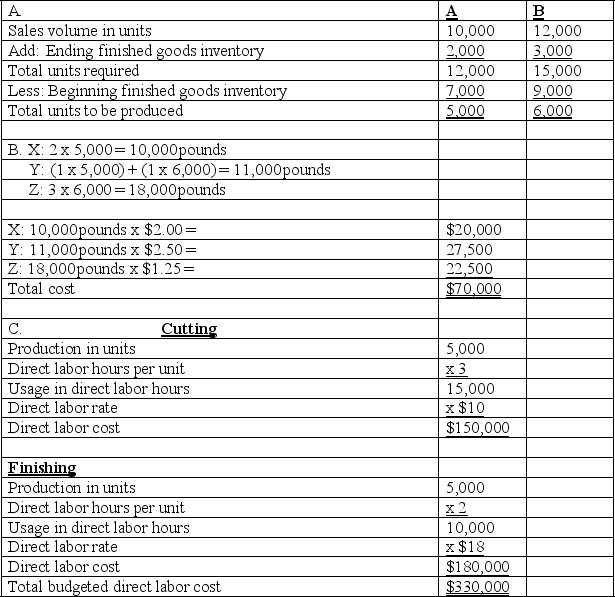
To derive the raw material to purchase during an accounting period, an accountant would calculate the raw material required for production and then:
(Multiple Choice)
4.8/5 (78)
(78) Managers typically avoid making assumptions that will be part of the year's financial plan.
(True/False)
4.9/5 (72)
(72) Boxer Company plans to sell 400,000 units of finished product in July 20x1. Management (1) anticipates a growth rate in sales of 5% per month thereafter and (2) desires a monthly ending finished-goods inventory (in units) of 80% of the following month's estimated sales. There are 300,000 completed units in the June 30, 20x1 inventory.
Each unit of finished product requires four pounds of direct material at a cost of $1.50 per pound. There are 1,600,000 pounds of direct material in inventory on June 30, 20x1.
Required:
A. Prepare a production budget for the quarter ended September 30, 20x1. Note: For both part "A" and part "B" of this problem, prepare your budget on a quarterly (not monthly) basis.
B. Independent of your answer to part "A," assume that Boxer plans to produce 1,200,000 units of finished product for the quarter ended September 30. If the firm desires to stock direct materials at the end of this period equal to 25% of current production usage, compute the cost of direct material purchases for the quarter.
(Essay)
4.9/5 (72)
(72) Houseman, Inc. anticipates sales of 50,000 units, 48,000 units, and 51,000 units in July, August, and September, respectively. Company policy is to maintain an ending finished-goods inventory equal to 40% of the following month's sales.
-On the basis of this information, how many units would the company plan to produce in August?
(Multiple Choice)
4.9/5 (78)
(78) Dalton Industries makes all purchases on account, subject to the following payment pattern:
Paid in the month of purchase: 30%
Paid in the first month following purchase: 60%
Paid in the second month following purchase: 10%
If purchases for January, February, and March were $200,000, $180,000, and $230,000, respectively, what were the firm's budgeted payments in March?
(Multiple Choice)
4.9/5 (76)
(76) Use the following information to answer the following Questions
Morgan Company's budgeted income statement reflects the following amounts:
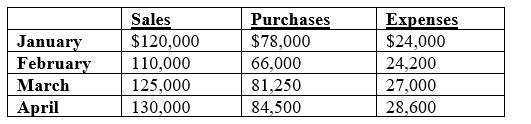 Sales are collected 50% in the month of sale, 30% in the month following sale, and 19% in the second month following sale. One percent of sales is uncollectible and expensed at the end of the year.
Morgan pays for all purchases in the month following purchase and takes advantage of a 3% discount. The following balances are as of January 1:
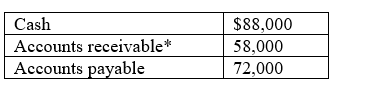 *Of this balance, $35,000 will be collected in January and the remaining amount will be collected in February.
The monthly expense figures include $5,000 of depreciation. The expenses are paid in the month incurred
-Morgan's budgeted cash receipts in February are:
Sales are collected 50% in the month of sale, 30% in the month following sale, and 19% in the second month following sale. One percent of sales is uncollectible and expensed at the end of the year.
Morgan pays for all purchases in the month following purchase and takes advantage of a 3% discount. The following balances are as of January 1:
*Of this balance, $35,000 will be collected in January and the remaining amount will be collected in February.
The monthly expense figures include $5,000 of depreciation. The expenses are paid in the month incurred
-Morgan's budgeted cash receipts in February are: (Multiple Choice)
4.8/5 (74)
(74) Chong Corporation has a highly automated production facility. Which of the following correctly shows the two factors that would likely have the most direct influence on the company's manufacturing overhead budget?
(Multiple Choice)
4.9/5 (79)
(79) Barry Clarion, new-accounts manager at East Bank of New Hampshire, has been asked to project how many new accounts he will open during 20x2. The local economy has been growing, and the bank has experienced a 10% increase in the number of new accounts over each of the past five years. In 20x1, the bank had 10,000 accounts.
Clarion is paid a salary, plus a bonus of $20 for every new account above the budgeted amount. Thus, if the annual budget calls for 1,000 new accounts, and 1,080 new accounts are obtained, his bonus will be $1,600 (80 *$20).
Clarion believes that the local economy will continue to grow at the same rate in 20x2 as it has in recent years. He decided to submit a projection of 700 new accounts for 20x2.
Required:
Your consulting firm has been hired by the bank president to make recommendations for improving the bank's operation. Write a memorandum to the president defining and explaining the negative consequences of budgetary slack. Also discuss the bank's bonus system for the new-accounts manager and how the bonus program tends to encourage budgetary slack.
(Essay)
4.9/5 (81)
(81) End-of-period figures for accounts receivable and payables to suppliers would be found on the:
(Multiple Choice)
5.0/5 (90)
(90) Terrence Corporation plans to sell 41,000 units of its single product in March. The company has 2,800 units in its March 1 finished-goods inventory and anticipates having 2,400 completed units in inventory on March 31. On the basis of this information, how many units does Terrence plan to produce during March?
(Multiple Choice)
4.9/5 (75)
(75) A company's sales forecast would likely consider all of the following factors except:
(Multiple Choice)
4.8/5 (64)
(64) Implementation of participative budgeting prevents budget padding.
(True/False)
4.9/5 (82)
(82) The comprehensive set of budgets that serves as a company's overall financial plan is commonly known as:
(Multiple Choice)
4.9/5 (90)
(90) Joyner Company has the following historical collection pattern for its credit sales:
70% collected in month of sale
15% collected in the first month after sale
10% collected in the second month after sale
4% collected in the third month after sale
1% uncollectible
Budgeted credit sales for the last six months of the year follow.
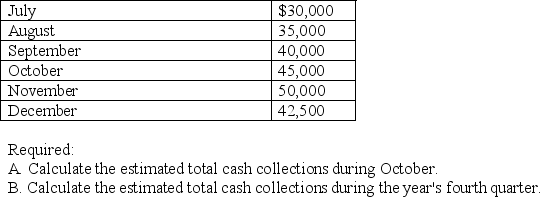
(Essay)
4.8/5 (98)
(98) Translation of foreign currencies is a challenge faced by the budgeting process in firms with international operations.
(True/False)
4.8/5 (72)
(72) Barre plans to sell 5,000 units each quarter next year. During the first two quarters each unit will sell for $12; during the last two quarters the sales price will increase $1.50 per unit. What is Barre's estimated sales revenue for next year?
(Multiple Choice)
4.8/5 (75)
(75) 
Filters
- Essay(0)
- Multiple Choice(0)
- Short Answer(0)
- True False(0)
- Matching(0)