



 Chat with AI
Exam 9: Financial Planning and Analysis: the Master Budget

Exam 1: The Changing Role of Managerial Accounting in a Dynamic Business Environment85 Questions
Exam 2: Basic Cost Management Concepts115 Questions
Exam 3: Product Costing and Cost Accumulation in a Batch Production Environment95 Questions
Exam 4: Process Costing and Hybrid Product-Costing Systems88 Questions
Exam 5: Activity-Based Costing and Management103 Questions
Exam 6: Activity Analysis, Cost Behavior, and Cost Estimation90 Questions
Exam 7: Cost-Volume-Profit Analysis109 Questions
Exam 8: Variable Costing and the Costs of Quality and Sustainability74 Questions
Exam 9: Financial Planning and Analysis: the Master Budget112 Questions
Exam 10: Standard Costing and Analysis of Direct Costs97 Questions
Exam 11: Flexible Budgeting and Analysis of Overhead Costs89 Questions
Exam 12: Responsibility Accounting, Operational Performance Measures, and the Balanced Scorecard89 Questions
Exam 13: Investment Centers and Transfer Pricing101 Questions
Exam 14: Decision Making: Relevant Costs and Benefits96 Questions
Exam 15: Target Costing and Cost Analysis for Pricing Decisions107 Questions
Exam 16: Capital Expenditure Decisions120 Questions
Exam 17: Allocation of Support Activity Costs and Joint Costs81 Questions
Exam 18: The Sarbanes-Oxley Act, Internal Controls, and Management Accounting20 Questions
Exam 19: Compound Interest and the Concept of Present Value27 Questions
Exam 20: Inventory Management20 Questions
Select questions type


The following events took place when Managers A, B, and C were preparing budgets for the upcoming period:
I. Manager A increased property tax expenditures by 2% when she was informed of a recent rate hike by local authorities.
II. Manager B reduced sales revenues by 4% when informed of recent aggressive actions by a new competitor.
III. Manager C, who supervises employees with widely varying skill levels, used the highest wage rate in the department when preparing the labor budget.
Assuming that the percentage amounts given are reasonable, which of the preceding cases is (are) an example of building slack in budgets?
(Multiple Choice)
4.9/5  (68)
(68) Use the following information to answer the following Questions
Morgan Company's budgeted income statement reflects the following amounts:
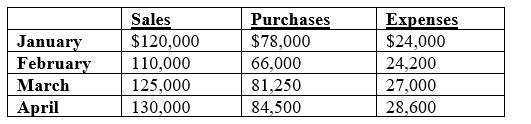 Sales are collected 50% in the month of sale, 30% in the month following sale, and 19% in the second month following sale. One percent of sales is uncollectible and expensed at the end of the year.
Morgan pays for all purchases in the month following purchase and takes advantage of a 3% discount. The following balances are as of January 1:
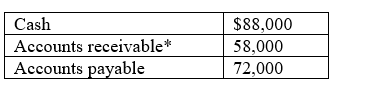 *Of this balance, $35,000 will be collected in January and the remaining amount will be collected in February.
The monthly expense figures include $5,000 of depreciation. The expenses are paid in the month incurred
-Morgan's expected cash balance at the end of January is:
Sales are collected 50% in the month of sale, 30% in the month following sale, and 19% in the second month following sale. One percent of sales is uncollectible and expensed at the end of the year.
Morgan pays for all purchases in the month following purchase and takes advantage of a 3% discount. The following balances are as of January 1:
*Of this balance, $35,000 will be collected in January and the remaining amount will be collected in February.
The monthly expense figures include $5,000 of depreciation. The expenses are paid in the month incurred
-Morgan's expected cash balance at the end of January is: (Multiple Choice)
4.8/5 (89)
(89) Gallonte Inc. began operations in April of this year. It makes all sales on account, subject to the following collection pattern: 30% are collected in the month of sale; 60% are collected in the first month after sale; and 10% are collected in the second month after sale.
- If sales for April, May, and June were $60,000, $80,000, and $70,000, respectively, what were the firm's budgeted collections for the quarter?
(Multiple Choice)
4.8/5 (88)
(88) A manufacturer develops bud?gets for the direct materials, direct labor, and overhead that will be required in the production process from which of the following?
(Multiple Choice)
4.7/5 (72)
(72) Which of the following statements concerning the budget director is false?
(Multiple Choice)
4.8/5 (82)
(82) The comprehensive set of budgets that serves as a company's overall financial plan is commonly known as the financial budget.
(True/False)
4.8/5 (71)
(71) Parvis makes all sales on account, subject to the following collection pattern: 20% are collected in the month of sale; 70% are collected in the first month after sale; and 10% are collected in the second month after sale. If sales for October, November, and December were $70,000, $60,000, and $50,000, respectively, what was the budgeted receivables balance on December 31?
(Multiple Choice)
4.8/5 (83)
(83) The following selected data pertain to Flagship Corporation:
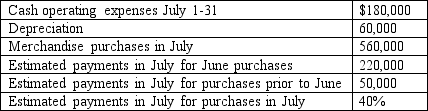 July's cash disbursements are expected to be:
 (Multiple Choice)
4.9/5 (77)
(77) Which of the following budgets is based on many other master-budget components?
(Multiple Choice)
4.7/5 (81)
(81) Wu Production Company, which uses activity-based budgeting, is in the process of preparing a manufacturing overhead budget. Which of the following would likely appear on that budget?
(Multiple Choice)
4.8/5 (74)
(74) A manufacturing firm would begin preparation of its master budget by constructing a:
(Multiple Choice)
5.0/5 (83)
(83) Which of the following statements about financial planning models (FPMs) is (are) false?
(Multiple Choice)
4.7/5 (85)
(85) Marvel Woodcraft makes furniture. Marvel's expected sales are 20,000 bookcases for the quarter. The company begins the quarter with inventory of 3,000 bookcases and wants to have enough finished bookcases on hand at the end of the quarter to provide for 15% of the next quarter's expected sales of 24,000 bookcases.
-Ignoring any beginning inventory, if 50 board feet are required for each bookcase and the wood costs $2 per board foot, how much will Marvel pay for the bookcases it needs produce during the quarter?
(Multiple Choice)
4.7/5 (83)
(83) Which of the following would have no effect, either direct or indirect, on an organization's cash budget?
(Multiple Choice)
4.9/5 (87)
(87) Activity-based budgeting (ABB) takes the Activity-based costing model (ABC) and reverses the flow of the analysis.
(True/False)
4.7/5 (73)
(73) A company's plan for the issuance of stock or incurrence of debt is commonly called a:
(Multiple Choice)
4.9/5 (74)
(74) Grande Corporation assembles bicycles by purchasing frames, wheels, and other parts from various suppliers. Consider the following data:
* The company plans to sell 25,000 bicycles during each month of the year's first quarter.
*A review of the accounting records disclosed a finished-goods inventory of 1,400 bicycles on January 1 and an expected finished-goods inventory of 1,850 bicycles on January 31.
*Grande has 4,300 wheels in inventory on January 1, a level that is expected to drop by 5% at month-end.
*Assembly time totals 30 minutes per bicycle, and workers are paid $14 per hour.
*Grande accounts for employee benefits as a component of direct labor cost. Pension and insurance costs average $2 per hour (total); additionally, the company pays Social Security taxes that amount to 8% of gross wages earned.
Required:
A. How many bicycles does Grande expect to produce (i.e., assemble) in January?
B. How many wheels are budgeted to be purchased in January?
C. Compute Grande's total direct labor cost for January.
D. Briefly explain how the company's purchasing activity would affect the end-of-period balance sheet.
(Essay)
5.0/5 (78)
(78) Which of the following statements best describes the relationship between the sales-forecasting process and the master-budgeting process?
(Multiple Choice)
5.0/5 (83)
(83) Which of the following outcomes is (are) sometimes associated with participative budgeting?
(Multiple Choice)
4.7/5 (67)
(67) 
Filters
- Essay(0)
- Multiple Choice(0)
- Short Answer(0)
- True False(0)
- Matching(0)