



 Chat with AI
Exam 16: Capital Expenditure Decisions

Exam 1: The Changing Role of Managerial Accounting in a Dynamic Business Environment85 Questions
Exam 2: Basic Cost Management Concepts115 Questions
Exam 3: Product Costing and Cost Accumulation in a Batch Production Environment95 Questions
Exam 4: Process Costing and Hybrid Product-Costing Systems88 Questions
Exam 5: Activity-Based Costing and Management103 Questions
Exam 6: Activity Analysis, Cost Behavior, and Cost Estimation90 Questions
Exam 7: Cost-Volume-Profit Analysis109 Questions
Exam 8: Variable Costing and the Costs of Quality and Sustainability74 Questions
Exam 9: Financial Planning and Analysis: the Master Budget112 Questions
Exam 10: Standard Costing and Analysis of Direct Costs97 Questions
Exam 11: Flexible Budgeting and Analysis of Overhead Costs89 Questions
Exam 12: Responsibility Accounting, Operational Performance Measures, and the Balanced Scorecard89 Questions
Exam 13: Investment Centers and Transfer Pricing101 Questions
Exam 14: Decision Making: Relevant Costs and Benefits96 Questions
Exam 15: Target Costing and Cost Analysis for Pricing Decisions107 Questions
Exam 16: Capital Expenditure Decisions120 Questions
Exam 17: Allocation of Support Activity Costs and Joint Costs81 Questions
Exam 18: The Sarbanes-Oxley Act, Internal Controls, and Management Accounting20 Questions
Exam 19: Compound Interest and the Concept of Present Value27 Questions
Exam 20: Inventory Management20 Questions
Select questions type


The net-present-value method assumes that project funds are reinvested at the:
(Multiple Choice)
4.9/5  (79)
(79) When a company is analyzing a capital project by a discounted-cash-flow approach and income taxes are being considered, depreciation:
(Multiple Choice)
4.8/5 (69)
(69) Consider the following factors related to an investment:
I. The net income from the investment.
II. The cash flows from the investment.
III. The timing of the cash flows from the investment.
Which of the preceding factors would be important considerations in a net-present-value analysis?
(Multiple Choice)
4.9/5 (80)
(80) The true economic yield produced by an asset is summarized by the asset's:
(Multiple Choice)
4.9/5 (76)
(76) Both net present value (NPV) and the internal rate of return (IRR) have a reinvestment assumption.
Required:
A. State the assumption for each method.
B. One of the advantages of the NPV method is that users can adjust for risk considerations. Explain how this is done.
(Essay)
4.8/5 (77)
(77) Jenkins plans to generate $650,000 of sales revenue if a capital project is implemented. Assuming a 30% tax rate, the sales revenue should be reflected in the analysis by a:
(Multiple Choice)
4.9/5 (94)
(94) The internal-rate-of-return method assumes that project funds are reinvested at the:
(Multiple Choice)
4.9/5 (65)
(65) When making investment decisions that involve advanced manufacturing systems, the use of net present value:
(Multiple Choice)
4.8/5 (78)
(78) Which of the following project evaluation methods focuses on accounting income rather than cash flows?
(Multiple Choice)
4.7/5 (78)
(78) Coulter Company is studying a capital project that will produce $600,000 of added sales revenue, $400,000 of additional cash operating expenses, and $50,000 of depreciation. Assuming a 30% income tax rate, the company's after-tax cash inflow (outflow) is:
(Multiple Choice)
4.8/5 (89)
(89) Warner Corporation is considering the acquisition of a new machine that costs $350,000. The machine is expected to have a four-year service life and will produce annual savings in cash operating costs of $100,000. Warner uses the optional straight-line method of depreciation and depreciates the asset over its four-year service life. The company is subject to a 30% income tax rate, has an after-tax hurdle rate of 12%, and rounds calculations to the nearest dollar.
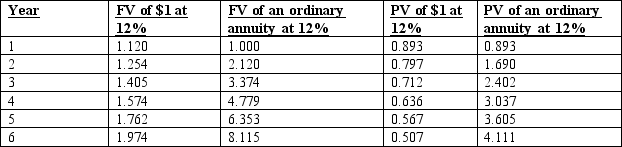 Required:
A. Determine the annual after-tax cash flows that result from acquisition of the machine.
B. Calculate the machine's net present value. Is the machine an attractive investment? Why?
Required:
A. Determine the annual after-tax cash flows that result from acquisition of the machine.
B. Calculate the machine's net present value. Is the machine an attractive investment? Why? (Essay)
4.7/5 (87)
(87) Marker Sail Company plans to purchase $4.5 million of equipment in the not-too-distant future. The equipment will be depreciated by the optional straight-line method over the MACRS life of 5 years. Marker is subject to a 30% income tax rate.
The company's accountant is about to perform a net-present-value analysis, assuming a 10% after-tax hurdle rate.
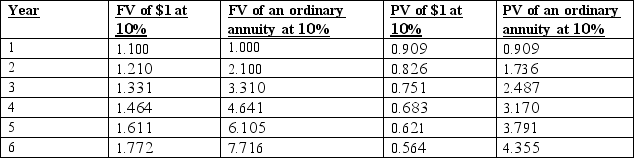 Required:
A. Determine the discounted cash flows that would be reflected in the analysis in year 0 and year 1.
B. Determine the discounted cash flow that would be reflected in the analysis in year 6, assuming that Marker sells the equipment for $450,000,
Required:
A. Determine the discounted cash flows that would be reflected in the analysis in year 0 and year 1.
B. Determine the discounted cash flow that would be reflected in the analysis in year 6, assuming that Marker sells the equipment for $450,000, (Essay)
4.9/5 (70)
(70) Under MACRS, an asset's estimated salvage value is not subtracted in computing the asset's depreciation basis.
(True/False)
4.8/5 (76)
(76) The rule for project acceptance under the net-present-value method is that:
(Multiple Choice)
4.9/5 (83)
(83) Of the five expenses that follow, which one is most likely treated differently than the others when income taxes are considered in a discounted-cash-flow analysis?
(Multiple Choice)
4.9/5 (96)
(96) Which of the following is the proper calculation of a company's depreciation tax shield?
(Multiple Choice)
4.8/5 (77)
(77) Activity-based-costing systems are costly, time-consuming to implement, and do not improve the ability of an analyst to estimate the cash flows associated with a proposed project.
(True/False)
4.8/5 (79)
(79) When income taxes are considered in capital budgeting, the cash flows related to a company's advertising expense would be correctly figured by taking the cash paid for advertising and:
(Multiple Choice)
4.8/5 (70)
(70) St. Michaels School ranks investments by using the profitability index (PI). The following data relate to Project X and Project Y:
 Which project would be more attractive as judged by its ranking, and why?
 (Multiple Choice)
4.9/5 (81)
(81) 
Filters
- Essay(0)
- Multiple Choice(0)
- Short Answer(0)
- True False(0)
- Matching(0)