



 Chat with AI
Exam 16: Capital Expenditure Decisions

Exam 1: The Changing Role of Managerial Accounting in a Dynamic Business Environment85 Questions
Exam 2: Basic Cost Management Concepts115 Questions
Exam 3: Product Costing and Cost Accumulation in a Batch Production Environment95 Questions
Exam 4: Process Costing and Hybrid Product-Costing Systems88 Questions
Exam 5: Activity-Based Costing and Management103 Questions
Exam 6: Activity Analysis, Cost Behavior, and Cost Estimation90 Questions
Exam 7: Cost-Volume-Profit Analysis109 Questions
Exam 8: Variable Costing and the Costs of Quality and Sustainability74 Questions
Exam 9: Financial Planning and Analysis: the Master Budget112 Questions
Exam 10: Standard Costing and Analysis of Direct Costs97 Questions
Exam 11: Flexible Budgeting and Analysis of Overhead Costs89 Questions
Exam 12: Responsibility Accounting, Operational Performance Measures, and the Balanced Scorecard89 Questions
Exam 13: Investment Centers and Transfer Pricing101 Questions
Exam 14: Decision Making: Relevant Costs and Benefits96 Questions
Exam 15: Target Costing and Cost Analysis for Pricing Decisions107 Questions
Exam 16: Capital Expenditure Decisions120 Questions
Exam 17: Allocation of Support Activity Costs and Joint Costs81 Questions
Exam 18: The Sarbanes-Oxley Act, Internal Controls, and Management Accounting20 Questions
Exam 19: Compound Interest and the Concept of Present Value27 Questions
Exam 20: Inventory Management20 Questions
Select questions type


Sinclair is considering the acquisition of new machinery that will produce uniform benefits over the next eight years. The following information is available:
Annual savings in cash operating costs: $350,000
Annual depreciation expense: $250,000
If the company is subject to a 30% tax rate, what denominator should be used to compute the machinery's payback period?
(Multiple Choice)
4.7/5  (71)
(71) Consider the following statements about the total-cost and the incremental-cost approaches of investment evaluation:
I. Both approaches will yield the same conclusions.
II. Choosing between these approaches is a matter of personal preference.
III. The incremental approach focuses on cost differences between alternatives.
Which of the above statements is (are) true?
(Multiple Choice)
4.8/5 (73)
(73) Young Company received $18,000 cash from the sale of a machine that had a $13,000 book value. If the company is subject to a 30% income tax rate, the net cash flow to use in a discounted-cash-flow analysis would be:
(Multiple Choice)
4.9/5 (86)
(86) An advantage of the NPV method is that the analyst can adjust for risk considerations.
(True/False)
4.8/5 (83)
(83) Spear Company is considering a $5.4 million asset investment that has a four-year service life and a $400,000 salvage value. The investment is expected to produce annual savings in cash operating costs of $860,000 and will require a $250,000 overhaul in year 3, which is fully-deductible for tax purposes.
Spear uses the net-present-value method to analyze investments. Asset investments are depreciated by the straight-line method, ignoring salvage values in related computations.
Required:
A. Ignoring income taxes, determine the (pre-discounted) cash-flow amounts that would be used in a net-present-value analysis for (1) the asset acquisition, (2) annual savings in cash operating costs, (3) annual straight-line depreciation, (4) the overhaul in year 3, and (5) disposal of the asset in year 4. Note cash outflows in parentheses.
B. Repeat requirement "A," assuming the company is subject to a 30% income tax rate. Assume the company depreciates the asset using the optional straight-line method. Additionally, it depreciates it over the asset's service life (not its MACRS life).
(Essay)
4.9/5 (78)
(78) In a net-present-value analysis, the discount rate is often called the:
(Multiple Choice)
4.8/5 (66)
(66) Pizza Company has $70,000 of depreciation expense and is subject to a 30% income tax rate. On an after-tax basis, depreciation results in a:
(Multiple Choice)
4.8/5 (73)
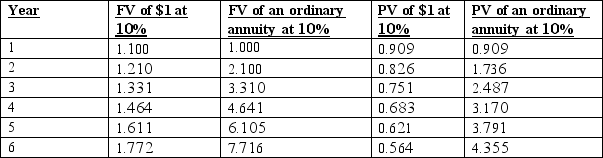
(73) On January 2, 20x1, Jennifer Grey purchased 800 shares of Sounder Telecommunications common stock at $35 per share. The company paid a $1.50 dividend per share on December 28 of that year, and raised the amount by $0.50 per share for a distribution on December 28, 20x2. Jennifer sold her entire investment on December 30, 20x2, generating a $5,000 gain on the sale of stock.
 Required:
A. Prepare a dated listing of the cash inflows and outflows related to Jennifer's stock investment. Ignore income taxes.
B. Assume that Jennifer has a 10% hurdle rate for all investments. Rounding to the nearest dollar, compute the net present value of her investment in Sounder and determine whether she achieved her 10% goal.
Required:
A. Prepare a dated listing of the cash inflows and outflows related to Jennifer's stock investment. Ignore income taxes.
B. Assume that Jennifer has a 10% hurdle rate for all investments. Rounding to the nearest dollar, compute the net present value of her investment in Sounder and determine whether she achieved her 10% goal. (Essay)
4.8/5 (76)
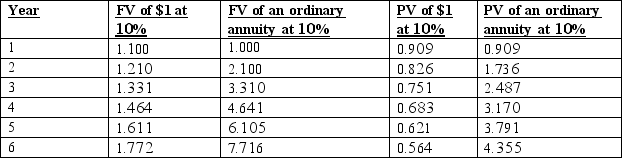
(76) The Excon Machine Tool Company is considering the addition of a computerized lathe to its equipment inventory. The initial cost of the equipment is $600,000, and the lathe is expected to have a useful life of five years and no salvage value. The cost savings and increased capacity attributable to the machine are estimated to generate increases in the firm's annual cash inflows (before considering depreciation) of $180,000. The machine will be depreciated using MACRS for tax purposes. The 5-year MACRS depreciation percentages as computed by the IRS are: Year 1 = 20.00%; Year 2 = 32.00%; Year 3 = 19.20%; Year 4 = 11.52%; Year 5 = 11.52%; Year 6 = 5.76%.
Warren is currently in the 40% income tax bracket. A 10% after-tax rate of return is desired.
 Required:
A. What is the net present value of the investment? Round to the nearest dollar.
B. Should the machine be acquired by the firm?
C. Assume that the equipment will be sold at the end of its useful life for $100,000. If the depreciation amounts are not revised, calculate the dollar impact of this change on the total net present value.
Required:
A. What is the net present value of the investment? Round to the nearest dollar.
B. Should the machine be acquired by the firm?
C. Assume that the equipment will be sold at the end of its useful life for $100,000. If the depreciation amounts are not revised, calculate the dollar impact of this change on the total net present value. (Essay)
4.8/5 (78)
(78) When benefits are difficult to quantify in an NPV approach to a CIM investment decision, it is best to exclude them.
(True/False)
4.8/5 (73)
(73) Use the following information to answer the following Questions
Carmen Company has an asset that cost $5,000 and currently has accumulated depreciation of $2,000. Suppose the firm sold the asset for $2,500 and is subject to a 30% income tax rate.
-The net after-tax cash flow of the disposal is:
(Multiple Choice)
4.9/5 (70)
(70) The Modified Accelerated Cost Recovery System (MACRS) assumes that, on average, assets will be placed in service:
(Multiple Choice)
4.8/5 (76)
(76) Postaudits are an important part of capital budgeting.
Required:
A. What is a postaudit of a capital investment project?
B. What are the benefits of a postaudit?
C. A manager prepared an unsuccessful proposal for a capital project, as her firm decided not to fund and pursue the project. The manager observed, "The company's postaudit process will show that this project should have been funded." Comment on the manager's understanding of the postaudit process.
(Essay)
4.9/5 (80)
(80) A machine costs $25,000; it is expected to generate annual cash revenues of $8,000 and annual cash expenses of $2,000 for five years. The required rate of return is 12%.
 The net present value of the machine is:
 (Multiple Choice)
4.7/5 (76)
(76) A machine is expected to produce annual savings in cash operating costs of $400,000 for the next six years.
 If the company has a 10% after-tax hurdle rate and is subject to a 30% income tax rate, the correct discounted net cash flow would be:
 (Multiple Choice)
4.9/5 (74)
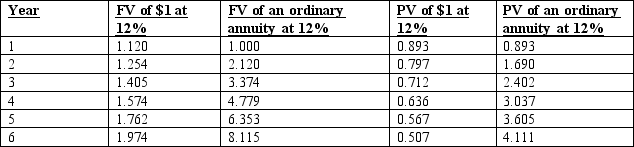
(74) Racer Industries is currently purchasing Part No. 76 from an outside supplier for $80 per unit. Because of supplier reliability problems, the company is considering producing the part internally in an idle manufacturing plant. Annual volume over the next six years is expected to total 300,000 units at variable manufacturing costs of $75 per unit.
Racer must acquire $80,000 of new equipment if it reopens the plant. The equipment has a six-year service life, a $14,000 salvage value, and will be depreciated by the straight-line method. Repairs and maintenance are expected to average $5,200 per year in years 4-6, and the equipment will be sold at the end of its life.
 Required:
Rounding to the nearest dollar, use the net-present-value method (total-cost approach) and a 12% hurdle rate to determine whether Mark should make or buy Part No. 76. Ignore income taxes.
Required:
Rounding to the nearest dollar, use the net-present-value method (total-cost approach) and a 12% hurdle rate to determine whether Mark should make or buy Part No. 76. Ignore income taxes.
(Essay)
4.8/5 (63)
(63) The hurdle rate that is used in a net-present-value analysis is the same as the firm's:
(Multiple Choice)
4.9/5 (82)
(82) The mayor of Trenton is considering the purchase of a new computer system for the city's tax department. The system costs $75,000 and has an expected life of five years. The mayor estimates the following savings will result if the system is purchased:
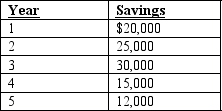 What can be said about the computer system's internal rate of return if the net present value at 12% is positive? Trenton uses a 10% discount rate for capital-budgeting decisions.
 (Multiple Choice)
5.0/5 (86)
(86) 
Filters
- Essay(0)
- Multiple Choice(0)
- Short Answer(0)
- True False(0)
- Matching(0)