



 Chat with AI
Exam 16: Capital Expenditure Decisions

Exam 1: The Changing Role of Managerial Accounting in a Dynamic Business Environment85 Questions
Exam 2: Basic Cost Management Concepts115 Questions
Exam 3: Product Costing and Cost Accumulation in a Batch Production Environment95 Questions
Exam 4: Process Costing and Hybrid Product-Costing Systems88 Questions
Exam 5: Activity-Based Costing and Management103 Questions
Exam 6: Activity Analysis, Cost Behavior, and Cost Estimation90 Questions
Exam 7: Cost-Volume-Profit Analysis109 Questions
Exam 8: Variable Costing and the Costs of Quality and Sustainability74 Questions
Exam 9: Financial Planning and Analysis: the Master Budget112 Questions
Exam 10: Standard Costing and Analysis of Direct Costs97 Questions
Exam 11: Flexible Budgeting and Analysis of Overhead Costs89 Questions
Exam 12: Responsibility Accounting, Operational Performance Measures, and the Balanced Scorecard89 Questions
Exam 13: Investment Centers and Transfer Pricing101 Questions
Exam 14: Decision Making: Relevant Costs and Benefits96 Questions
Exam 15: Target Costing and Cost Analysis for Pricing Decisions107 Questions
Exam 16: Capital Expenditure Decisions120 Questions
Exam 17: Allocation of Support Activity Costs and Joint Costs81 Questions
Exam 18: The Sarbanes-Oxley Act, Internal Controls, and Management Accounting20 Questions
Exam 19: Compound Interest and the Concept of Present Value27 Questions
Exam 20: Inventory Management20 Questions
Select questions type


The last step in any investment analysis is to determine the cash flows that are relevant to the analysis.
(True/False)
4.7/5  (76)
(76) Kansas Corporation is reviewing an investment proposal that has an initial cost of $52,500. An estimate of the investment's end-of-year book value, the yearly after-tax net cash inflows, and the yearly net income are presented in the schedule below. Yearly after-tax net cash inflows include savings from the depreciation tax shield. The investment's salvage value at the end of each year is equal to book value, and there will be no salvage value at the end of the investment's life.
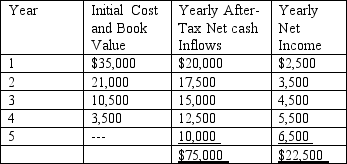 Kansas uses a 14% after-tax target rate of return for new investment proposals.
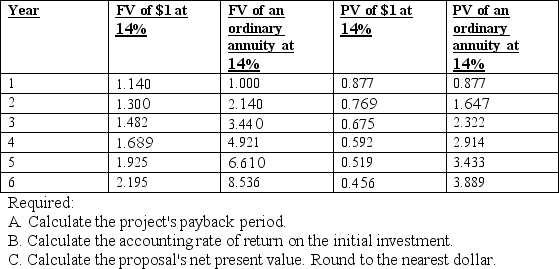
Kansas uses a 14% after-tax target rate of return for new investment proposals.
(Essay)
4.8/5 (75)
(75) Some investment proposals require additional outlays for working capital.
(True/False)
4.7/5 (72)
(72) Higgins Company plans to incur $350,000 of salaries expense if a capital project is implemented. Assuming a 30% tax rate, the salaries should be reflected in the analysis by a:
(Multiple Choice)
4.9/5 (71)
(71) The rule for project acceptance under the internal rate of return method is that:
(Multiple Choice)
4.9/5 (94)
(94) Clear Skies Airline Company is planning a project that is expected to last for six years and generate annual net cash inflows of $75,000. The project will require the purchase of a $280,000 machine, which is expected to have a salvage value of $10,000 at the end of the six-year period. The machine will require a $50,000 overhaul at the end of the fourth year. The company presently has a 12% minimum desired rate of return.
Based on this information, an accountant prepared the following analysis:
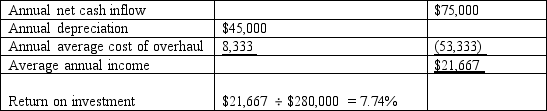 The accountant recommends that the project be rejected because it does not meet the company's minimum desired rate of return. Ignore income taxes.
Required:
A. What criticism(s) would you make of the accountant's evaluation?
B. Use the net-present-value method and determine whether the project should be accepted.
C. Based on your answer in requirement "B," is the internal rate of return greater or less than 12%? Explain.
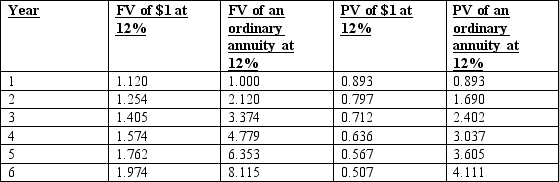
The accountant recommends that the project be rejected because it does not meet the company's minimum desired rate of return. Ignore income taxes.
Required:
A. What criticism(s) would you make of the accountant's evaluation?
B. Use the net-present-value method and determine whether the project should be accepted.
C. Based on your answer in requirement "B," is the internal rate of return greater or less than 12%? Explain.
(Essay)
4.9/5 (88)
(88) A machine costs $25,000; it is expected to generate annual cash revenues of $8,000 and annual cash expenses of $2,000 for five years. The required rate of return is 12%. Using the tables that follow, which of the following statements about the machine's internal rate of return is true?
(Multiple Choice)
4.8/5 (80)
(80) An increased number of companies are investing in advanced manufacturing systems.
Required:
A. Many proposed advanced manufacturing systems have a negative net present value when discounted-cash-flow analysis is used. Explain several causes of this situation.
B. Two major benefits of advanced systems are greater flexibility in the manufacturing process and improvements in product quality. Explain how these benefits can create problems when performing discounted-cash-flow analysis.
(Essay)
5.0/5 (81)
(81) Hampton Company plans to incur $230,000 of additional cash operating expenses and produce $410,000 of additional sales revenue if a capital project is implemented. Assuming a 30% tax rate, these two items collectively should appear in a capital budgeting analysis as:
(Multiple Choice)
4.9/5 (69)
(69) Workman Company is considering a five-year project that requires a typical investment in working capital, in this case, $100,000. Consider the following statements about this situation:
I. Workman should include a $100,000 outflow that occurs at time 0 in a discounted-cash-flow analysis.
II. Workman should include separate $100,000 outflows in each year of the project's five-year life.
III. Workman should include a $100,000 recovery of its working-capital investment in year 5 of a discounted-cash-flow analysis.
Which of the above statements is (are) correct?
(Multiple Choice)
4.8/5 (79)
(79) A company used the net-present-value method to analyze an investment and found the investment to be very attractive. If the firm used Modified Accelerated Cost Recovery System (MACRS) and changes to the straight-line depreciation, the investment's net present value will:
(Multiple Choice)
4.9/5 (91)
(91) The payback period can only be used if net cash inflows are uniform throughout a project's life.
(True/False)
4.9/5 (71)
(71) The systematic follow-up on a capital project to see how the project actually turns out is commonly known as:
(Multiple Choice)
5.0/5 (81)
(81) In eight years, Shu Company plans to receive $11,000 cash from the sale of a machine that has a $16,000 book value.
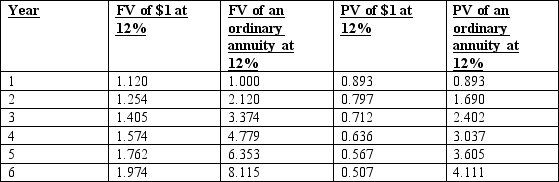 If the firm is subject to a 30% income tax rate and has a 12% after-tax hurdle rate, the correct discounted net cash flow would be:
 (Multiple Choice)
4.8/5 (88)
(88) A machine was sold in December 20x3 for $9,000. It was purchased in January 20x1 for $15,000, and depreciation of $12,000 was recorded from the date of purchase through the date of disposal. Assuming a 40% income tax rate, the after-tax cash inflow at the time of sale is:
(Multiple Choice)
4.8/5 (81)
(81) Julio Company purchased a $200,000 machine that has a four-year life and no salvage value. The company uses straight-line depreciation on all asset acquisitions and is subject to a 30% tax rate. The proper cash flow to show in a discounted-cash-flow analysis as occurring at time 0 would be:
(Multiple Choice)
4.8/5 (67)
(67) Two widely used methods of discounted-cash-flow analysis are the net-present-value method and the return on assets method.
(True/False)
4.9/5 (75)
(75) Depreciation is often described as a "tax shield."
Required:
A. Explain how depreciation provides such a shield.
B. MACRS is an accelerated depreciation system. Explain how an accelerated system can provide a more beneficial tax shield than, say, a straight-line depreciation system.
(Essay)
4.8/5 (65)
(65) If a proposal's profitability index is greater than one then the net present value is positive.
(True/False)
4.8/5 (84)
(84) 
Filters
- Essay(0)
- Multiple Choice(0)
- Short Answer(0)
- True False(0)
- Matching(0)