



 Chat with AI
Exam 4: Inverse, Exponential, and Logarithmic Functions

Exam 1: Equations and Inequalities494 Questions
Exam 2: Graphs and Functions525 Questions
Exam 3: Polynomial and Rational Functions516 Questions
Exam 4: Inverse, Exponential, and Logarithmic Functions471 Questions
Exam 5: Trigonometric Functions301 Questions
Exam 6: The Circular Functions and Their Graphs289 Questions
Exam 7: Trigonometric Identities and Equations494 Questions
Exam 8: Applications of Trigonometry446 Questions
Exam 9: Systems and Matrices505 Questions
Exam 10: Analytic Geometry206 Questions
Exam 11: Further Topics in Algebra351 Questions
Exam 12: Review of Basic Concepts640 Questions
Select questions type


Use the properties of logarithms to rewrite the expression. Simplify the result if possible. Assume all variables represent positive real numbers.
-
(Multiple Choice)
4.9/5  (64)
(64) Find the value. Give an approximation to four decimal places.
-ln 0.000772
(Multiple Choice)
4.8/5 (69)
(69) Solve the equation and express the solution in exact form.
-
(Multiple Choice)
4.8/5 (82)
(82) Graph the exponential function using transformations where appropriate.
-
(Multiple Choice)
5.0/5 (72)
(72) Provide an appropriate response.
-Use the properties of exponents to write the function of the form , where is a constant.
(Multiple Choice)
4.8/5 (80)
(80) Solve the problem. Round your answer to the nearest tenth, when appropriate. Use the formula as needed.
-Find the if .
(Multiple Choice)
4.7/5 (78)
(78) Write the word or phrase that best completes each statement or answers the question.
-
(Essay)
4.8/5 (78)
(78) Write the word or phrase that best completes each statement or answers the question.
-How long will it take a sample of radioactive substance to decay to half of its original amount, if it decays according to the function , where is the time in years? Round your answer to the nearest hundredth year.
(Multiple Choice)
4.8/5 (92)
(92) If the function is one-to-one, find its inverse. If not, write ʺnot one-to-one.ʺ
-
(Multiple Choice)
4.9/5 (74)
(74) Solve the following graphically. If necessary, round answers to the nearest thousandth.
-
(Multiple Choice)
4.9/5 (84)
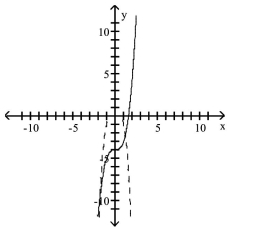
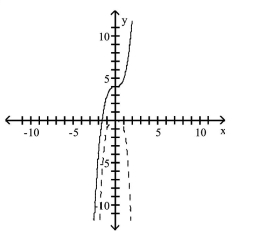
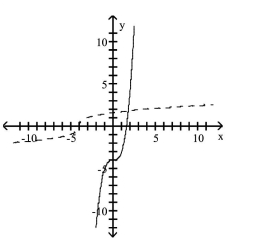
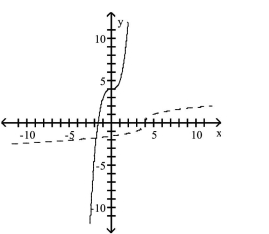
(84) For the function as defined that is one-to-one, graph f and f-1 on the same axes.
-
 A)
 B)
 C)
 D)
A)
B)
C)
D)
(Essay)
4.9/5 (68)
(68) 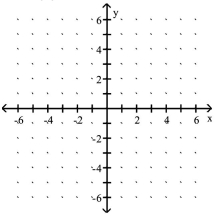
For the function as defined that is one-to-one, graph f and f-1 on the same axes.
-
(Multiple Choice)
4.8/5 (80)
(80) Find the domain and range of the inverse of the given function.
-
(Multiple Choice)
4.7/5 (78)
(78) 
Filters
- Essay(0)
- Multiple Choice(0)
- Short Answer(0)
- True False(0)
- Matching(0)