



 Chat with AI
Exam 4: Inverse, Exponential, and Logarithmic Functions

Exam 1: Equations and Inequalities494 Questions
Exam 2: Graphs and Functions525 Questions
Exam 3: Polynomial and Rational Functions516 Questions
Exam 4: Inverse, Exponential, and Logarithmic Functions471 Questions
Exam 5: Trigonometric Functions301 Questions
Exam 6: The Circular Functions and Their Graphs289 Questions
Exam 7: Trigonometric Identities and Equations494 Questions
Exam 8: Applications of Trigonometry446 Questions
Exam 9: Systems and Matrices505 Questions
Exam 10: Analytic Geometry206 Questions
Exam 11: Further Topics in Algebra351 Questions
Exam 12: Review of Basic Concepts640 Questions
Select questions type


Write the word or phrase that best completes each statement or answers the question.
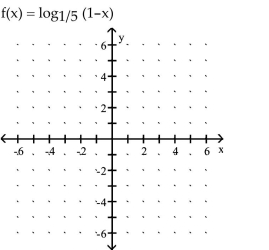
-In the formula is the amount of radioactive material remaining from an initial amount at a given time , and is a negative constant determined by the nature of the material A certain radioactive isotope decays at a rate of annually. Determine half-life of this isotope, to the nearest year.
(Multiple Choice)
4.9/5  (83)
(83) 
Determine whether the statement is true or false.
-If a function f has an inverse function and the domain of f is all real numbers, then the domain of must also be all real numbers.
(True/False)
4.7/5 (79)
(79) Write the word or phrase that best completes each statement or answers the question.
-In the formula is the number of items in terms of an initial population I at a given time and is a growth constant equal to the percent of growth per unit time. There are currently 57 million cars in a certain country, decreasing by annually. How many years will it take for this country to have 30 million cars? Round to the nearest year.
(Multiple Choice)
4.8/5 (83)
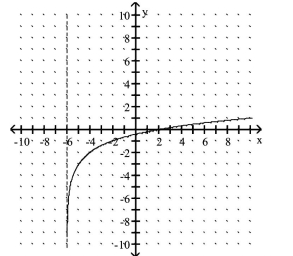
(83) Write an equation for the graph given. The graph represents an logarithmic function f with base 2 or 3, translated and/or reflected.
-
(Multiple Choice)
5.0/5 (72)
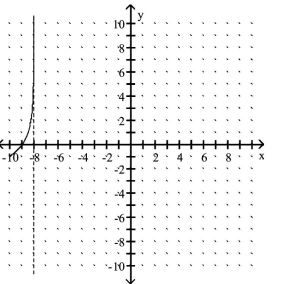
(72) Write an equation for the graph given. The graph represents an logarithmic function f with base 2 or 3, translated and/or reflected.
-
(Multiple Choice)
4.8/5 (85)
(85) Write the word or phrase that best completes each statement or answers the question.
-An artifact is discovered at a certain site. If it has of the carbon-14 it originally contained, what is the approximate age of the artifact to the nearest year? (carbon-14 decays at the rate of annually.)
(Multiple Choice)
4.7/5 (75)
(75) Find the value. Give an approximation to four decimal places.
-
(Multiple Choice)
4.8/5 (77)
(77) Determine whether the statement is true or false.
-If f is a one-to-one function and the graph of f lies completely within the third quadrant, then the
graph of lies completely within the second quadrant.
(True/False)
4.8/5 (79)
(79) Find the function value. If the result is irrational, round your answer to the nearest thousandth.
-Let . Find .
(Multiple Choice)
4.9/5 (94)
(94) Solve the equation and express the solution in exact form.
-
(Multiple Choice)
4.7/5 (69)
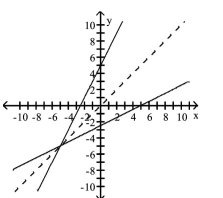
(69) Decide whether the pair of functions graphed are inverses.
-
(Multiple Choice)
4.7/5 (86)
(86) The graph of a function f is given. Use the graph to find the indicated value.
-
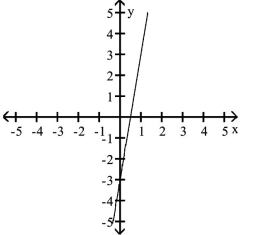
(Multiple Choice)
4.8/5 (58)
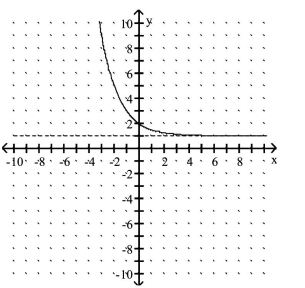
(58) Write an equation for the graph given. The graph represents an exponential function f with base 2 or 3, translated and/or reflected.
-
(Multiple Choice)
4.8/5 (92)
(92) Use the properties of logarithms to rewrite the expression. Simplify the result if possible. Assume all variables represent positive real numbers.
-
(Multiple Choice)
5.0/5 (89)
(89) 
Filters
- Essay(0)
- Multiple Choice(0)
- Short Answer(0)
- True False(0)
- Matching(0)