



 Chat with AI
Exam 4: Inverse, Exponential, and Logarithmic Functions

Exam 1: Equations and Inequalities494 Questions
Exam 2: Graphs and Functions525 Questions
Exam 3: Polynomial and Rational Functions516 Questions
Exam 4: Inverse, Exponential, and Logarithmic Functions471 Questions
Exam 5: Trigonometric Functions301 Questions
Exam 6: The Circular Functions and Their Graphs289 Questions
Exam 7: Trigonometric Identities and Equations494 Questions
Exam 8: Applications of Trigonometry446 Questions
Exam 9: Systems and Matrices505 Questions
Exam 10: Analytic Geometry206 Questions
Exam 11: Further Topics in Algebra351 Questions
Exam 12: Review of Basic Concepts640 Questions
Select questions type


Solve the problem.
-The population growth of an animal species is described by where is measured in months. Find the population of this species in an area 6 months after the species is introduced.
(Multiple Choice)
4.8/5  (88)
(88) Solve the equation and express the solution in exact form.
-
(Multiple Choice)
4.8/5 (80)
(80) If the function is one-to-one, find its inverse. If not, write ʺnot one-to-one.ʺ
-
(Multiple Choice)
4.8/5 (71)
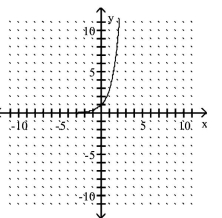
(71) Use the graph of f to sketch a graph of the inverse of f using a dashed curve.
-
(Multiple Choice)
4.9/5 (87)
(87) Solve the following graphically. If necessary, round answers to the nearest thousandth.
-
(Multiple Choice)
4.9/5 (81)
(81) 
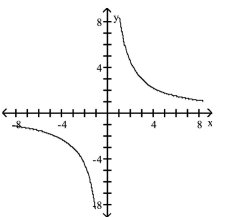
Solve the problem.
-Let and . Write the following expression in terms of and without using the function .
(Multiple Choice)
4.8/5 (59)
(59) Use a graphing calculator to estimate the solution set of the equation. Round to the nearest hundredth.
-ex = 10
(Multiple Choice)
4.9/5 (93)
(93) Solve the problem.
-Find the required annual interest rate, to the nearest tenth of a percent, for $1100 to grow to $1400 if interest is compounded monthly for 7 years.
(Multiple Choice)
4.9/5 (82)
(82) Write the word or phrase that best completes each statement or answers the question.
-
(Short Answer)
4.8/5 (73)
(73) Find the value. Give an approximation to four decimal places.
-ln 0.985
(Multiple Choice)
5.0/5 (87)
(87) Write the expression as a single logarithm with coefficient 1. Assume all variables represent positive real numbers.
-
(Multiple Choice)
4.7/5 (83)
(83) Find the future value.
-$4498 invested for 4 years at 4.4% compounded quarterly
(Multiple Choice)
4.9/5 (88)
(88) Solve the problem.
-What is the rate on an investment that doubles $5777 in 16 years? Assume interest is compounded quarterly.
(Multiple Choice)
4.9/5 (81)
(81) 
Filters
- Essay(0)
- Multiple Choice(0)
- Short Answer(0)
- True False(0)
- Matching(0)