



 Chat with AI
Exam 4: Inverse, Exponential, and Logarithmic Functions

Exam 1: Equations and Inequalities494 Questions
Exam 2: Graphs and Functions525 Questions
Exam 3: Polynomial and Rational Functions516 Questions
Exam 4: Inverse, Exponential, and Logarithmic Functions471 Questions
Exam 5: Trigonometric Functions301 Questions
Exam 6: The Circular Functions and Their Graphs289 Questions
Exam 7: Trigonometric Identities and Equations494 Questions
Exam 8: Applications of Trigonometry446 Questions
Exam 9: Systems and Matrices505 Questions
Exam 10: Analytic Geometry206 Questions
Exam 11: Further Topics in Algebra351 Questions
Exam 12: Review of Basic Concepts640 Questions
Select questions type


If the function is one-to-one, find its inverse. If not, write ʺnot one-to-one.ʺ
-
(Multiple Choice)
4.8/5  (75)
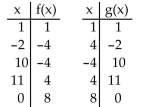
(75) Decide whether or not the functions are inverses of each other.Use the definition of inverses to determine whether f and g are inverses.
-
(Multiple Choice)
4.8/5 (86)
(86) Provide an appropriate response.
-Use the properties of exponents to write the function of the form , where is a constant.
(Multiple Choice)
4.8/5 (85)
(85) Solve the equation and express the solution in exact form.
-
(Multiple Choice)
4.9/5 (89)
(89) Find the future value.
-$4232 invested for 4 years at 6% compounded annually
(Multiple Choice)
4.7/5 (73)
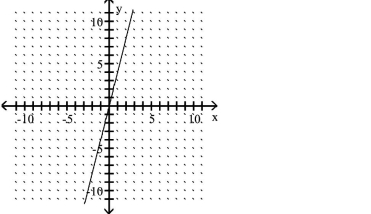
(73) Use the graph of f to sketch a graph of the inverse of f using a dashed curve.
-
(Multiple Choice)
4.9/5 (95)
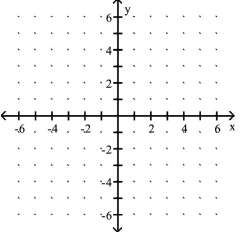
(95) 
Solve the problem.
-Let and . Write the following expression in terms of and without using the function .
(Multiple Choice)
4.8/5 (82)
(82) Find the value. Give an approximation to four decimal places.
-
(Multiple Choice)
4.9/5 (66)
(66) If the function is one-to-one, find its inverse. If not, write ʺnot one-to-one.ʺ
-
(Multiple Choice)
4.8/5 (80)
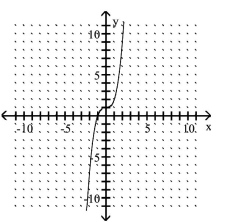
(80) Use the graph of f to sketch a graph of the inverse of f using a dashed curve.
-
(Multiple Choice)
4.9/5 (71)
(71) 
Solve the equation and express the solution in exact form.
-
(Multiple Choice)
4.8/5 (83)
(83) Solve the equation and express the solution in exact form.
-
(Multiple Choice)
4.8/5 (82)
(82) If the function is one-to-one, find its inverse. If not, write ʺnot one-to-one.ʺ
-
(Multiple Choice)
4.8/5 (88)
(88) 
Filters
- Essay(0)
- Multiple Choice(0)
- Short Answer(0)
- True False(0)
- Matching(0)