



 Chat with AI
Exam 4: Inverse, Exponential, and Logarithmic Functions

Exam 1: Equations and Inequalities494 Questions
Exam 2: Graphs and Functions525 Questions
Exam 3: Polynomial and Rational Functions516 Questions
Exam 4: Inverse, Exponential, and Logarithmic Functions471 Questions
Exam 5: Trigonometric Functions301 Questions
Exam 6: The Circular Functions and Their Graphs289 Questions
Exam 7: Trigonometric Identities and Equations494 Questions
Exam 8: Applications of Trigonometry446 Questions
Exam 9: Systems and Matrices505 Questions
Exam 10: Analytic Geometry206 Questions
Exam 11: Further Topics in Algebra351 Questions
Exam 12: Review of Basic Concepts640 Questions
Select questions type


Write the word or phrase that best completes each statement or answers the question.
-The population of a particular city is increasing at a rate proportional to its size. It follows the function where is a constant and is the time in years. If the current population is 39,000 , in how many years is the population expected to be 97,500 ?
(Multiple Choice)
4.9/5  (82)
(82) Find the value. Give an approximation to four decimal places.
-
(Multiple Choice)
4.9/5 (79)
(79) Write the word or phrase that best completes each statement or answers the question.
-A population is increasing according to the exponential function defined by , where is in millions and is the number of years. Which of the following should be done in order to answer the question "How large will the population be in 3 months?"
(Multiple Choice)
4.7/5 (94)
(94) Find the domain and range of the inverse of the given function.
-
(Multiple Choice)
4.8/5 (83)
(83) If the function is one-to-one, find its inverse. If not, write ʺnot one-to-one.ʺ
-
(Multiple Choice)
4.8/5 (73)
(73) Find the value. Give an approximation to four decimal places.
-ln(729 × 25)
(Multiple Choice)
5.0/5 (77)
(77) Find the value. Give an approximation to four decimal places.
-ln 45,600,000
(Multiple Choice)
4.8/5 (92)
(92) Find the value. Give an approximation to four decimal places.
-
(Multiple Choice)
4.8/5 (74)
(74) Use the change of base rule to find the logarithm to four decimal places.
-
(Multiple Choice)
4.8/5 (78)
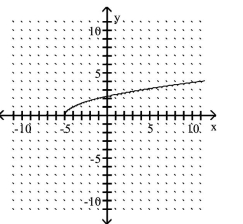
(78) Use the graph of f to sketch a graph of the inverse of f using a dashed curve.
-
(Multiple Choice)
4.9/5 (71)
(71) Solve the equation and express the solution in exact form.
-
(Multiple Choice)
4.7/5 (84)
(84) 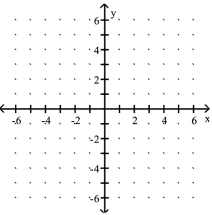
Find the present value of the future value.
-$10,000, invested for 5 years at 3% compounded quarterly
(Multiple Choice)
4.9/5 (83)
(83) Find the domain and range of the inverse of the given function.
-
(Multiple Choice)
4.7/5 (67)
(67) Solve the problem.
-Let and . Write the following expression in terms of and without using the function .
(Multiple Choice)
4.9/5 (89)
(89) Solve the problem.
-The population growth of an animal species is described by where is measured in months. Find the population of this species in an area 6 months after the species is introduced.
(Multiple Choice)
4.9/5 (81)
(81) 
Filters
- Essay(0)
- Multiple Choice(0)
- Short Answer(0)
- True False(0)
- Matching(0)