



 Chat with AI
Exam 4: Inverse, Exponential, and Logarithmic Functions

Exam 1: Equations and Inequalities494 Questions
Exam 2: Graphs and Functions525 Questions
Exam 3: Polynomial and Rational Functions516 Questions
Exam 4: Inverse, Exponential, and Logarithmic Functions471 Questions
Exam 5: Trigonometric Functions301 Questions
Exam 6: The Circular Functions and Their Graphs289 Questions
Exam 7: Trigonometric Identities and Equations494 Questions
Exam 8: Applications of Trigonometry446 Questions
Exam 9: Systems and Matrices505 Questions
Exam 10: Analytic Geometry206 Questions
Exam 11: Further Topics in Algebra351 Questions
Exam 12: Review of Basic Concepts640 Questions
Select questions type


Use a graphing calculator to estimate the solution set of the equation. Round to the nearest hundredth.
-2 - x = 5-x

Free
(Multiple Choice)
4.9/5  (83)
(83) Correct Answer: Verified
D
If the function is one-to-one, find its inverse. If not, write ʺnot one-to-one.ʺ
-
Free
(Multiple Choice)
4.7/5 (84)
(84) Correct Answer:Verified
VerifiedB
Find the value. Give an approximation to four decimal places.
-
Free
(Multiple Choice)
4.9/5 (78)
(78) Correct Answer:Verified
VerifiedB
Write the word or phrase that best completes each statement or answers the question.
-The purchasing power of a dollar is decreasing at the rate of annually, compounded continuously. How long will it take for the purchasing power of to be worth ? Round answers to the nearest hundredth.
(Multiple Choice)
4.9/5 (82)
(82) Solve the following graphically. If necessary, round answers to the nearest thousandth.
-
(Multiple Choice)
4.9/5 (71)
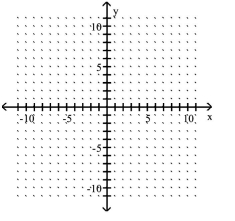
(71) Graph the exponential function using transformations where appropriate.
-
(Multiple Choice)
4.8/5 (83)
(83) Determine whether the statement is true or false.
-If f is a one-to-one function and the graph of f lies completely within the third quadrant, then the
graph of lies completely within the third quadrant.
(True/False)
4.8/5 (89)
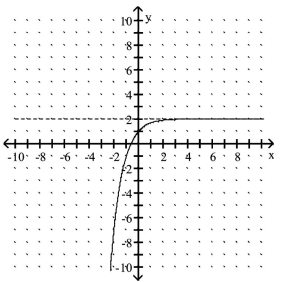
(89) Write an equation for the graph given. The graph represents an exponential function f with base 2 or 3, translated and/or reflected.
-
(Multiple Choice)
5.0/5 (78)
(78) Solve the problem.
-The growth in population of a city can be seen using the formula , where is the number of years. According to this formula, in how many years will the population reach 10,020 ? Round to the nearest tenth of a year.
(Multiple Choice)
4.9/5 (70)
(70) Find the future value.
-$59,981 invested for 3 years at 6% compounded semiannually
(Multiple Choice)
4.9/5 (63)
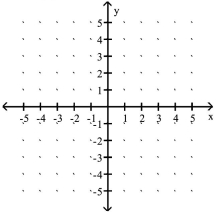
(63) Graph the exponential function using transformations where appropriate.
-
(Multiple Choice)
4.9/5 (70)
(70) Solve the problem.
-An element decays at the rate of S(t) = se-0.038t, where s is the initial amount in grams and t is the time in years since this initial amount was present. If you have a 30-gram piece of this
Element, how many grams will you have 2 years from now? Round your answer to the nearest
Tenth of a gram.
(Multiple Choice)
4.7/5 (88)
(88) Write the word or phrase that best completes each statement or answers the question.
-
(Essay)
4.7/5 (76)
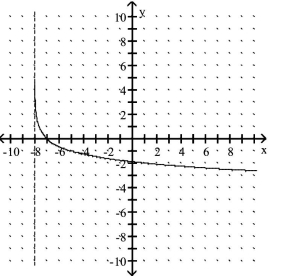
(76) Write an equation for the graph given. The graph represents an logarithmic function f with base 2 or 3, translated and/or reflected.
-
(Multiple Choice)
4.8/5 (74)
(74) Solve the problem.
-Suppose the government wants to impose a tax on fossil fuels to reduce carbon emissions. The cost benefit is modeled by , where represents the dollars of tax per ton of carbon emitted and represents the percent reduction in emissions of carbon. ( is in decimal form.) Determine when . Round to three decimal places.
(Multiple Choice)
4.9/5 (77)
(77) 
Filters
- Essay(0)
- Multiple Choice(0)
- Short Answer(0)
- True False(0)
- Matching(0)