



 Chat with AI
Exam 4: The Market Forces of Supply and Demand

Exam 1: Ten Principles of Economics220 Questions
Exam 2: Thinking Like an Economist284 Questions
Exam 3: Interdependence and the Gains From Trade192 Questions
Exam 4: The Market Forces of Supply and Demand277 Questions
Exam 5: Elasticity and Its Application222 Questions
Exam 6: Supply, Demand, and Government Policies321 Questions
Exam 7: Consumers, Producers, and the Efficiency of Markets218 Questions
Exam 8: Applications: The Costs of Taxation203 Questions
Exam 9: Application: International Trade214 Questions
Exam 10: Externalities204 Questions
Exam 11: Public Goods and Common Resources182 Questions
Exam 12: The Design of the Tax System225 Questions
Exam 13: The Costs of Production261 Questions
Exam 14: Firms in Competitive Markets243 Questions
Exam 15: Monopoly231 Questions
Exam 16: Monopolistic Competition246 Questions
Exam 17: Oligopoly204 Questions
Exam 18: The Markets for the Factors of Production232 Questions
Exam 19: Earnings and Discrimination230 Questions
Exam 20: Income Inequality and Poverty194 Questions
Exam 21: The Theory of Consumer Choice209 Questions
Exam 22: Frontiers in Microeconomics185 Questions
Exam 23: Measuring a Nations Income231 Questions
Exam 24: Measuring the Cost of Living214 Questions
Exam 25: Production and Growth187 Questions
Exam 26: Saving, Investment, and the Financial System225 Questions
Exam 27: Tools of Finance198 Questions
Exam 28: Unemployment and Its Natural Rate361 Questions
Exam 29: The Monetary System210 Questions
Exam 30: Money Growth and Inflation201 Questions
Exam 31: Open-Economy Macroeconomics: Basic Concepts194 Questions
Exam 32: A Macroeconomic Theory of the Open Economy188 Questions
Exam 33: Aggregate Demand and Aggregate Supply189 Questions
Exam 34: The Influence of Monetary and Fiscal Policy on Aggregate Demand207 Questions
Exam 35: The Short-Run Tradeoff Between Inflation and Unemployment223 Questions
Exam 36: Six Debates Over Macroeconomic Policy154 Questions
Select questions type


Public service announcements, mandatory health warnings on cigarette packages, and the prohibition of cigarette advertising on television are all policies aimed at shifting the demand curve for cigarettes to the right.
(True/False)
4.8/5  (78)
(78) Scenario 4-1
Suppose the demand schedule in a market can be represented by the equation QD = 500 - 10P, where QD is the quantity demanded and P is the price. Also, suppose the supply schedule can be represented by the equation QS = 200 + 10P, where QS is the quantity supplied.
-Refer to Scenario 4-1. Suppose the supply curve shifts to QS = 300 + 10P. What is the new equilibrium price and quantity in this market?
(Short Answer)
4.8/5 (82)
(82) Figure 4-10 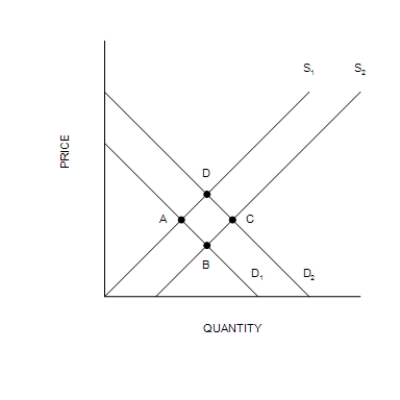 -Refer to Figure 4-10. Which of the following movements would illustrate the effect of an increase in the incomes of parents with school-aged children on the market for Spanish lessons?
 (Multiple Choice)
4.8/5 (88)
(88) A group of buyers and sellers of a particular good or service is called a
(Short Answer)
4.8/5 (74)
(74) A shortage will occur at any price below equilibrium price and a surplus will occur at any price above equilibrium price.
(True/False)
4.8/5 (81)
(81) Suppose that a decrease in the price of good X results in fewer units of good Y being demanded. This implies that X and Y are
(Multiple Choice)
4.8/5 (94)
(94) A decrease in the price of blueberries will decrease both the equilibrium price and quantity in the market for blueberry muffins.
(True/False)
4.9/5 (64)
(64) Table 4-5
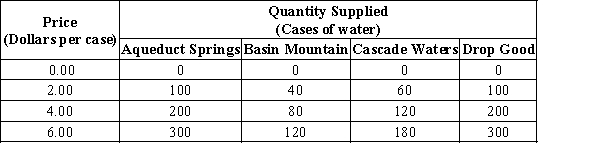 -Refer to Table 4-5. If the four suppliers listed are the only suppliers in this market and the market quantity demanded is 600 cases when the price is $4.00, which of the following statements is correct?
 (Multiple Choice)
4.8/5 (66)
(66) Beef is a normal good. You observe that both the equilibrium price and quantity of beef have fallen over time. Which of the following explanations would be most consistent with this observation?
(Multiple Choice)
4.8/5 (84)
(84) The current price of blue jeans is $30 per pair, but the equilibrium price of blue jeans is $25 per pair. As a result, which of the following statements is not true?
(Multiple Choice)
4.8/5 (78)
(78) Figure 4-4 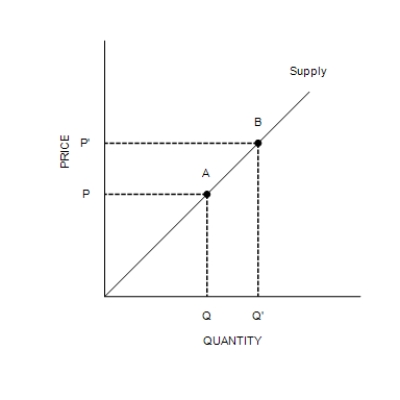 -Refer to Figure 4-4. The movement from point A to point B on the graph is caused by
 (Multiple Choice)
4.9/5 (83)
(83) If the supply of tennis balls, a complement to tennis racquets, decreases, what will happen to the equilibrium price of tennis balls and to the equilibrium price of tennis racquets?
(Essay)
4.9/5 (81)
(81) Price cannot fall so low that some sellers choose to supply a quantity of zero.
(True/False)
5.0/5 (92)
(92) If the demand for movies increases at the same time as the movie industry adopts labor-saving technology for producing movies, the equilibrium price for movies will increase, but the effect on the equilibrium quantity of movies is ambiguous.
(True/False)
4.7/5 (76)
(76) Figure 4-14
Consider the market for 2-packs of light bulbs below.
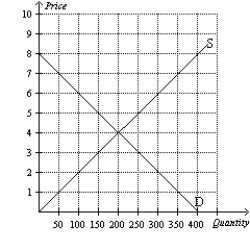
-Refer to Figure 4-31. At a price of $3, is there a shortage or surplus, and how large is the shortage/surplus?
-Refer to Figure 4-31. At a price of $3, is there a shortage or surplus, and how large is the shortage/surplus? (Short Answer)
4.9/5 (80)
(80) Which of the following events would cause both the equilibrium price and equilibrium quantity of number two grade potatoes to increase if number two grade potatoes are an inferior good?
(Multiple Choice)
4.8/5 (79)
(79) Figure 4-13
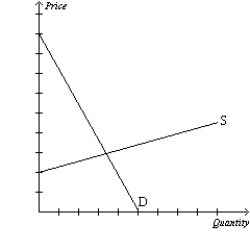
-Refer to Figure 4-30. In this market for tablet computers, more suppliers enter the market and the price of laptops, a substitute good, increases, while all other factors remain constant. Which curve(s) shift(s) and in which direction?
-Refer to Figure 4-30. In this market for tablet computers, more suppliers enter the market and the price of laptops, a substitute good, increases, while all other factors remain constant. Which curve(s) shift(s) and in which direction? (Essay)
4.8/5 (88)
(88) 
Filters
- Essay(0)
- Multiple Choice(0)
- Short Answer(0)
- True False(0)
- Matching(0)